
 Send
Send Share
Share
 Details

 Download
 Similars
 Diaporama
 Stats
StatsMilkstone


 Read More
Giclée / Art Print
Museum-quality giclée or canvas print with fast production and flexible finish options. ( Buy Hand Made Painting Switch to Digital Image)




































Pick from our preset sizes that match the artwork's original proportions.

You may enter your own dimensions to fit a specific frame or space. If your selected size does not match the original image's proportions, we will either crop the artwork or extend the image with a mirrored or solid-fill edge. A digital mockup will be sent for your approval before production begins.
Please note that the on-screen preview does not reflect the actual cropping or extension. Only the mockup will accurately show the final composition.
While custom sizes are available, we recommend selecting a dimension from the predefined list to preserve the original proportions.
Worldwide Delivery () in 2 weeks instead of standard 4/5 weeks. (10 September)

Free Worldwide Express Shipping

High-Quality Linen Canvas

Full Shipping Insurance

Customs Tax Refund Guarantee

True Color Matching Guarantee

100-Day Return Policy (Defects Only)

100% Money-Back Guarantee

Bulk Discount Offer
 Glass option is only available in size under 110 CM

Milkstone
Giclée / Art Print
Reproduction Size
-


Total Price
$ 81
Wolfgang Laib’s “Milkstone”: A Meditation on Materiality and Silence
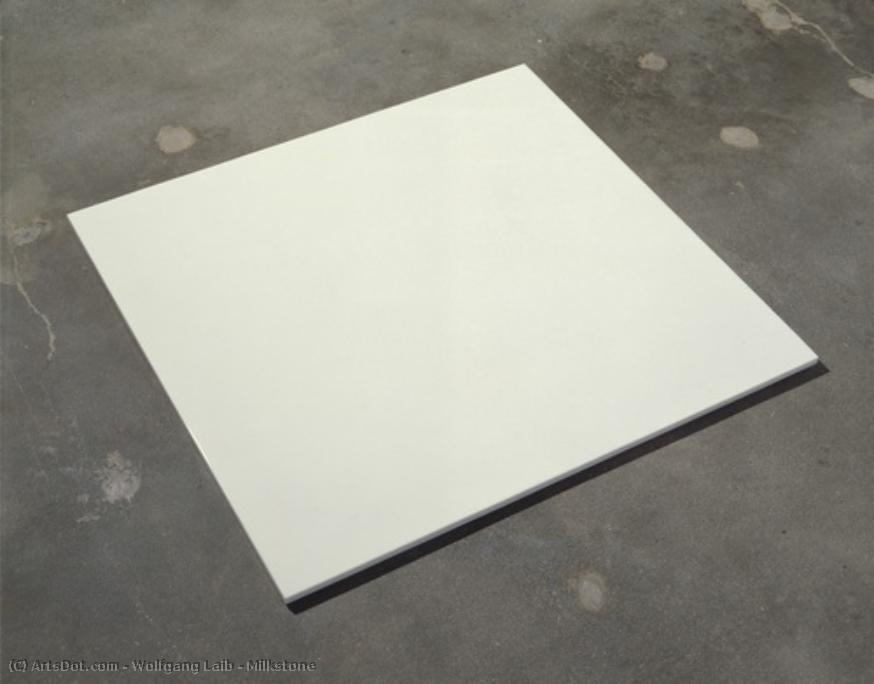
“Milkstone,” created in 1987 by Wolfgang Laib, stands as a testament to the artist's unwavering commitment to minimalist aesthetics and profound contemplation of natural phenomena. This sculptural installation—a photograph capturing a solidified block of milk—immediately commands attention with its stark simplicity against a dark backdrop, inviting viewers into an exploration of form, texture, and subtle symbolic resonance. ### Conceptual Foundations & Influences Laib’s artistic sensibilities were deeply rooted in Taoist philosophy and Zen Buddhism, disciplines that championed stillness, observation, and the acceptance of inherent beauty within the natural world. These principles permeate his oeuvre, guiding him to prioritize fundamental elements—like the material itself—over elaborate ornamentation or representational imagery. Documenta 7 and Documenta 8, pivotal exhibitions marking Laib’s artistic breakthrough, solidified his position as a leading voice in Conceptual Art, demonstrating his ability to communicate complex ideas through deceptively simple visual forms. ### The Sculpture Itself: Form & Technique The “Milkstone” is constructed from solidified milk—a process meticulously controlled to achieve structural integrity while preserving the organic essence of its constituent material. Laib’s technique involves careful manipulation of temperature and humidity, transforming liquid into a crystalline solid that retains traces of its original state. The resulting block possesses a subtly granular surface texture, contrasting with the polished darkness of the floor beneath it—a deliberate juxtaposition designed to heighten visual perception and underscore the artwork's materiality. Its geometric form – a rectangular prism – embodies Laib’s fascination with precise lines and balanced proportions, reflecting the core tenets of Zen geometry. ### Symbolism & Emotional Resonance Beyond its formal qualities, “Milkstone” carries significant symbolic weight. Milk, universally recognized as nourishment and purity, evokes associations with infancy, vulnerability, and the regenerative power of nature. Laib’s work invites viewers to pause, consider, and contemplate these concepts—promoting a meditative experience that transcends mere visual appreciation. The piece speaks to an unspoken yearning for serenity and harmony, mirroring the artist's own quiet existence in rural Germany and his dedication to capturing moments of profound beauty. ### Context & Legacy “Milkstone” exemplifies Laib’s enduring contribution to Contemporary Art. Its minimalist aesthetic—characterized by its rejection of superfluous embellishments—resonates powerfully with the broader artistic movement of the 1980s, which sought to challenge conventional notions of representation and explore alternative modes of expression. Today, reproductions of “Milkstone” grace homes and galleries worldwide, serving as reminders of Laib’s unwavering belief in the transformative potential of art – a celebration of silence, geometry, and the enduring beauty of elemental materials.Artist Biography
The Sculptor of Silence and Elemental Essence
Born in Metzingen, Germany, in 1950, Wolfgang Laib has cultivated an artistic practice that transcends the boundaries of traditional sculpture, moving instead into the realm of pure, meditative experience. His work does not merely occupy space; it breathes with the rhythms of the natural world. Operating from a tranquil village in southern Germany while maintaining studios in New York City and South India, Laib’s life is a testament to the pursuit of stillness. This unique geographical duality—the structured precision of Europe meeting the spiritual depth of India—informs an aesthetic that seeks to find the eternal within the ephemeral.
Laib’s artistic journey was profoundly shaped by his early immersion in the philosophies of Taoism and Zen Buddhism. These ancient traditions provided him with a lens through which to view the universe, emphasizing simplicity, the beauty of natural forms, and the profound power of emptiness. Rather than imposing a human will upon his materials, Laib seeks a state of harmony, where the artist acts as a facilitator for the inherent qualities of the earth itself. This spiritual foundation is evident in every meticulously placed grain of pollen and every drop of milk that graces his monumental works.
Materiality and the Poetry of Nature
The hallmark of Laib’s oeuvre is his radical use of elemental, organic materials that challenge the conventional permanence of sculpture. He is perhaps most celebrated for his milkstones—monumental blocks of white marble that serve as a canvas for a single, delicate drop of milk. In these pieces, the cold, enduring weight of the stone meets the fragile, life-giving essence of the liquid, creating an evocative juxtaposition of purity and vulnerability. This subtle interplay serves as a meditation on nourishment, renewal, and the delicate balance of existence.
Beyond the marble, Laib’s use of pollen has become one of the most iconic expressions of contemporary Land Art. By collecting vast quantities of pollen and arranging them into precise, geometric fields, he creates installations that feel both cosmic and deeply terrestrial. These golden, velvety surfaces possess a luminous quality that seems to vibrate with life. A defining moment in his career was the presentation of his colossal pollen installation at the Museum of Modern Art (MoMA) in 2013, an achievement that showcased his ability to transform a museum's white cube into a sacred, breathing landscape.
Legacy and Global Recognition
Laib’s contribution to the contemporary art canon is marked by his ability to bridge the gap between the physical and the metaphysical. His participation in the prestigious Documenta 7 (1982) and Documenta 8 (1987) established him as a pivotal figure within the German Land Art movement, proving that sculpture could be found not just in earthworks, but in the very substances of life itself. His work has been recognized on the highest international stages, including representing Germany at the Venice Biennale.
The historical significance of Wolfgang Laib lies in his refusal to participate in the noise of the modern era, choosing instead to champion a quiet, profound minimalism. For his immense contributions to the arts, he has been honored with the Praemium Imperiale, one of the highest honors in the art world. His legacy continues to inspire those who seek meaning in the subtle textures of the natural world, reminding us that true greatness often resides in the most delicate and silent of gestures.

Wolfgang Laib
1950 - , Germany
Quick Facts
- Artistic Movement Or Style: Minimalist Sculpture
- Date Of Birth: 1950
- Full Name: Wolfgang Laib
- Nationality: German
- Notable Artworks:
- Untitled
- A Wax Room for a Mountain
- Place Of Birth: Metzingen, Germany
Related Articles

Bronze Sculptures That Defined Art History | OriginalUniqueArt
Journey through art history with our Top 10 bronze sculptures! Explore masterpieces by Rodin, Michelangelo & more. Discover stories behind iconic statues and find museum-quality reproductions for your home decor at OriginalUniqueArt.com.

White on Canvas: 10 Masterpieces & Timeless Elegance for Your Home Decor
Explore 10 iconic white paintings by Monet, Whistler & Rothko! Discover the stories behind these serene masterpieces and their impact on art history. Find museum-quality reproductions for your home decor at .

Minimalist Masterpieces: 10 Artworks for Serene Home Decor | OriginalUniqueArt
Find serenity with 10 minimalist masterpieces! Explore Agnes Martin, Rothko & more. Discover the stories behind iconic abstract art, neutral palettes & calming designs. Museum-quality reproductions at OriginalUniqueArt.com – elevate your home decor today!

Kandinsky's Masterpieces: 25 Paintings That Define Abstract Art | OriginalUniqueArt
Journey through Wassily Kandinsky's 25 most iconic abstract paintings. Explore his revolutionary use of color, form & spiritual expressionism. Find museum-quality Kandinsky reproductions and elevate your home decor with OriginalUniqueArt.com. Discover all masterpieces on OriginalUniqueArt.com!

Abstract Expressionism's 10 Defining Masterpieces |
Explore 10 defining Abstract Expressionism masterpieces by Pollock, Rothko & de Kooning. Discover the stories behind these iconic paintings and find museum-quality art reproductions to elevate your home decor on .


