Menu
FREE ART CONSULTATION
PreviewPreview AR previewAR preview Switch to Print Switch to PrintSwitch to Image Switch to Image SendSend
DetailsDetails Add to favorites Add to favorites DownloadDownload SimilarsSimilars X-RayX-Ray DiaporamaDiaporama

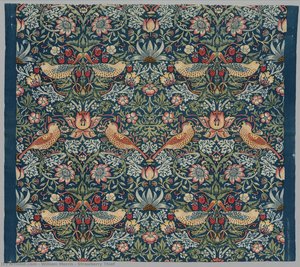
Strawberry Thief

William Morris's iconic 'Strawberry Thief' textile celebrates thrushes & fruit with intricate indigo-discharge printing. A masterpiece of Arts & Crafts design, showcasing nature and beauty.

Discover William Morris (1834-1896), a pivotal figure of the Arts & Crafts movement! Explore his iconic textiles, wallpapers, poetry, and socialist vision that redefined Victorian design.

Hand Made Oil Reproduction

Hand-painted oil on canvas in your size and frame, made to order by our artists. (Switch to Print Switch to PrintSwitch to Image Switch to Image)

P118B $10
P118H $10
P118W $10
P438Z $10
P508JH $12
P508YH $12
P805H $10
P805Z $10
P919BZ $10
P919G $10
P919XJ $10
P959ZH $10
P968JZ $12
W106C $8
W218G $10
W218JH $8
W218Y $10
W307PJ $10
W316G $10
W316PJ $8
W316Y $10
W398PJ $8
W4111J $10
W500HY $15
W500JH $15
W692G $12
W849H $8
W940BG $15
W953PJ $8

Standard
custom
CM
INCH

Pick from our preset sizes that match the artwork's original proportions.

width
height

You may enter your own dimensions to fit a specific frame or space. If your selected size does not match the original image's proportions, we will either crop the artwork or extend the painting with additional hand-painted elements. A digital mockup will be sent for your approval before production begins.
Please note that the on-screen preview does not reflect the actual cropping or extension. Only the mockup will accurately show the final composition.
While custom sizes are available, we recommend selecting a dimension from the predefined list to preserve the original proportions.

Examples of what can be changed: Replace face with customer photo; Add pet (e.g., replace cat with dog); Include hidden message in background; Change background landscape or elements.
After order, OriginalUniqueArt.com team will email client for instructions and provide a mockup preview

Worldwide Delivery () in 3/4 weeks instead of standard 5 weeks. (7 August). No compromise on quality.

why_choose_icon
Free Worldwide Express Shipping
why_choose_icon
High-Quality Linen Canvas
why_choose_icon
Full Shipping Insurance
why_choose_icon
Customs Tax Refund Guarantee
why_choose_icon
True Color Matching Guarantee
why_choose_icon
60-Day Return Policy (Defects Only)
why_choose_icon
100% Money-Back Guarantee
why_choose_icon
Bulk Discount Offer

Total Price

$ 300

reproduction

Strawberry Thief

Reproduction Medium

Reproduction Size

-

Total Price

$ 300

Quick Facts

  • Location: Cleveland Museum of Art
  • Title: Strawberry Thief
  • Movement: Arts & Crafts
  • Artistic style: Textile design
  • Medium: Cotton, discharge print
  • Dimensions: 88.3 x 99.1 cm
  • Subject or theme: Thrushes, fruit

Art Quiz

There is only one correct answer for each question.

Question 1:
What is the primary subject depicted in William Morris’s ‘Strawberry Thief’?
Question 2:
Which printing technique was most notably perfected by William Morris in the creation of ‘Strawberry Thief’?
Question 3:
What does May Morris remark about her father's observation of the thrushes in the garden depicted in ‘Strawberry Thief’?
Question 4:
The ‘Strawberry Thief’ textile is particularly significant within the Arts & Crafts movement because it:
Question 5:
What is the significance of the indigo-discharge process used in creating ‘Strawberry Thief’?

Artwork Description

William Morris’s “Strawberry Thief”: A Tapestry of Thrushes and Rebellion

William Morris's "Strawberry Thief," completed in 1936, isn’t merely a decorative textile; it’s a vibrant distillation of the Arts and Crafts movement’s core tenets – a celebration of nature, a rejection of industrialization, and a subtle yet potent expression of social critique. This iconic design, now instantly recognizable, draws its inspiration from Morris's own garden at Kelmscott Manor in Oxfordshire, specifically the mischievous thrushes that frequented his fruit beds. The scene depicted isn’t one of idyllic pastoral beauty, however; it’s imbued with a sense of playful disruption and quiet rebellion against the rigid order of the established world.

The design itself is a masterclass in Morris's signature techniques. It employs the revolutionary “indigo-discharge” process – a painstaking method that demanded the entire cloth be dyed a deep blue before being meticulously bleached and then block printed with multiple colors. This technique, perfected at Merton Abbey, allowed for incredibly nuanced shades of color and a remarkable level of detail, far surpassing the capabilities of earlier printing methods. The vibrant reds of the strawberries, the earthy browns of the branches, and the delicate greens of the foliage are all rendered with astonishing precision, showcasing Morris’s unparalleled skill as a textile designer. The intricate patterns of the birds themselves – each subtly different in posture and plumage – demonstrate his meticulous attention to detail and his deep understanding of avian anatomy.

A Garden of Symbolism

Beyond its technical brilliance, “Strawberry Thief” is rich with symbolic meaning. The thrushes, far from being simply charming garden visitors, represent a challenge to the established order. They are depicted as bold, almost audacious figures, stealing fruit and disrupting the carefully cultivated landscape. This imagery resonated deeply with Morris’s socialist leanings; he saw in the thrush's defiance a metaphor for the downtrodden masses resisting oppressive social structures. The abundance of strawberries themselves – a symbol of fertility and prosperity – further underscores this theme, suggesting that true wealth lies not in material possessions but in connection to nature and community.

The inclusion of apples, scattered amongst the berries, adds another layer of complexity. Apples have long been associated with knowledge, temptation, and the fall from grace—references to biblical stories and folklore. Their presence here subtly hints at a critique of societal excess and the dangers of unchecked ambition. The careful arrangement of these fruits creates a dynamic composition, drawing the eye across the textile and inviting contemplation.

The Legacy of Kelmscott Manor

"Strawberry Thief" is inextricably linked to the atmosphere of Kelmscott Manor, where it was conceived and created. This secluded retreat served as Morris’s sanctuary – a place where he could escape the pressures of London society and immerse himself in the beauty of the English countryside. The design reflects his deep connection to this landscape, capturing its essence with remarkable fidelity. The textile embodies the Arts and Crafts movement's core values: a reverence for craftsmanship, a commitment to natural materials, and a desire to create objects that are both beautiful and meaningful.

Furthermore, the piece’s creation coincided with Morris’s growing interest in social reform and his belief in the importance of traditional crafts. He saw these skills as vital to preserving cultural heritage and fostering a sense of community. “Strawberry Thief” can be viewed as an embodiment of this philosophy – a celebration of rural life, a critique of industrialization, and a testament to the enduring power of handmade objects.

A Timeless Appeal

More than eighty years after its creation, "Strawberry Thief" continues to captivate audiences with its vibrant colors, intricate details, and profound symbolism. It’s a design that transcends time and style, retaining its relevance in today's world. Its enduring popularity is a testament to Morris’s genius as a designer and his ability to capture the essence of beauty, nature, and social commentary within a single textile. Reproductions of this iconic piece offer a window into a bygone era – a reminder of a time when craftsmanship was valued above all else and when art had the power to inspire both aesthetic appreciation and social change.


Artist Biography

A Life Rooted in Nature and Romance

William Morris, born on March 24, 1834, in Walthamstow, Essex, emerged from a comfortably affluent middle-class background—a circumstance that afforded him the freedom to pursue passions rather than professions. His father’s success as a financier provided not only security but also an environment where aesthetic sensibilities could flourish. Morris's childhood was deeply shaped by the English countryside surrounding his home and a fascination with tales of medieval chivalry, laying the groundwork for a lifelong devotion to both natural beauty and romantic narratives. These early influences weren’t merely sentimental; they formed the core of his artistic philosophy. He wasn’t simply *inspired* by nature or the past—he believed in their inherent moral and aesthetic superiority to the rapidly industrializing present. His formal education at Oxford University initially steered him toward a clerical path, but it was within the vibrant intellectual circles of the university that his true calling began to take shape. He joined “The Set,” a group of students who shared an intense interest in art, literature, and medieval history, forging friendships—most notably with Edward Burne-Jones—that would profoundly impact his artistic trajectory. It was during this period that he encountered the writings of John Ruskin, whose critique of industrial society and advocacy for craftsmanship resonated deeply with Morris’s burgeoning beliefs.

The Arts & Crafts Revolution

Following Oxford, a brief foray into architecture quickly gave way to painting, as Morris collaborated with Dante Gabriel Rossetti on mural projects. However, it was the founding of Morris, Marshall, Faulkner & Co. in 1861—later known simply as Morris & Co.—that marked a pivotal moment, not just in his career but in the history of design. This wasn’t merely a business venture; it was an attempt to create a new way of life, one where art permeated every aspect of daily existence and craftsmanship was valued above all else. Alongside Burne-Jones, Rossetti, Philip Webb, and others, Morris sought to revive traditional techniques and produce beautiful, well-made objects for the home. The firm’s early work was profoundly influenced by Red House, a home Morris commissioned from Webb—a structure that embodied the Arts & Crafts ideal of creating a unified aesthetic environment through handcrafted furnishings and decoration. Morris became a leading voice in the burgeoning Arts & Crafts movement, championing handmade craftsmanship as an antidote to the perceived dehumanizing effects of mass production. He believed passionately that art should be accessible to all, not just the wealthy elite, and that it should be integrated into everyday life—a radical notion at a time when design was often seen as separate from function. This philosophy extended beyond mere aesthetics; it was rooted in a deep social conscience and a desire to improve the lives of working people.

A Legacy Woven in Textiles, Poetry, and Print

While Morris & Co. encompassed a wide range of decorative arts—furniture, stained glass, carpets—he is perhaps most celebrated for his textile designs. These weren’t simply patterns; they were intricate narratives woven with flowing floral motifs, lush foliage, and rich, evocative colors. His wallpapers, in particular, revolutionized interior design, moving away from the sterile imitations prevalent during the Victorian era toward nature-inspired creations that were both beautiful and functional. He didn't just *design* these patterns; he immersed himself in the process of their creation, understanding the nuances of dyeing techniques and weaving methods. Beyond textiles, Morris revived the art of tapestry making, producing large-scale narrative tapestries based on medieval romances and Arthurian legends—works that showcased his skill as a storyteller and his deep connection to the past. His creative energy wasn’t confined to the visual arts; he was also a prolific writer, composing poetry, novels, and translations. *The Earthly Paradise* (1868-1870) and *News from Nowhere* (1890) are testaments to his literary talent and his utopian vision of a society rooted in craftsmanship and social justice. In 1890, he founded the Kelmscott Press, a private printing press dedicated to producing high-quality books with beautiful typography and illustrations—a venture that profoundly influenced modern book design.

Socialism, Conservation, and Enduring Influence

Morris’s commitment extended beyond aesthetics into the realm of social activism. He became increasingly involved in socialist politics, advocating for workers' rights and social reform. He believed that a truly beautiful society couldn’t exist without economic equality and justice—a conviction that informed both his art and his political writings. This wasn’t abstract theorizing; he actively supported various socialist causes and used his platform to raise awareness about the plight of working people. Furthermore, Morris was a pioneer in conservation, recognizing the importance of preserving historic buildings and landscapes for future generations. He understood that these structures weren't merely relics of the past but vital links to cultural identity and artistic inspiration. The William Morris Gallery in Walthamstow stands as a testament to his enduring legacy, showcasing his work and providing insights into his life and ideas. Today, his designs continue to inspire artists and designers across disciplines. His emphasis on craftsmanship, natural forms, and integrated design has had a lasting impact on interior decoration, textile art, and graphic design. His vision of a world where beauty and utility are intertwined—and where art is accessible to all—remains as relevant today as it was in the 19th century. William Morris wasn’t just an artist; he was a visionary who sought to transform society through the power of design, craftsmanship, and social justice.
William Morris

William Morris

1834 - 1896 , United Kingdom

Quick Facts

  • Artistic Movement Or Style: Arts & Crafts
  • Artists Or Movements Influenced By This Artist: ['Arts & Crafts movement']
  • Artists Who Influenced This Artist:
    • John Ruskin
    • Edward Burne-Jones
  • Date Of Birth: March 24, 1834
  • Date Of Death: October 3, 1896
  • Full Name: William Morris
  • Nationality: British
  • Notable Artworks:
    • Sun and moon angels
    • Oak leaves in All Saints
    • Judas Maccabaeus
  • Place Of Birth (City And Country): Walthamstow, UK
Explore artworks organized by themes, styles, and characteristics.