Preview
 Send
Send Share
Share
 Details
 Guide
Guide

 Download
 Similars
 X-Ray
X-Ray Diaporama
 Q&A
Q&A Stats
StatsChasing the Goose


 Read More
Giclée / Art Print
Museum-quality giclée or canvas print with fast production and flexible finish options. ( Buy Hand Made Painting Switch to Digital Image)




































Pick from our preset sizes that match the artwork's original proportions.

Type the width and the height you need, to fit your frame or your wall. A print can only be cut, never made bigger than the picture, so a size with a different shape loses a part of the image. We send you a digital mockup to approve before we print anything. The picture shown on this page does not show the real cut — only the mockup does.
Worldwide Delivery () in 2 weeks instead of standard 4/5 weeks. (7 November)

Free Worldwide Express Shipping

High-Quality Linen Canvas

Full Shipping Insurance

Customs Tax Refund Guarantee

True Color Matching Guarantee

100-Day Return Policy (Defects Only)

100% Money-Back Guarantee

Bulk Discount Offer
 Glass option is only available in size under 110 CM

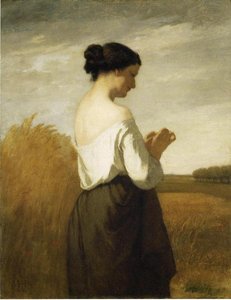
Chasing the Goose
Giclée / Art Print
Reproduction Size
-


Total Price
$ 81
A Moment of Rural Joy: "Chasing the Goose" by William Morris Hunt
This charming painting, “Chasing the Goose,” captures a fleeting moment of youthful exuberance in a rural landscape. Painted around 1850, it depicts a young boy energetically pursuing a goose across a sun-drenched field. The scene is alive with movement; one goose takes flight, while another remains closer to the boy, who clutches a stick in anticipation. Scattered throughout the composition are other birds, contributing to the lively and dynamic atmosphere of the artwork. In the background, a modest house and trees provide context, grounding the scene within a familiar pastoral setting. The overall impression is one of simple joy, playful pursuit, and the beauty of everyday life.Barbizon Influence & Artistic Technique
William Morris Hunt (1824-1879) was a pivotal figure in 19th-century Boston art, recognized as a leading American Barbizon painter. This painting exemplifies the tenets of the Barbizon school, which emphasized direct observation of nature and a rejection of academic conventions. Hunt’s style is characterized by its luminous quality and naturalistic depiction of light and shadow. He was heavily influenced by French artist Jean-François Millet, whose depictions of rural life resonated deeply with Hunt's own artistic sensibilities.- Technique: The painting likely utilizes oil on canvas, a common medium for landscape artists of the period. Hunt’s brushwork appears loose and expressive, capturing the textures of the field and the movement of the birds with remarkable skill.
- Color Palette: A warm and earthy color palette dominates the scene – greens, browns, yellows – evoking a sense of warmth and tranquility. The use of light is particularly noteworthy, illuminating the boy and goose while casting gentle shadows across the field.
Historical Context & Artistic Legacy
“Chasing the Goose” was created during a period of significant artistic transition in America. While traditional academic painting still held sway, artists like Hunt were increasingly drawn to European styles and sought to capture the beauty of their own surroundings with greater realism and emotional depth. Hunt played a crucial role in introducing these new ideas to Boston’s art scene, encouraging his contemporaries to embrace European influences while developing distinctly American artistic voices. His work helped pave the way for later generations of American Impressionists like William Merritt Chase, whose vibrant canvases further explored the possibilities of light and color.Symbolism & Emotional Resonance
Beyond its charming depiction of rural life, “Chasing the Goose” carries subtle symbolic weight. The boy’s pursuit can be interpreted as a metaphor for youthful ambition, determination, or simply the boundless energy of childhood. The geese themselves might represent freedom and escape, while the pastoral setting evokes feelings of peace, tranquility, and connection to nature. Ultimately, the painting's emotional impact lies in its ability to evoke a sense of nostalgia and remind viewers of the simple joys found in everyday moments – a timeless theme that continues to resonate with audiences today.Questions & Answers
How can I get a digital file of "Chasing the Goose" by William Morris Hunt?
To get a digital file of "Chasing the Goose" by William Morris Hunt, order a high-resolution digital image download on its Digital Image page.
Where can I buy a print of "Chasing the Goose" by William Morris Hunt?
"Chasing the Goose" is available as a fine art print on cotton canvas or archival canvas paper. Orders are placed on its Fine Art Print page, in the size of your choice.
At what age did William Morris Hunt make "Chasing the Goose"?
William Morris Hunt made "Chasing the Goose" at the age of 26. The artist was born in 1824 and the work is dated 1850.
Artist Biography
A Pioneer of American Barbizon Painting
William Morris Hunt, born in Brattleboro, Vermont, in 1824, stands as a pivotal figure in the development of American art during the 19th century. He wasn’t merely a painter; he was an advocate, an educator, and a catalyst who championed the principles of the Barbizon School on American soil. Hunt's lineage reflected both established societal roots – his father descended from Vermont founders, while his mother hailed from Connecticut wealth – and a burgeoning artistic sensibility that would ultimately redefine the landscape of American painting. His early life was marked by privilege but also by an initial suppression of creative inclinations, a situation rectified when his determined mother, Jane Leavitt Hunt, defied convention and relocated the family to Europe in pursuit of proper artistic training for her children. This bold move set the stage for Hunt’s profound engagement with European masters and ultimately shaped his distinctive style.Formative Years in France: Millet and the Barbizon Circle
Hunt's formal education began under Thomas Couture in Paris, where he received a grounding in classical techniques. However, it was an encounter at the 1851 Paris Salon that irrevocably altered his artistic trajectory. Jean-François Millet’s *The Sower* resonated deeply with Hunt, sparking a profound shift in his aesthetic sensibilities. He abandoned the rigid constraints of academic painting and embarked on a two-year period of direct study with Millet at Barbizon. This immersion into the heart of the Barbizon School proved transformative. The emphasis on plein air painting – working directly from nature – and a commitment to depicting rural life with honesty and realism became cornerstones of Hunt’s artistic philosophy. He absorbed not only Millet's technical approach but also his profound respect for the dignity of labor and the beauty inherent in everyday existence. Historian David McCullough noted that this French training significantly advanced Hunt’s development, while S.G.W. Benjamin recognized his role in directing younger American artists towards Paris and Munich, fostering a new boldness in technique and style.Returning to America: Portraiture and Landscape
Upon returning to the United States in 1855, following his marriage to Louise Dumaresq Perkins, Hunt established himself as a prominent artist in Boston. While he achieved considerable success as a portrait painter – capturing the likenesses of notable figures like William M. Evarts, Charles Francis Adams, and Senator Charles Sumner – landscape painting remained central to his artistic identity. His landscapes reflected the Barbizon influence: loose brushwork, realistic depictions of rural scenes, and an acute sensitivity to atmospheric effects. He didn’t simply reproduce nature; he sought to capture its essence, its mood, and its fleeting moments of beauty. Notable works from this period include *The Belated Kid*, *Girl at the Fountain*, *Hurdy-Gurdy Boy*, *View of the St. Johns River* (1874), *Woman with Cow* (1874) and *Niagara Falls* (1878). However, tragedy struck in 1872 when the Great Boston Fire consumed many of his paintings, along with a valuable collection of French art, including his cherished copy of Millet’s *The Sower*.Later Years, Legacy, and Artistic Philosophy
Despite this devastating loss, Hunt continued to paint, accepting commissions for murals at the State Capitol in Albany, New York. These allegorical scenes, unfortunately, deteriorated rapidly due to faulty installation, contributing to a period of profound disappointment and depression. This experience underscored his commitment to artistic integrity and the importance of proper materials and execution. In 1878, he published *Talks About Art*, a collection of essays that articulated his artistic philosophy and received widespread acclaim. Hunt’s legacy extends beyond his own paintings. He was a dedicated teacher who encouraged younger artists to embrace realism and plein air painting, leaving an indelible mark on the development of American art. He championed a shift away from academic conventions towards a more direct and honest engagement with nature, fostering a uniquely American artistic voice. His influence can be seen in the work of countless artists who followed, solidifying his position as a leading figure in the American Barbizon movement and a true pioneer of modern painting. He remains an important link between European traditions and the burgeoning artistic identity of 19th-century America.
William Morris Hunt
1824 - 1879 , United States of America
Quick Facts
- Full Name: William Morris Hunt
- Nationality: American
- Date Of Birth: 1824
- Date Of Death: 1879
- Place Of Birth: Brattleboro, United States of America
- Notable Artworks:
- The Belated Kid
- Girl at the Fountain
- Hurdy-Gurdy Boy
- View of St. Johns River
- Woman with Cow
- Niagara Falls
- Artistic Movement Or Style: Barbizon School
- Artists Who Influenced This Artist:
- Jean-François Millet
- Thomas Couture
- Artists Or Movements Influenced By This Artist: ['American Barbizon painters']
Related Articles

William Merritt Chase: A Study in American Impressionism & Artistic Luminosity
Explore the life & work of William Merritt Chase, a leading American Impressionist painter and influential art educator. Discover his vibrant portraits, landscapes, and lasting legacy with OriginalUniqueArt.
William Henry Hunt: Luminosity & Detail in Early 19th-Century Watercolour Painting
Explore the captivating watercolour paintings of William Henry Hunt (1790-1864). Discover his mastery of naturalistic detail, luminous technique & influence on 19th-century art. Learn about collecting Hunt's work and its enduring value.

American Regionalism: The Soul of the Heartland and the Mastery of Grant Wood
Explore the profound history of American Regionalism. Discover how Grant Wood captured the heart of the Midwest through masterpieces like American Gothic. An expert guide to the movement, its cultural impact, and the enduring beauty of American Realism.

Grant Wood & American Regionalism: Identity, Myth & the Rural Landscape
Explore the world of Grant Wood & American Regionalism with OriginalUniqueArt. Discover the symbolism behind 'American Gothic', recurring themes, and the movement's lasting impact on art history. High-quality reproductions available.

American Realism's Defining Works: 10 Masterpieces for Your Home
Explore 10 defining American Realism masterpieces – Hopper, Homer & more. Discover the stories behind these iconic paintings and bring timeless art to your home with OriginalUniqueArt's museum-quality reproductions. Explore the full collection online.