Preview
 Send
Send Share
Share
 Details
 Guide
Guide

 Download
 Similars
 X-Ray
X-Ray Diaporama
 Stats
StatsMoonlight
 1910
1910 51.0 x 61.0 cm
 Read More
The artwork displayed on this page is protected by copyright law, which means we cannot legally create or sell an identical reproduction. This protection is enforced under international agreements such as the Berne Convention and by national laws, including those outlined by the U.S. Copyright Law - Title 17.
As a respectful and legal alternative, we offer custom, hand-painted artworks inspired by the original. Our skilled and professional artists carefully study the original's style, mood, and artistic essence to create a new, unique piece that evokes the same feeling - while remaining an original creation in its own right.
This method fully complies with copyright regulations because it does not involve copying or duplicating the protected artwork. Instead, it is a creative reinterpretation - a new painting that is influenced by the original but not identical to it.
Hand Made Oil Reproduction
Hand-painted oil on canvas in your size and frame, made to order by our artists. ( Switch to Print Switch to Digital Image)




































Pick from our preset sizes that match the artwork's original proportions.

Type the width and the height you need, to fit your frame or your wall. This is hand-painted, so for a size with a different shape the artist can paint a bit more around the picture, or cut a bit — you choose. We send you a digital mockup to approve before the painting starts. The picture shown on this page does not show the real result — only the mockup does.
After order, OriginalUniqueArt.com team will email client for instructions and provide a mockup preview
Worldwide Delivery () in 3/4 weeks instead of standard 5 weeks. (23 October). No compromise on quality.

Free Worldwide Express Shipping

High-Quality Linen Canvas

Full Shipping Insurance

Customs Tax Refund Guarantee

True Color Matching Guarantee

100-Day Return Policy (Defects Only)

100% Money-Back Guarantee

Bulk Discount Offer
 Glass option is only available in size under 110 CM

Moonlight
Reproduction Medium
Reproduction Size
-


Total Price
$ 300
Artistic Style and Composition
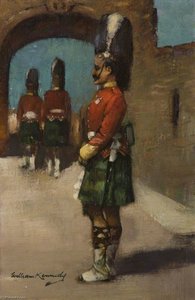
The painting depicts a small town street at night, with people walking around and a woman standing on the sidewalk near a building. The scene also includes several other individuals scattered throughout the area, some of them carrying handbags. The street appears to be wet, suggesting that it has recently rained. Two horses are present in the image, one located near the center and another towards the right side of the painting. A car is parked on the left side of the scene, adding a modern touch to the otherwise old-fashioned atmosphere of the town. Key elements of the painting include the use of moonlight to illuminate the scene, creating a sense of warmth and coziness. The artist's attention to detail is also evident in the depiction of the town's architecture and the people's clothing. For more information on William Joseph Kennedy's artwork, visit /art/list/?Filter=AQSEVP-William-Joseph-Kennedy-Moonlight.Similar Artworks and Artists
Other notable paintings that showcase a similar style and theme include A Moonlight with a Lighthouse, Coast of Tuscany by Joseph Wright Of Derby, which can be found at the Tate Gallery in London. For more information on this artwork, visit /art/list/?Filter=8YDGNF-Joseph-Wright-Of-Derby-A-Moonlight-with-a-Lighthouse-Coast-of-Tuscany.- Restaurant in Tangier by William Joseph Kennedy is another notable artwork that showcases the artist's ability to convey a sense of relaxation and social interaction.
- The Museum Tavistock Town Hall in Canada also features a collection of handmade oil paintings reproductions, including works by Antonín Hlaváček.
The Moonlight painting by William Joseph Kennedy is a beautiful example of the artist's skill and attention to detail. With its captivating depiction of a small town street at night, this artwork is sure to delight art lovers and enthusiasts alike.
Questions & Answers
How can I view "Moonlight" by William Joseph Kennedy as a slideshow?
The diaporama of "Moonlight" can be watched on the artwork's Diaporama page.
In what year was "Moonlight" by William Joseph Kennedy created?
"Moonlight" dates from 1910. The date places the work within William Joseph Kennedy's career and its era.
Is there a factsheet about "Moonlight" by William Joseph Kennedy for students?
The Guide page of "Moonlight" by William Joseph Kennedy offers a printable two-sheet factsheet: the artwork with its identity table, a decade band placing it in the artist's lifetime, other works by the artist, the measured color palette, and ready-to-copy citations in four styles.
Artist Biography
William Joseph Kennedy: A Chronicle of Albany and the American Soul
William Joseph Kennedy, born in Albany, New York, in 1928, wasn’t merely a novelist; he was a chronicler of a specific place—a gritty, often overlooked corner of America—and through that lens, a profound explorer of the human condition. His work, deeply rooted in the history and folklore of his hometown, transcends simple regionalism to become a resonant meditation on family, memory, loss, and the enduring struggle for redemption. Kennedy’s legacy isn't defined by grand narratives or sweeping historical events, but rather by the intimate portraits he crafted—characters wrestling with their pasts, haunted by secrets, and striving, however imperfectly, toward some semblance of grace.
Kennedy’s early life was inextricably linked to the vibrant, often turbulent, Irish-American community that shaped Albany. His family history, tracing back to County Wexford, Ireland, instilled a deep appreciation for storytelling and a keen awareness of the immigrant experience. This heritage, coupled with his upbringing in a city grappling with its own complex social dynamics—a blend of old money, political corruption, and working-class struggles—provided fertile ground for his literary explorations. His father, William Kennedy Sr., a prominent businessman and politician, instilled in him a respect for the power of influence and the intricacies of human relationships within the corridors of power – themes that would later permeate his own writing.
Initially pursuing journalism, Kennedy honed his craft as a reporter for various New York newspapers. This experience proved invaluable, providing him with an understanding of narrative structure, investigative techniques, and the art of capturing authentic voices. However, it was the pull of fiction—a desire to delve deeper into the psychological landscapes of his characters—that ultimately led him to embrace the novel as his primary medium. His early works, such as *The Ink Truck* (1969) and *Legs* (1975), established his signature style: a blend of sharp social commentary, lyrical prose, and a willingness to confront uncomfortable truths about American life.
The Albany Cycle: A Regional Tapestry
Kennedy’s most celebrated achievement is undoubtedly the “Albany Cycle”—a series of novels that collectively form a sprawling, multi-generational saga centered on the Phelan family. This fictional dynasty, rooted in the city's history and populated by a cast of unforgettable characters, serves as a microcosm for the broader American experience. *Billy Phelan’s Greatest Game* (1978) introduced readers to this world, followed by *Roscoe* (2002), which explored the dark underbelly of Albany’s political landscape, and *Changó’s Beads and Two-Tone Shoes* (2011), a poignant reflection on family secrets and the enduring power of memory.
What distinguishes the Albany Cycle is Kennedy's meticulous attention to detail—his ability to evoke the sights, sounds, and smells of Albany with remarkable precision. He doesn’t shy away from depicting the city’s flaws—its corruption, its poverty, its social divisions—but he also celebrates its resilience, its spirit, and its unique cultural identity. The cycle is not simply a chronicle of events; it's an exploration of how history shapes individual lives and how the past continues to haunt the present.
Literary Influences and Style
Kennedy’s writing style is characterized by its lyrical prose, its sharp wit, and its unflinching honesty. He draws inspiration from a wide range of sources—from the works of Ernest Hemingway and William Faulkner to the oral traditions of his Irish-American heritage. Faulkner's exploration of Southern identity and the weight of history profoundly influenced Kennedy’s approach to storytelling, particularly in *Ironweed*.
However, Kennedy’s style is distinctly his own—a blend of realism and surrealism, of social commentary and psychological insight. He frequently employs stream-of-consciousness narration, allowing readers access to the inner thoughts and feelings of his characters. His use of symbolism—particularly the recurring motif of water—adds layers of meaning to his narratives, suggesting themes of purification, renewal, and the cyclical nature of life.
Critical Acclaim and Lasting Legacy
Despite initial challenges in securing publication for his novels, Kennedy’s work eventually gained widespread recognition. *Ironweed* (1983), a sprawling epic about an aging alcoholic haunted by his past, won him the Pulitzer Prize for Fiction—a testament to its literary merit and its profound exploration of human suffering. The novel was adapted into a film in 1987, starring Daniel Day-Lewis.
Kennedy’s influence extends far beyond the realm of fiction. His work has been praised for its insightful portrayal of American society, its evocative depiction of Albany, and its unflinching examination of human nature. He is remembered as a master storyteller—a writer who possessed a rare gift for capturing the complexities of life in all its beauty and ugliness. His novels continue to resonate with readers today, offering a timeless meditation on family, memory, and the enduring search for meaning in a world often marked by loss and disappointment.

William Joseph Kennedy
1928 - , United States of America
Quick Facts
- Full Name: William Joseph Kennedy
- Nationality: American
- Date Of Birth: 1928
- Place Of Birth: Albany, United States of America
- Notable Artworks:
- Ironweed
- Legs
- Billy Phelan’s Greatest Game
- O Albany!
- Quinn’s Book
- Very Old Bones
- The Flaming Corsage
- Roscoe
- Changó’s Beads
- Artistic Movement Or Style: Southern Literature, American Realism
- Artists Who Influenced This Artist:
- Faulkner
- Hunter S. Thompson
- Artists Or Movements Influenced By This Artist:
- Yoknapatawpha County
- Southern Gothic