Preview
 Send
Send Share
Share
 Details

 Download
 Similars
 X-Ray
X-Ray Diaporama
 Stats
StatsLionhunt
 Expressionism
 1947
1947 65.0 x 50.0 cm
 Read More
Giclée / Art Print
Museum-quality giclée or canvas print with fast production and flexible finish options. ( Buy Hand Made Painting Switch to Digital Image)




































Pick from our preset sizes that match the artwork's original proportions.

You may enter your own dimensions to fit a specific frame or space. If your selected size does not match the original image's proportions, we will either crop the artwork or extend the image with a mirrored or solid-fill edge. A digital mockup will be sent for your approval before production begins.
Please note that the on-screen preview does not reflect the actual cropping or extension. Only the mockup will accurately show the final composition.
While custom sizes are available, we recommend selecting a dimension from the predefined list to preserve the original proportions.
Worldwide Delivery () in 2 weeks instead of standard 4/5 weeks. (11 September)

Free Worldwide Express Shipping

High-Quality Linen Canvas

Full Shipping Insurance

Customs Tax Refund Guarantee

True Color Matching Guarantee

100-Day Return Policy (Defects Only)

100% Money-Back Guarantee

Bulk Discount Offer
 Glass option is only available in size under 110 CM

Lionhunt
Giclée / Art Print
Reproduction Size
-


Total Price
$ 81
Artist Biography
Werner Peiner: A Painter Caught Between Realism and Nazi Ideology
Werner Peiner (20 July 1897 – 19 August 1984) was a German painter whose artistic journey spanned from the expressive currents of early Expressionism to the increasingly formalized aesthetic dictated by the Third Reich, ultimately cementing his position as one of its most prominent official artists. Born in Düsseldorf, Peiner’s formative years were steeped in the intellectual ferment of Weimar Germany, where he absorbed influences from figures like Wilhelm Döringer and embraced a style characterized by nuanced observation and emotional depth—a departure from purely representational art that would foreshadow his later allegiance to Nazi ideology.- Early Influences & Artistic Formation:
- The Expressionist Spirit: Peiner’s initial artistic explorations found resonance in the expressive fervor of Expressionism, particularly evident in landscapes imbued with melancholic beauty and portraits capturing psychological complexity. His early works demonstrated a sensitivity to tonal modulation and textural variation—techniques honed during his studies at Düsseldorf Art Academy under Döringer.
- New Objectivity & The Bauhaus Connection:
- As the decade progressed, Peiner’s artistic sensibilities shifted toward New Objectivity, mirroring the broader intellectual currents of the time. This movement championed a detached yet precise depiction of reality, prioritizing clarity and geometric forms—a stylistic choice that reflected Peiner's engagement with the principles espoused by Bauhaus.
The Rise of Official Art & Patronage Under Göring
Peiner’s career took a decisive turn in 1933 with his appointment as professor at Düsseldorf Art Academy, coinciding with Hitler's ascent to power. This position afforded him access to influential figures like Hermann Göring, who recognized Peiner’s talent and championed his artistic vision. Göring actively supported Peiner’s endeavors, notably commissioning monumental tapestries for the New Reich Chancellery—a project that served as a powerful visual embodiment of Nazi propaganda's narrative of Germanic grandeur and spiritual renewal. The patronage extended beyond mere financial backing; it represented an endorsement of Peiner’s artistic sensibilities within the framework of the regime’s ideological ambitions.- Kronenburg Master Classes & Artistic Experimentation:
- Peiner established Kronenburg Master School for Painting in 1936, attracting a cohort of aspiring artists who embraced his distinctive approach to landscape painting and portraiture. The school’s ethos—characterized by meticulous observation and stylistic innovation—reflected Peiner's commitment to upholding artistic standards while simultaneously aligning with the aesthetic imperatives of Nazi Germany.
- The Gottbegnadeten List & Artistic Recognition:
- In 1944, Peiner was included on Hitler’s “Gottbegnadeten Liste”—the list of twelve most important visual artists deemed worthy of protection by the Führer—a testament to his artistic reputation and Göring's unwavering support. This inclusion underscored the regime’s conviction that Peiner’s work represented the pinnacle of German artistic achievement.
Legacy & Controversial Significance
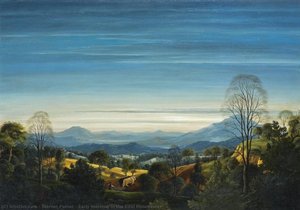
Despite facing censure for accepting Nazi patronage, Werner Peiner remains a significant figure in German art history. His landscapes—particularly “Early Morning in the Eifel Mountains”—capture the serene beauty of the Rhineland region with remarkable precision and tonal subtlety. However, his role as an official artist raises complex questions about artistic integrity and complicity within a totalitarian context. Peiner’s oeuvre serves as a poignant reminder of how art can be shaped by political forces—a legacy that continues to provoke scholarly debate and artistic contemplation.
Werner Peiner
1897 - 1984 , Germany
Quick Facts
- Artistic Movement Or Style: New Objectivity & Realism
- Artists Or Movements Influenced By This Artist: ['Expressionism']
- Artists Who Influenced This Artist: ['W. Döringer']
- Date Of Birth: July 20, 1897
- Date Of Death: August 19, 1984
- Full Name: Werner Peiner
- Nationality: German
- Notable Artworks:
- Early Morning in the Eifel Mountains
- Der Thronhimmel
- Place Of Birth: Düsseldorf, Germany