

 Send
Send Share
Share
 Details
 Guide
Guide

 Download
 Similars
 Diaporama
 Stats
StatsErase
 Installation Art
- Installation
- Contemporary Installation Art
 2013
2013- Contemporary
 Kochi-Muziris Biennale
 Read More
The artwork displayed on this page is protected by copyright law, which means we cannot legally create or sell an identical reproduction. This protection is enforced under international agreements such as the Berne Convention and by national laws, including those outlined by the U.S. Copyright Law - Title 17.
As a respectful and legal alternative, we offer custom, hand-painted artworks inspired by the original. Our skilled and professional artists carefully study the original's style, mood, and artistic essence to create a new, unique piece that evokes the same feeling - while remaining an original creation in its own right.
This method fully complies with copyright regulations because it does not involve copying or duplicating the protected artwork. Instead, it is a creative reinterpretation - a new painting that is influenced by the original but not identical to it.
Hand Made Oil Reproduction
Hand-painted oil on canvas in your size and frame, made to order by our artists. ( Switch to Print Switch to Digital Image)




































Pick from our preset sizes that match the artwork's original proportions.

Type the width and the height you need, to fit your frame or your wall. This is hand-painted, so for a size with a different shape the artist can paint a bit more around the picture, or cut a bit — you choose. We send you a digital mockup to approve before the painting starts. The picture shown on this page does not show the real result — only the mockup does.
After order, OriginalUniqueArt.com team will email client for instructions and provide a mockup preview
Worldwide Delivery () in 3/4 weeks instead of standard 5 weeks. (23 October). No compromise on quality.

Free Worldwide Express Shipping

High-Quality Linen Canvas

Full Shipping Insurance

Customs Tax Refund Guarantee

True Color Matching Guarantee

100-Day Return Policy (Defects Only)

100% Money-Back Guarantee

Bulk Discount Offer
 Glass option is only available in size under 110 CM

Erase
Reproduction Medium
Reproduction Size
-


Total Price
$ 300
A Ritual of Release: The Immersive World of Erase
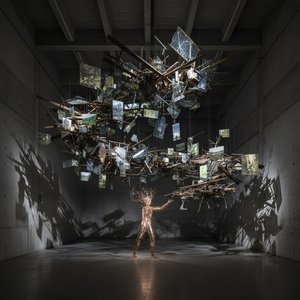
In the quiet intersection of sculpture and performance, Venkataiah Srinivas Prasad’s 2013 installation, Erase, stands as a profound testament to the power of catharsis. This is not merely an object to be viewed from a distance, but an experiential journey that demands physical participation. The work presents a striking visual paradox: a thorny, woven cocoon suspended precariously above a rugged ascent of gunny sacks. As one navigates the uneven terrain of these earth-toned, filled bags, the viewer is drawn upward toward a prickly hollow. This architectural movement—the literal climb toward vulnerability—sets the stage for a deeply personal encounter with one's own psyche.
The aesthetic of the piece is rooted in a raw, organic minimalism that resonates with the textures of the natural world. The use of thorny branches to construct the cocoon creates a sense of protective yet sharp boundaries, while the burlap and sand elements ground the installation in a tactile, elemental reality. To look upon this work is to witness a dialogue between the man-made and the wild; the structured geometry of the ascent meets the chaotic, organic sprawl of the thorns. For collectors and designers, the visual language of Erase offers a sophisticated palette of earthy neutrals and complex textures that evoke a sense of grounded tranquility and contemplative depth.
Symbolism and the Alchemy of Destruction
Beyond its physical presence, Erase functions as a vessel for human emotion. The interior of the thorny cocoon serves as a sacred, private chamber—a sanctuary where the boundaries between the self and the external world blur. It is within this hollow that the artist invites the viewer to perform an act of psychological shedding. By whispering or thinking of unwanted memories, fears, or traumas into the heart of the structure, the participant engages in a ritualistic form of letting go. The installation acts as a physical manifestation of the desire to purge the heavy burdens of the past.
The true climax of the work, however, lies in its ephemeral nature. At the conclusion of its exhibition period, the cocoon is set ablaze under the cover of night. This ritualistic destruction is the ultimate expression of the title; as the flames consume the thorns and the branches, they take with them the very confessions uttered within. What remains is nothing but a layer of sand—a clean slate, devoid of the weight of history. This cycle of creation and annihilation offers a powerful metaphor for renewal, making the piece an emotionally resonant masterpiece that speaks to the universal human need for rebirth and the beauty of starting anew.
A Legacy of Experimental Vision
Venkataiah Srinivas Prasad’s work continues to captivate because it refuses to remain static. By blending elements of installation art, environmental sculpture, and ritualistic performance, he challenges the traditional boundaries of what a piece of art can be. Erase is not just a relic of a moment in time, but a living concept that explores the fragility of memory and the strength found in vulnerability. For those seeking to bring a sense of profound meaning and narrative complexity into their spaces, a high-quality reproduction of this work serves as a constant reminder of the transformative power of release and the enduring elegance of the natural world.
Questions & Answers
Who created "Erase" and what style is it in?
Behind "Erase" stand Venkataiah Srinivas Prasad and the Contemporary Installation Art movement.
What space is suggested for "Erase" by Venkataiah Srinivas Prasad?
The recommended space for "Erase" by Venkataiah Srinivas Prasad is a wellness center. The suggestion can of course be adapted to your interior.
What use is suggested for "Erase" by Venkataiah Srinivas Prasad?
The recommended use of a print of "Erase" is conversation.
Artist Biography
The Soul of Installation: Venkataiah Srinivas Prasad
Venkataiah Srinivas Prasad was an artist whose work occupied the profound intersection of sculpture and performance, creating experiences that transcended mere observation to demand physical and emotional participation. Born in Chamarajanagara, India, his practice was deeply rooted in the concept of catharsis and the ritualistic release of human emotion. Rather than producing static objects for distant contemplation, Prasad crafted immersive environments that invited viewers to navigate uneven terrains and engage with the raw, organic textures of the natural world.
His artistic language was one of organic minimalism, often utilizing elemental materials to bridge the gap between the man-made and the wild. Through his use of earth-toned elements, burlap, and sand, he grounded his installations in a tactile reality that resonated with the primal textures of the earth. His work frequently explored the tension between protection and vulnerability, using sharp, thorny structures to create boundaries that were simultaneously sheltering and prickly, mirroring the complexities of the human psyche.
A Ritual of Release
One of his most significant contributions to contemporary installation art was the 2013 work titled Erase, showcased at the Kochi-Muziris Biennale in Kochi. This piece functioned as a vessel for psychological shedding, presenting a striking visual paradox: a thorny, woven cocoon suspended above a rugged ascent of gunny sacks. The installation was not merely an architectural feat but a sacred chamber where participants were invited to whisper or think of unwanted memories, fears, or traumas into the heart of the structure.
The true power of Prasad's work lay in its ephemeral and ritualistic nature. In Erase, the climax of the experience was the intentional destruction of the artwork itself. At the conclusion of its exhibition, the thorny cocoon was set ablaze under the cover of night, a symbolic act where flames consumed both the physical branches and the whispered confessions held within. This cycle of destruction left behind nothing but a layer of sand—a clean slate representing the ultimate purification from the weight of history.
Legacy and Artistic Significance
Prasad's significance in the realm of Contemporary Installation Art stems from his ability to transform the gallery space into a site of spiritual and psychological alchemy. His mastery lay in the following elements:
- The creation of experiential journeys that required the viewer to physically climb and navigate difficult landscapes.
- The use of symbolic materials, such as thorns and sand, to represent the duality of pain and peace.
- The implementation of performance-based destruction to achieve a sense of true artistic finality and emotional cleansing.
Through his dedication to the ritual of letting go, Venkataiah Srinivas Prasad left an indelible mark on the landscape of contemporary art, reminding us that the most profound encounters often occur when we allow ourselves to be vulnerable to the transformative power of change.

Venkataiah Srinivas Prasad
1947 - 2024 , India
Related Articles

Raja Ravi Varma: Bridging Tradition & Modernity in 19th-Century Indian Art
Explore the life & art of Raja Ravi Varma, a pioneer who fused European techniques with Indian iconography. Discover his iconic paintings, lasting legacy, and influence on modern Indian art at OriginalUniqueArt.
Richard Wilson: Deconstructing Landscape & Memory in Contemporary Installation Art
Explore Richard Wilson's groundbreaking landscape paintings & his enduring influence on contemporary installation art. Discover investment opportunities, provenance insights & the materiality of memory in this expert analysis.

Transforming Hospitality Spaces: A Comprehensive Approach to Hotel Art Procurement and Installation for Consistent Brand Aesthetics
Elevate your hotel's aesthetic with expert art procurement & installation services. Discover how strategic artwork enhances guest experiences & reinforces brand identity. Get a free consultation!

The Aesthetic Catalyst: Leveraging Art Installations for Guest Engagement & Organic Social Marketing
Discover how strategic art installations elevate hotel experiences & drive organic social visibility. Expert insights on design, ROI, guest engagement, and creating unforgettable spaces for luxury hospitality brands.
F.A.Q.: Wall Murals & Frescoes – Customization, Scale & Installation for Elite Collectors
OriginalUniqueArt.com provides bespoke wall murals & frescoes for elite collectors. Discover custom scale options, professional installation, and expert artistry. Commission a unique masterpiece today.
