Preview
 Send
Send Share
Share
 Details
 Guide
Guide

 Download
 Similars
 X-Ray
X-Ray Diaporama
 Stats
StatsSt. Peter
 1530
1530 213.0 x 231.0 cm
 Vasco Museum
 Read More
Giclée / Art Print
Museum-quality giclée or canvas print with fast production and flexible finish options. ( Buy Hand Made Painting Switch to Digital Image)




































Pick from our preset sizes that match the artwork's original proportions.

Type the width and the height you need, to fit your frame or your wall. A print can only be cut, never made bigger than the picture, so a size with a different shape loses a part of the image. We send you a digital mockup to approve before we print anything. The picture shown on this page does not show the real cut — only the mockup does.
Worldwide Delivery () in 2 weeks instead of standard 4/5 weeks. (25 October)

Free Worldwide Express Shipping

High-Quality Linen Canvas

Full Shipping Insurance

Customs Tax Refund Guarantee

True Color Matching Guarantee

100-Day Return Policy (Defects Only)

100% Money-Back Guarantee

Bulk Discount Offer
 Glass option is only available in size under 110 CM

St. Peter
Giclée / Art Print
Reproduction Size
-


Total Price
$ 81
Artist Biography
The Master of Viseu: The Life and Legacy of Grão Vasco
In the heart of the Portuguese Renaissance, few names resonate with as much reverence as Vasco Fernandes, known to history by the affectionate moniker Grão Vasco. Born around 1475 in the historic city of Viseu, Fernandes emerged as a titan of the 16th century, a painter whose brush captured the spiritual fervor and burgeoning worldly splendor of his era. His life’s work represents a profound intersection of Northern European technical precision and a uniquely Portuguese soul, creating a visual language that defined the Manueline period—an age of maritime discovery and ornate, decorative magnificence.
The foundation of Fernandes' extraordinary skill was laid in the workshops of his contemporaries, most notably under the influence of Joaneanes. This connection to Flemish traditions was transformative; it introduced him to the sophisticated medium of oil painting, which allowed for a level of luminosity and microscopic detail previously unseen in the Iberian Peninsula. Through this lineage, Vasco learned to manipulate light and shadow, mastering the art of chiaroscroll and the delicate layering of pigments to create textures that seemed almost tactile to the viewer. This synthesis of Flemish realism with a local, emotive sensibility became the hallmark of his mature style.
A Tapestry of Faith and Detail
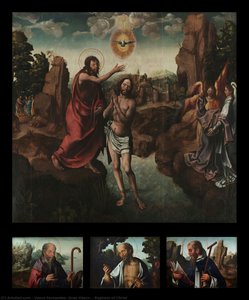
The oeuvre of Grão Vasco is characterized by its monumental altarpieces, which served not merely as decorations but as profound theological windows for the faithful. His ability to weave complex religious narratives into compositions of immense dramatic power is perhaps best observed in his treatment of sacred subjects. In works such as Baptism of Christ, one can witness a breathtaking command of dynamic movement and spiritual pathos. The luminous details of the water and the divine light descending upon the scene reflect a master at the height of his technical prowess, using every brushstroke to evoke a sense of the miraculous.
Beyond the singular figures of saints, Fernandes possessed a remarkable ability to capture human emotion and communal tension. His interpretations of the Last Supper stand as towering achievements of Renaissance artistry. In these compositions, the artist moves beyond simple iconography to explore the psychological depth of the disciples, utilizing the dramatic interplay of light to highlight the gravity of Christ's final meal. The meticulous attention to drapery, the symbolic use of flora, and the architectural grandeur within his paintings all contribute to a sense of Manueline splendor—a style that mirrors the richness of Portugal's golden age of exploration.
Historical Significance and Enduring Influence
The historical importance of Vasco Fernandes cannot be overstated; he was the architect of a national aesthetic. By integrating the meticulousness of the North with the decorative exuberance of the Portuguese court, he provided a visual identity for a nation at the zenith of its power. His legacy is found in the way he elevated the status of the painter from a mere craftsman to a profound storyteller of the human and divine condition.
Today, the works of Grão Vasco continue to captivate audiences worldwide, serving as essential touchstones for anyone seeking to understand the Renaissance in Southern Europe. His contributions can be summarized through several key artistic pillars:
- Technical Innovation: The masterful adoption and refinement of Flemish oil painting techniques within Portugal.
- Cultural Synthesis: The seamless blending of Northern European realism with the ornate, maritime-inspired Manueline style.
- Spiritual Narrative: An unparalleled ability to translate complex religious doctrines into emotionally resonant visual experiences.
- National Identity: Establishing a definitive Portuguese school of painting that stood alongside the great traditions of Italy and Flanders.
As we gaze upon the enduring brilliance of his altarpieces, we see more than just paint on wood; we see the heartbeat of a Renaissance era, preserved through the visionary eyes of Grão Vasco.

Vasco Fernandes (Grao Vasco)
1475 - 1542 , Portugal
Quick Facts
- Full Name: Vasco Fernandes
- Nationality: Portuguese
- Date Of Birth: 1475
- Date Of Death: 1542
- Place Of Birth: Viseu, Portugal
- Notable Artworks:
- St. John the Baptist
- The Seine in Paris
- Sailing the Pacific Ocean
- The Wedding of the Fish
- Artistic Movement Or Style: Manueline style
- Artists Who Influenced This Artist: ['Joaneanes']
- Artists Or Movements Influenced By This Artist: ['Edite Melo']