
![Abstract Composition [triptych] — Vaclav Vytlacil](/media/artworks/images-full/33/82/3382ffe38a127a5d95c61f33ebb979e5.jpg)
 Preview
 Send
Send Share
Share
 Details
 Guide
Guide

 Download
 Similars
 X-Ray
X-Ray Diaporama
 Q&A
Q&A Stats
StatsAbstract Composition [triptych]


 Read More
The artwork displayed on this page is protected by copyright law, which means we cannot legally create or sell an identical reproduction. This protection is enforced under international agreements such as the Berne Convention and by national laws, including those outlined by the U.S. Copyright Law - Title 17.
This method fully complies with copyright regulations because it does not involve copying or duplicating the protected artwork. Instead, it is a creative reinterpretation - a new painting that is influenced by the original but not identical to it.
Giclée / Art Print
Museum-quality giclée or canvas print with fast production and flexible finish options. ( Buy Hand Made Painting Switch to Digital Image)




P118B $10

P118H $10

P118W $10

P438Z $10

P508JH $12

P508YH $12

P805H $10

P805Z $10

P919BZ $10

P919G $10

P919XJ $10

P959ZH $10

P968JZ $12

W106C $8

W218G $10

W218JH $8

W218Y $10

W307PJ $10

W316G $10

W316PJ $8

W316Y $10

W398PJ $8

W4111J $10

W500HY $15

W500JH $15

W692G $12

W849H $8

W940BG $15

W953PJ $8




Pick from our preset sizes that match the artwork's original proportions.

Type the width and the height you need, to fit your frame or your wall. A print can only be cut, never made bigger than the picture, so a size with a different shape loses a part of the image. We send you a digital mockup to approve before we print anything. The picture shown on this page does not show the real cut — only the mockup does.
Worldwide Delivery () in 2 weeks instead of standard 4/5 weeks. (30 October)

Free Worldwide Express Shipping

High-Quality Linen Canvas

Full Shipping Insurance

Customs Tax Refund Guarantee

True Color Matching Guarantee

100-Day Return Policy (Defects Only)

100% Money-Back Guarantee

Bulk Discount Offer
 Glass option is only available in size under 110 CM
![Abstract Composition [triptych]](/static/images/originaluniqueart/artworks/painting.a1e74a1cb7dc.png)
Abstract Composition [triptych]
Giclée / Art Print
Reproduction Size
-


Total Price
$ 81
Artist Biography
The Architect of Abstraction: The Life and Legacy of Vaclav Vytlacil
In the vibrant tapestry of American modernism, few threads are as intricately woven or as profoundly influential as those spun by Vaclav Vytlacil. Born in New York City on November 1, 1892, to Czech immigrants, Vytlacil’s journey was one of constant movement and artistic evolution. Though his roots were planted in the bustling energy of Manhattan, his early years in Chicago provided a diverse cultural backdrop that would later inform the rich, layered textures of his work. His formal odyssey began at the Art Institute of Chicago in 1906, where he first learned to translate the physical world into pigment and form. This foundational period was marked by a rigorous pursuit of technical mastery, a trait that would remain a cornerstone of his practice even as he ventured into the radical territories of abstraction.
The trajectory of Vytlacil’s career took a decisive turn when he moved to New York to study at the prestigious Art Students League in 1913. Under the watchful eye of the portraitist John C. Johansen, Vytlacil developed an acute sensitivity to tonal control and meticulous observation. However, the boundaries of traditional representation could not long contain his burgeoning curiosity. Seeking the vanguard of innovation, he turned his gaze toward Europe, immersing himself in the artistic currents of Munich. It was during this transformative period that he encountered the legendary Hans Hofmann. This meeting would become the defining moment of his life, establishing a profound intellectual and aesthetic bond. As one of Hofmann’s most devoted disciples, Vytlacil embraced the revolutionary principles of spatial tension and color dynamics, eventually becoming a vital conduit for these ideas as they crossed the Atlantic to reshape American art.
A Symphony of Form and Color
Vytlacil’s oeuvre serves as a breathtaking chronicle of an artist transitioning from the tangible to the transcendental. His early works often found beauty in the quietude of the domestic sphere, utilizing still life compositions to explore the interplay of light and volume. In masterpieces such as Still Life with Grapes, Vase, and Fish, one can witness the delicate tension between classical subject matter and modern experimentation. He possessed a singular ability to elevate the mundane—a cluster of grapes or the curve of a vase—into something monumental through deliberate brushwork and a sophisticated understanding of weight and balance. These compositions were not merely depictions of objects but were explorations of how light breathes life into form, creating a sense of three-dimensional presence that pulls the viewer into a shared, tactile space.
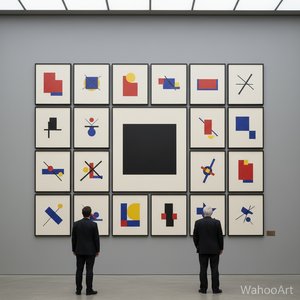
As his relationship with Cubist aesthetics deepened, Vytlacil’s work underwent a radical metamorphosis. The structured reality of his early still lifes gave way to the rhythmic energy of abstraction. His later compositions, such as the striking Abstract Composition [Triptych], demonstrate a mastery of geometric shapes, bold lines, and textured surfaces. In these works, the artist moved beyond the representation of objects to focus on the pure emotional resonance of color and space. He utilized the lessons learned from Hofmann to create canvases that felt alive with movement, where the boundaries between foreground and background dissolved into a harmonious dialogue of energetic strokes. This evolution reflects a lifelong commitment to pushing the limits of what paint could communicate, moving from the observation of the external world to the expression of an internal, rhythmic truth.
Historical Significance and Enduring Influence
Beyond his individual canvases, Vaclav Vytlacil played a crucial role in the pedagogical landscape of mid-century America. He was not merely a practitioner of modernism but one of its most dedicated educators and advocates. Following World War II, he became instrumental in disseminating the transformative teachings of Hans Hofmann across the United States, lecturing at various institutions and fostering a new generation of artists who would go on to define the American avant-garde. His ability to bridge the gap between European innovation and American experimentation helped solidify a unique identity for American abstraction, making it a formidable force on the global stage.
Today, the legacy of Vytlacil is preserved in the permanent collections of the world's most esteemed institutions, including:
- The Museum of Modern Art (MoMA)
- The Metropolitan Museum of Art
- The Smithsonian American Art Museum
Vytlacil’s contribution to art history lies in his role as a bridge-builder—between tradition and revolution, between the figurative and the abstract, and between the teachings of the Old World and the burgeoning spirit of the New. His life remains a testament to the power of artistic devotion and the enduring impact of a vision that seeks to find the infinite within the finite.

Vaclav Vytlacil
1890 - 1984
Quick Facts
- Full Name: Vaclav Vytlacil
- Nationality: American
- Date Of Birth: 1890
- Date Of Death: 1984
- Place Of Birth: New York City, USA
- Notable Artworks:
- Abstract Composition [Triptych]
- Still Life
- Artistic Movement Or Style: Abstract American Art; Hans Hofmann's teachings
- Artists Who Influenced This Artist: Hans Hofmann
- Artists Or Movements Influenced By This Artist: Cubist Movement
Related Articles

Dark Masterpieces: 10 Iconic Paintings Dominated by Black Tones |
Explore 10 iconic paintings dominated by black tones, from Rembrandt’s chiaroscuro to Goya's dark expressions. Discover the stories behind these masterpieces & find museum-quality art reproductions for your home at .

White on Canvas: 10 Masterpieces & Timeless Elegance for Your Home Decor
Explore 10 iconic white paintings by Monet, Whistler & Rothko! Discover the stories behind these serene masterpieces and their impact on art history. Find museum-quality reproductions for your home decor at .
Kazimir Malevich: 25 Masterpieces of Suprematism & Abstract Art | OriginalUniqueArt
Explore 25 iconic artworks by Kazimir Malevich, pioneer of Suprematism & abstract art. Discover the stories behind 'Black Square' and more! Find museum-quality prints & elevate your home decor with OriginalUniqueArt.com.

Kandinsky's Masterpieces: 25 Paintings That Define Abstract Art | OriginalUniqueArt
Journey through Wassily Kandinsky's 25 most iconic abstract paintings. Explore his revolutionary use of color, form & spiritual expressionism. Find museum-quality Kandinsky reproductions and elevate your home decor with OriginalUniqueArt.com. Discover all masterpieces on OriginalUniqueArt.com!

Abstract Expressionism's 10 Defining Masterpieces |
Explore 10 defining Abstract Expressionism masterpieces by Pollock, Rothko & de Kooning. Discover the stories behind these iconic paintings and find museum-quality art reproductions to elevate your home decor on .


![Abstract Composition [triptych]](/media/artworks/images-thumb/08/3c/083c0675045645fd42d4e6c6d63f1ced.jpg)


