Preview
 Send
Send Share
Share
 Details
 Guide
Guide

 Download
 Similars
 X-Ray
X-Ray Diaporama
 Q&A
Q&A Stats
StatsThe Beauty

- 89.0 x 76.0 cm


 Read More
Giclée / Art Print
Museum-quality giclée or canvas print with fast production and flexible finish options. ( Buy Hand Made Painting Switch to Digital Image)




P118B $10

P118H $10

P118W $10

P438Z $10

P508JH $12

P508YH $12

P805H $10

P805Z $10

P919BZ $10

P919G $10

P919XJ $10

P959ZH $10

P968JZ $12

W106C $8

W218G $10

W218JH $8

W218Y $10

W307PJ $10

W316G $10

W316PJ $8

W316Y $10

W398PJ $8

W4111J $10

W500HY $15

W500JH $15

W692G $12

W849H $8

W940BG $15

W953PJ $8




Pick from our preset sizes that match the artwork's original proportions.

Type the width and the height you need, to fit your frame or your wall. A print can only be cut, never made bigger than the picture, so a size with a different shape loses a part of the image. We send you a digital mockup to approve before we print anything. The picture shown on this page does not show the real cut — only the mockup does.
Worldwide Delivery () in 2 weeks instead of standard 4/5 weeks. (8 November)

Free Worldwide Express Shipping

High-Quality Linen Canvas

Full Shipping Insurance

Customs Tax Refund Guarantee

True Color Matching Guarantee

100-Day Return Policy (Defects Only)

100% Money-Back Guarantee

Bulk Discount Offer
 Glass option is only available in size under 110 CM

The Beauty
Giclée / Art Print
Reproduction Size
-


Total Price
$ 81
A Renaissance Reverie in American Light: Exploring “The Beauty” by Titian Ramsay Peale II
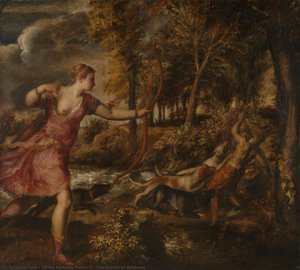
“The Beauty,” painted in 1536 by the remarkably prescient Titian Ramsay Peale II, is more than a portrait; it’s a carefully constructed echo of Venetian High Renaissance ideals transplanted to the burgeoning artistic landscape of early America. Peale, born into a family deeply intertwined with the history of American art – his father, Charles Willson Peale, was a foundational figure in establishing the nation's first museum – inherited not just an artistic legacy but also a profound respect for classical forms and techniques. This painting stands as a testament to that inheritance, demonstrating a deliberate and sophisticated engagement with the visual language of masters like Raphael and Leonardo da Vinci.
The subject herself is presented with an almost ethereal grace. Dressed in a flowing blue gown – a color historically associated with royalty and piety – she embodies a serene beauty. The rich hue is masterfully rendered, utilizing layering techniques characteristic of Peale’s style to create depth and luminosity. A delicate gold necklace encircles her neck, instantly elevating the portrait and hinting at wealth and status, while also drawing the eye to the subtle play of light across its surface. Her long hair, intricately braided, frames a face that is both youthful and contemplative; she possesses an inherent dignity that speaks volumes despite the lack of overt expression.
The Language of Detail: Technique and Artistic Intent
Peale’s meticulous approach to detail is immediately apparent upon close inspection. The artist demonstrates a remarkable command of sfumato, a technique perfected by Leonardo da Vinci, subtly blurring edges and creating an atmospheric haze that softens the forms and imbues the portrait with a sense of mystery. The rendering of fabric—the folds of the gown, the sheen of the necklace—is exceptionally realistic, achieved through careful observation and a deep understanding of anatomy and drapery. The use of oil paint allows for rich color saturation and subtle gradations, contributing to the painting’s overall luminosity. Notice particularly how Peale builds up layers of glaze – thin washes of translucent paint applied over dried underlayers – to achieve this effect.
Furthermore, the composition itself is carefully balanced, adhering to principles of Renaissance perspective. The woman is positioned slightly off-center, creating a dynamic and engaging visual arrangement. The background, though relatively simple, serves to enhance the subject’s presence without distracting from her beauty. Peale's deliberate choices in color and form are not merely decorative; they contribute significantly to the painting’s overall narrative and emotional impact.
Historical Context: Bridging Worlds
“The Beauty” was created during a pivotal moment in American history – a period of rapid growth, exploration, and self-definition. While deeply influenced by European artistic traditions, Peale's work also reflects the unique cultural context of his time. He was part of a generation striving to establish a distinct American identity within the broader framework of Western art. His father’s museum, a hub for scientific inquiry and artistic display, played a crucial role in fostering this dialogue between Old World reverence and New World expression.
The painting can be viewed as an attempt to synthesize these influences – a conscious effort to bring the idealized beauty of the Renaissance to the American scene. It’s a fascinating example of how artists navigated the complexities of cultural exchange during a period of profound transformation. Considering the date, 1536, is particularly striking; Peale was consciously referencing and adapting techniques developed centuries earlier, demonstrating an extraordinary level of artistic awareness.
Symbolism and Emotional Resonance
Beyond its technical brilliance, “The Beauty” carries a subtle yet powerful symbolic weight. The blue dress, as mentioned previously, represents virtue and piety – qualities highly valued in Renaissance portraiture. The gold necklace symbolizes wealth, status, and perhaps even divine favor. However, the woman’s expression is remarkably neutral; she doesn't smile or gaze directly at the viewer, inviting us to contemplate her beauty on our own terms. This deliberate ambiguity adds a layer of complexity to the portrait, suggesting that its true value lies not just in its aesthetic appeal but also in its ability to evoke contemplation and introspection.
Ultimately, “The Beauty” by Titian Ramsay Peale II is a captivating work of art – a testament to the enduring power of classical ideals and a poignant reflection of American artistic ambition. OriginalUniqueArt offers meticulously crafted hand-painted reproductions that faithfully capture the artistry and nuance of this remarkable piece, allowing you to bring its timeless beauty into your home or studio.
Questions & Answers
Which artistic current is "The Beauty" by Titian Ramsay Peale II part of?
"The Beauty" by Titian Ramsay Peale II belongs to the High Renaissance movement. This movement provides the stylistic context of the work.
Where can I see a preview of "The Beauty"?
A preview of "The Beauty" by Titian Ramsay Peale II is available on the artwork's Preview page.
What level of contrast does "The Beauty" by Titian Ramsay Peale II show?
The light-dark contrast of "The Beauty" is recorded as balanced. Contrast describes how strongly light and dark areas differ.
Artist Biography
The intersection of science and classical form
To look at the work of Titian Ramsay Peale II is to see a deliberate attempt to reconcile the rigorous demands of 19th-century natural history with the aesthetic weight of the High Renaissance. Born in Philadelphia in 1799, he did not merely inherit a famous name as the son of Charles Willson Peale; he inherited a specific way of seeing. His early years were defined by this dual focus. He was an explorer and a scientific illustrator long before he was purely a painter. During the Stephen Harriman Long expedition to the Rocky Mountains between 1819 and 1820, his task was documentation. He recorded flora and fauna with a precision that required anatomical accuracy. This period of fieldwork provided the technical foundation for his later canvases. He understood how light hit a wing or how texture defined a specimen.
This scientific training prevented his later religious and mythological works from becoming mere abstractions. When he turned to subjects like St. Augustine, he applied the same scrutiny to the folds of a garment as he would to a botanical specimen. He utilized techniques such as sfumato to soften edges, yet the underlying structure remained grounded in physical reality. His work exists in the tension between the observational eye of a naturalist and the stylistic ambitions of Venetian colorism.
A technical bridge between eras
Peale’s development was marked by an refusal to adhere to the purely utilitarian trends of American art in his era. While many contemporaries focused on straightforward portraiture or landscape, he looked backward to the principles of artists like Rubens and the Venetian masters. This is most evident in his handling of color and light. He sought a luminous quality that mirrored the Old World traditions. His religious paintings, such as The Holy Family with a Shepherd, demonstrate a controlled use of oil paint to build depth through layers. He did not rely on superficial beauty; he relied on the structural application of pigment.
His technical repertoire was broad and functional. He worked across several media to achieve his goals:
- Watercolor and graphite for scientific documentation
- Oil on canvas for religious and mythological subjects
- Lithography and ink for illustration
- Photography, which he adopted as an amateur later in life
This versatility allowed him to move between the microscopic detail of a Cicada watercolor and the atmospheric scale of a landscape. He was not interested in style for its own sake, but in how specific techniques could communicate the weight of his subject matter.
The legacy of an overlooked naturalist
For much of the 20th century, Peale’s significance was obscured by the sheer scale of the Peale family's broader impact on American culture. He did not fit the mold of the purely commercial portraitist. His career included roles as a chief naturalist for the United States Exploring Expedition from 1838 to 1842 and work within the United States Patent Office. These were not distractions from his art; they were the source of it. The precision found in his wildlife drawings informed the dignity he brought to his classical subjects.
Today, the value of his work lies in this specific synthesis. He represents a moment when American identity was being formed through the simultaneous exploration of new territories and the reinterpretation of ancient artistic values. His paintings, now held in institutions such as the Uffizi Gallery and the Scottish National Gallery of Modern Art, remain relevant because they refuse to separate the intellect from the aesthetic. He proved that scientific observation and classical reverence could occupy the same canvas.

Titian Ramsay Peale II
1799 - 1885
Related Articles
Titian Ramsay Peale II: A Legacy of Botanical Precision & Artistic Innovation
Explore the life & art of Titian Ramsay Peale II, a master of botanical precision and wildlife painting. Discover his legacy bridging art & natural history at OriginalUniqueArt.
Azure Visions: Exploring Representations of the Blue Dress in Western Art History
Explore the rich history of the blue dress in Western art! Discover its symbolism, from Renaissance masterpieces to modern interpretations by artists like Martin & Schiele. Uncover cultural meanings and artistic techniques.

25 Must-See Masterpieces at the Hermitage Museum: A Journey Through Art History
Explore 25 iconic Hermitage masterpieces, from Rembrandt to Matisse. Discover museum-quality art on OriginalUniqueArt.com.
The Allure of Azure: Exploring the Symbolic & Aesthetic Depths of Blue in Art History
Explore the rich history of blue in art! Discover its symbolism, from ancient pigments to modern masterpieces by Kandinsky & Seurat. Uncover the psychological impact and cultural meanings behind this captivating hue.

Slate Blue Masterpieces: 10 Iconic Paintings & Timeless Home Decor Ideas
Immerse yourself in the captivating world of slate blue! Explore 10 iconic paintings by Monet, Van Gogh & Renoir. Discover their stories, techniques & find museum-quality art reproductions for your home at .