Switch to Print
 Read More







































 For artworks or reproductions larger than 105 cm (approximately 41 inches) on any side, the frame will be shipped as a kit, disassembled. This method ensures safe delivery and prevents damage during transport.


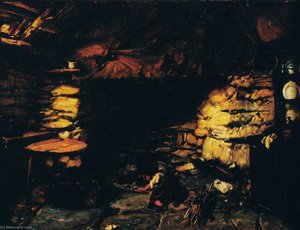
The painting Study of a Boy by Thomas Stuart Smith is a captivating work of art that showcases the artist's skillful brushwork and attention to detail. Measuring 30 x 24 cm, this oil on canvas piece is housed in the prestigious The Stirling Smith Art Gallery - Museum in Stirling, United Kingdom. At OriginalUniqueArt.com, we specialize in creating handmade oil reproductions of famous paintings, including works by renowned artists like Pierre-Auguste Renoir and Henri Matisse.
The use of tartan patterns, as seen in traditional Scottish dress, adds an extra layer of depth to the painting. According to Wikipedia's article on Tartan, this patterned cloth has a rich history dating back to ancient times. The incorporation of such cultural elements highlights Thomas Stuart Smith's attention to detail and his ability to weave together different artistic influences.
Delving into the Artist's Style
Thomas Stuart Smith's style is characterized by his use of bold colors and intricate details. In Study of a Boy, the subject's facial expression is rendered with remarkable precision, inviting the viewer to ponder the emotions behind the portrait. The artist's technique is reminiscent of other notable works, such as Ambroise Vollard Dressed as a Toreador by Pierre-Auguste Renoir, which can be found on our website at Pierre-Auguste Renoir: Ambroise Vollard Dressed as a Toreador.The use of tartan patterns, as seen in traditional Scottish dress, adds an extra layer of depth to the painting. According to Wikipedia's article on Tartan, this patterned cloth has a rich history dating back to ancient times. The incorporation of such cultural elements highlights Thomas Stuart Smith's attention to detail and his ability to weave together different artistic influences.
Exploring the Artistic Heritage
Our collection at OriginalUniqueArt.com features an array of artworks that showcase the diversity of artistic styles and techniques. From the Impressionist works of Pierre-Auguste Renoir to the Expressionist pieces of Wassily Kandinsky, each painting offers a unique perspective on the world. Some notable examples include:- Luxe I Huile sur Toile Paris, Musée d'Art Moderne by Henri Matisse
- Mountain landscape with church by Wassily Kandinsky
Questions & Answers
Is "Study of a Boy" available as a fine art print?
A print of "Study of a Boy" by Thomas Stuart Smith can be ordered directly on its Fine Art Print page: a fine art print on cotton canvas or archival canvas paper.
How is the palette of "Study of a Boy" by Thomas Stuart Smith described?
The colors of "Study of a Boy" form an earthy palette. This classification describes the dominant color families.
Which palette and lead color define "Study of a Boy"?
The color identity of "Study of a Boy" by Thomas Stuart Smith: an earthy palette, dominated by walnut (#8b5137).
More about this painting
 Preview
 Send
Send Share
Share
 Details
 Guide
Guide

 Download
 Similars
 X-Ray
X-Ray Diaporama
 Q&A
Q&A Stats
Stats