Preview
 Send
Send Share
Share
 Details
 Guide
Guide

 Download
 Similars
 X-Ray
X-Ray Diaporama
 Stats
StatsMeg Merilees


 Read More
Giclée / Art Print
Museum-quality giclée or canvas print with fast production and flexible finish options. ( Buy Hand Made Painting Switch to Digital Image)




P118B $10

P118H $10

P118W $10

P438Z $10

P508JH $12

P508YH $12

P805H $10

P805Z $10

P919BZ $10

P919G $10

P919XJ $10

P959ZH $10

P968JZ $12

W106C $8

W218G $10

W218JH $8

W218Y $10

W307PJ $10

W316G $10

W316PJ $8

W316Y $10

W398PJ $8

W4111J $10

W500HY $15

W500JH $15

W692G $12

W849H $8

W940BG $15

W953PJ $8




Pick from our preset sizes that match the artwork's original proportions.

You may enter your own dimensions to fit a specific frame or space. If your selected size does not match the original image's proportions, we will either crop the artwork or extend the image with a mirrored or solid-fill edge. A digital mockup will be sent for your approval before production begins.
Please note that the on-screen preview does not reflect the actual cropping or extension. Only the mockup will accurately show the final composition.
While custom sizes are available, we recommend selecting a dimension from the predefined list to preserve the original proportions.
Worldwide Delivery () in 2 weeks instead of standard 4/5 weeks. (26 September)

Free Worldwide Express Shipping

High-Quality Linen Canvas

Full Shipping Insurance

Customs Tax Refund Guarantee

True Color Matching Guarantee

100-Day Return Policy (Defects Only)

100% Money-Back Guarantee

Bulk Discount Offer
 Glass option is only available in size under 110 CM

Meg Merilees
Giclée / Art Print
Reproduction Size
-


Total Price
$ 81
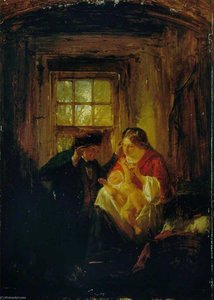
Thomas Faed's "Meg Merilees": A Portrait of Quiet Contemplation
The painting “Meg Merilees,” created in 1861 by the Scottish artist Thomas Faed, offers a poignant glimpse into Victorian sensibilities and the profound beauty of quiet introspection. This oil on panel work, currently residing at the Gracefield Arts Center in Dumfries, is more than just a portrait; it’s an evocative study of human emotion rendered with remarkable sensitivity and technical skill. Faed, a key figure within the Royal Scottish Academy, masterfully captures the sitter's internal world through subtle details – the downward cast gaze, the clasped hands, and the enveloping warmth of the fireplace – creating an atmosphere of serene contemplation that continues to resonate with viewers today.
A Window into Victorian Life
Painted during a period of significant social change in Britain, “Meg Merilees” reflects the values and aesthetics of the mid-19th century. The subject’s attire – a long coat or robe suggesting preparedness for colder weather – speaks to the practical concerns of daily life while simultaneously hinting at a deeper emotional state. Faed's meticulous attention to detail extends beyond mere representation; he skillfully employs light and shadow to create a sense of depth and volume, drawing the viewer into the scene and fostering an immediate connection with the subject. The inclusion of two birds adds a layer of symbolic richness, often associated with peace, hope, or spiritual aspiration – elements frequently explored in Victorian art.
Technique and Materials: A Masterful Reproduction
- Oil on Panel: Faed’s choice of oil paint on panel allowed for a rich, luminous finish, characteristic of the era. The slow drying time of oil paints enabled him to build up layers of color with incredible precision and nuance.
- Detailed Brushwork: Close examination reveals a delicate brushwork, particularly in rendering the textures of the fabric and the subtle gradations of light on the subject’s face.
- Traditional Techniques: OriginalUniqueArt.com's reproductions faithfully recreate these techniques, employing skilled artists who utilize traditional methods to ensure an authentic representation of Faed’s original vision. The use of high-quality materials guarantees a lasting and beautiful reproduction.
Owning a Piece of Art History – A Reproduction by OriginalUniqueArt.com
For art lovers seeking to experience the beauty and emotional depth of “Meg Merilees,” OriginalUniqueArt.com offers exceptional, handmade oil painting reproductions. These aren’t simply copies; they are meticulously crafted works of art that capture the essence of Faed's original masterpiece. Each reproduction is created by skilled artists who painstakingly replicate the color palette, brushwork, and overall atmosphere of the painting. Beyond a beautiful addition to any collection, purchasing a reproduction from OriginalUniqueArt.com supports the continuation of traditional artistic practices and allows you to own a tangible connection to a significant work of 19th-century art. Their services extend beyond simple reproductions, offering custom commissions and framing options to perfectly complement your space and personal taste.
Artist Biography
Giovanni Costa (Nino Costa): A Pioneer of Italian Landscape Painting
Giovanni Costa, known affectionately as “Nino” during his lifetime and later celebrated as Giovanni Costa, was a pivotal figure in the development of Italian landscape painting during the 19th century. Born in Rome on October 15, 1826, into a family deeply rooted in commerce – his father, Gioacchino Costa, had established a successful wool-spinning factory – Costa’s artistic journey began unexpectedly, nurtured by an early encounter with Baron Vincenzo Camuccini, a prominent Neoclassical painter. This initial exposure sparked a lifelong dedication to capturing the essence of the Italian countryside, ultimately influencing a generation of artists known as the Macchiaioli. His life was marked by both artistic passion and fervent patriotism, culminating in his courageous participation in Italy’s unification efforts.Early Influences and Artistic Training
Costa's formal training began at a young age, initially with Vincenzo Camuccini, who instilled in him the importance of direct observation and working from nature. Following his father’s death, he enrolled in the prestigious Collegio Bandinelli, where he studied under Luigi Durantini, Francesco Coghetti, Francesco Podesti, and Filippo Agricola – all esteemed artists of the time. These formative years exposed him to the principles of Neoclassicism while simultaneously encouraging a burgeoning interest in capturing the nuances of the natural world. Crucially, his experiences at the Accademia di San Luca provided access to a vibrant artistic community, fostering experimentation and pushing beyond traditional academic styles. This period laid the groundwork for his distinctive approach – one characterized by loose brushwork, vibrant color, and an emphasis on atmospheric effects.The Macchiaioli and a Revolutionary Style
Costa’s artistic trajectory took a significant turn in the 1850s when he encountered the Macchialoi, a group of Florentine artists who championed a revolutionary approach to painting. Rejecting the meticulous detail favored by earlier generations, the Macchialoi utilized “macchia,” or brushstrokes of pure color applied directly to the canvas – a technique that created a sense of immediacy and spontaneity. Costa embraced this method wholeheartedly, employing it to depict scenes of rural life, shepherds tending their flocks, and the rugged beauty of the Italian landscape. His paintings weren’t intended as photographic representations but rather as evocative impressions, capturing the light, mood, and spirit of the moment. His work served as a major inspiration for many younger artists, establishing him as a key figure in the movement's development.Patriotism and Participation in Italian Unification
Beyond his artistic pursuits, Costa was deeply committed to the cause of Italian unification. He actively participated in several patriotic uprisings, most notably during the revolutions of 1848 and 1870. His dedication culminated in a pivotal moment during the assault on Rome in 1870, where he fearlessly led the charge over the Porta Pia, symbolizing the triumph of the newly unified nation. This act of bravery cemented his place as a national hero and further solidified his reputation as a passionate patriot.Legacy and Notable Works
Giovanni Costa’s legacy extends far beyond his individual paintings. He profoundly influenced a generation of Italian landscape artists, shaping the course of 19th-century painting in Italy. His innovative use of color, brushwork, and atmospheric effects established a new standard for depicting the beauty of the Italian countryside. Notable works include *Donne sulla spiaggia di Porto d’Anzio*, a captivating depiction of women on the beach, and his numerous scenes of rural life that capture the essence of the Italian peasantry. His paintings are characterized by their warmth, vitality, and an undeniable sense of national pride. Costa died in Rome on January 31, 1903, leaving behind a rich artistic legacy that continues to inspire admiration and appreciation today.
thomas faed
1826 - 1900 , United Kingdom
Quick Facts
- Artistic Movement Or Style: Landscape painting
- Artists Or Movements Influenced By This Artist: ['Macchiaioli']
- Artists Who Influenced This Artist:
- Vincenzo Camuccini
- Luigi Durantini
- Francesco Coghetti
- Francesco Podesti
- Filippo Agricola
- Date Of Birth: 15 Oct 1826
- Date Of Death: 31 Jan 1903
- Full Name: Giovanni Costa (Nino Costa)
- Nationality: Italian
- Notable Artworks: ["Donne sulla spiaggia di Porto d'Anzio"]
- Place Of Birth: Rome, Italy
Related Articles
The Timeless Charm of Oil on Board: Reimagining Texture and Light through the Impressionist Lens
Discover the profound intimacy of oil on panel. Explore how Impressionist masters used rigid supports to capture light, texture, and impasto depth through exquisite, handmade oil reproductions for discerning collectors.

The Enduring Legacy of Oil on Canvas: Technique, History & Contemporary Practice
Explore the rich history & enduring techniques of oil painting on canvas. Discover the science behind its longevity, conservation practices, and contemporary relevance. Expert insights for art enthusiasts.

The Enduring Power of Painting: A Historical & Contemporary Exploration of Form and Emotion
Explore the rich history & enduring techniques of oil painting with OriginalUniqueArt. Discover masterpieces, learn about art collecting, and find authentic handmade reproductions crafted by skilled artists.

The Enduring Legacy of Oil on Canvas: Technique, History & Aesthetic Impact
Explore the rich history & techniques of oil painting – from Renaissance masters to Impressionism. Discover pigments, layering methods, and why this timeless medium endures. Expert insights for artists & art enthusiasts.

Oil on Canvas: A Historical & Technical Exploration of a Timeless Artistic Medium
Explore the rich history & enduring techniques of oil painting on canvas. Discover the science behind its longevity, conservation practices, and contemporary relevance. Expert insights for art enthusiasts.