- Home

- Oil Painting Reproduction
- Thomas Eakins
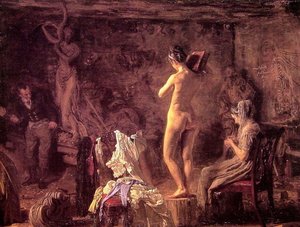
- William Rush Carving His Allegorical Figure of the Schuykill River
 Buy print
 Send
Send Share
Share
 Details

 Download
 Similars
 X-Ray
X-Ray Diaporama
William Rush Carving His Allegorical Figure of the Schuykill River


 Read More
Hand Made Oil Reproduction
Hand-painted oil on canvas in your size and frame, made to order by our artists.




P118B $10

P118H $10

P118W $10

P438Z $10

P508JH $12

P508YH $12

P805H $10

P805Z $10

P919BZ $10

P919G $10

P919XJ $10

P959ZH $10

P968JZ $12

W106C $8

W218G $10

W218JH $8

W218Y $10

W307PJ $10

W316G $10

W316PJ $8

W316Y $10

W398PJ $8

W4111J $10

W500HY $15

W500JH $15

W692G $12

W849H $8

W940BG $15

W953PJ $8




Pick from our preset sizes that match the artwork's original proportions.

You may enter your own dimensions to fit a specific frame or space. If your selected size does not match the original image's proportions, we will either crop the artwork or extend the painting with additional hand-painted elements. A digital mockup will be sent for your approval before production begins.
Please note that the on-screen preview does not reflect the actual cropping or extension. Only the mockup will accurately show the final composition.
While custom sizes are available, we recommend selecting a dimension from the predefined list to preserve the original proportions.
After order, OriginalUniqueArt.com team will email client for instructions and provide a mockup preview
Worldwide Delivery () in 3/4 weeks instead of standard 5 weeks. (16 July). No compromise on quality.

Free Worldwide Express Shipping

High-Quality Linen Canvas

Full Shipping Insurance

Customs Tax Refund Guarantee

True Color Matching Guarantee

60-Day Return Policy (Defects Only)

100% Money-Back Guarantee

Bulk Discount Offer
 Glass option is only available in size under 110 CM

William Rush Carving His Allegorical Figure of the Schuykill River
Reproduction Medium
Reproduction Size
-


Total Price
-
Artwork Description
A Study in Realism: Eakins’s Capturing of American Spirit
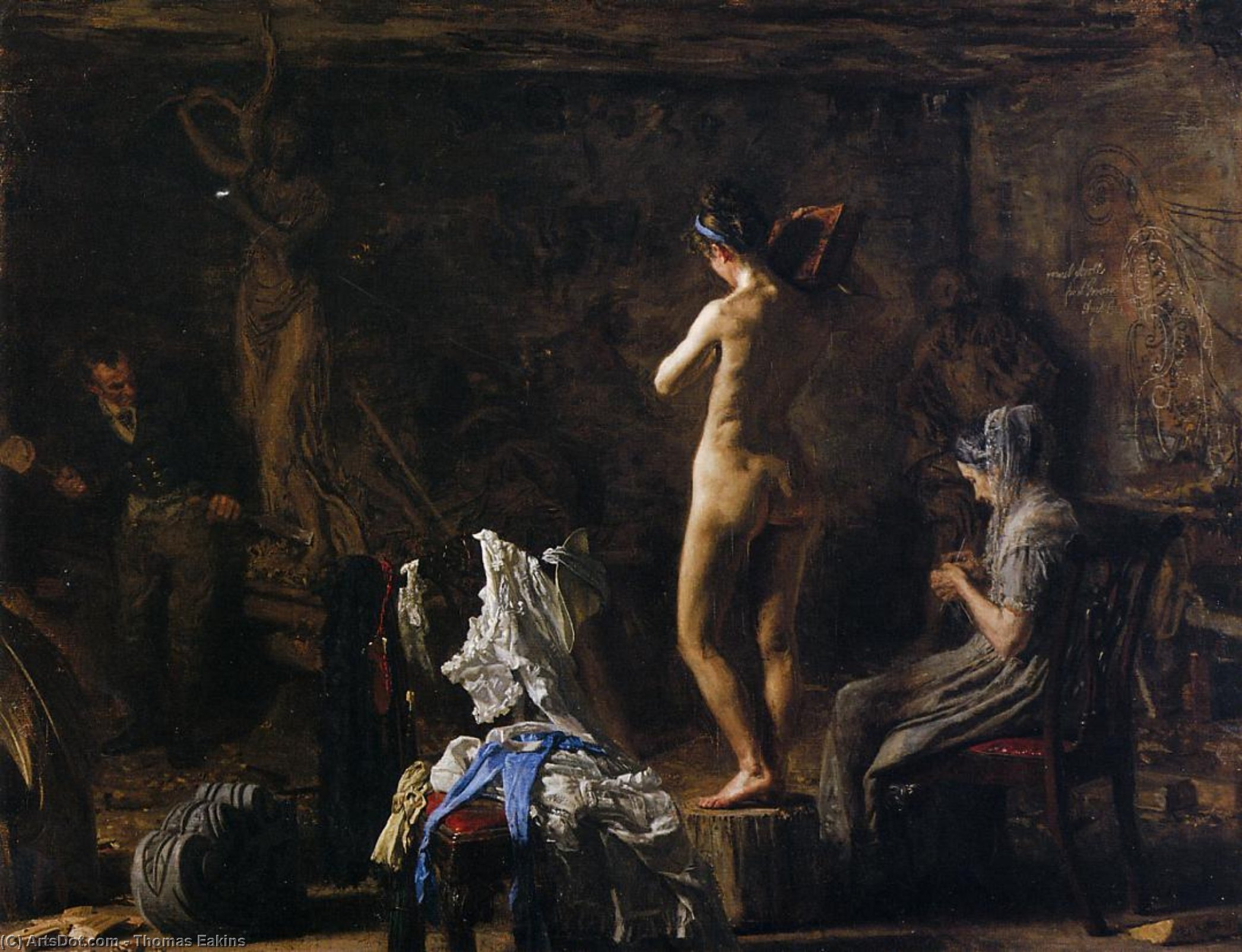
Thomas Eakins's "William Rush Carving His Allegorical Figure of the Schuylkill River" isn’t merely a depiction of an artist at work; it’s a meticulously crafted window into 19th-century Philadelphia, a city brimming with industry, intellectual fervor, and a burgeoning sense of American identity. Painted in 1876-77, this oil on canvas masterpiece transcends the simple act of sculpting to become a profound meditation on craft, observation, and the very essence of the American spirit. Eakins, renowned for his unflinching realism and his dedication to capturing the truth of human experience – often with a touch of provocative honesty – presents us with a scene both familiar and strikingly intimate.
The painting centers around William Rush, a prominent Philadelphia sculptor known for his monumental works adorning public spaces. Eakins doesn’t shy away from portraying Rush in the midst of his creative process, capturing him as he meticulously carves an allegorical figure representing the Schuylkill River – a vital artery supplying water to the city and symbolizing its lifeblood. The composition is remarkably balanced, drawing our eye immediately to Rush's focused expression and the intricate details of his work. Notice how Eakins masterfully employs chiaroscuro, using dramatic contrasts of light and shadow to sculpt the form of the sculpture itself and to highlight the figure of the sculptor, creating a powerful sense of depth and volume.
The Anatomy of Observation: Eakins’s Technique
Eakins's technical prowess is immediately apparent. He was obsessed with accuracy, demanding that his subjects be rendered with an almost scientific precision. This isn’t romanticized idealism; it’s a deliberate effort to dissect and understand the world around him. The painting showcases Eakins’s signature style: a meticulous attention to detail combined with a loose, expressive brushstroke. He doesn't simply paint what he sees; he paints *how* he sees it – capturing the texture of wood grain, the sheen of light on metal, and the subtle nuances of human expression. The use of color is restrained yet effective, allowing the forms and textures to dominate the scene.
Furthermore, Eakins’s choice of medium—oil on canvas—allowed him to build up layers of paint with incredible subtlety, creating a rich, tactile surface that invites close examination. He employed techniques borrowed from his studies in anatomy at Jefferson Medical College, applying principles of perspective and proportion with unwavering accuracy. The background figures, including a young woman observing the scene, are rendered with a similar level of detail, contributing to the overall sense of realism and immediacy.
Symbolism and Context: A Reflection of American Identity
Beyond its technical brilliance, "William Rush Carving His Allegorical Figure of the Schuylkill River" is deeply rooted in the cultural context of 19th-century America. The sculpture itself—representing the river—is a potent symbol of progress and prosperity, reflecting Philadelphia’s growing importance as a center of commerce and industry. Rush's work, like many American artists of his time, sought to establish a distinctly American artistic identity, moving away from European traditions and embracing themes relevant to their own society. The inclusion of the young woman observing Rush adds another layer of meaning, suggesting a dialogue between tradition and modernity, between established artistry and emerging female participation in the arts – a theme that was increasingly challenging societal norms.
Eakins’s decision to paint this scene in a studio setting—rather than on location—further underscores his commitment to capturing the essence of the subject rather than simply documenting its appearance. It's a deliberate act of artistic interpretation, inviting us to contemplate the process of creation and the relationship between artist, subject, and audience. The painting serves as a powerful reminder that art is not merely about representation; it’s about communication, observation, and ultimately, understanding.
Artist Biography
A Life Devoted to Reality
Thomas Cowperthwait Eakins, born in Philadelphia on July 25, 1844, stands as a monumental figure in American art—a painter of unflinching realism who dedicated his life to capturing the essence of human experience. He wasn’t merely interested in *representing* the world; he sought to dissect it, understand its anatomy, both physical and psychological, and then reconstruct it on canvas with an honesty that often bordered on provocation. Eakins's path was not one of immediate acclaim, but rather a slow burn of dedication, controversy, and ultimately, enduring recognition as perhaps the most profound realist in 19th and early 20th-century American art. His Philadelphia wasn’t a city of grand landscapes or romantic ideals; it was a world of doctors, rowers, hunters, and everyday individuals—and these were his subjects, rendered with an almost scientific precision.Early Influences and Artistic Formation
Eakins's upbringing fostered both intellectual curiosity and artistic inclination. His father, Benjamin Eakins, a writing master and calligrapher, instilled in him a love of discipline and meticulous observation. This foundation was further strengthened by his education at Central High School and the Pennsylvania Academy of the Fine Arts, where he excelled in drawing and anatomy—a fascination that would permeate his entire oeuvre. However, it was his time in Europe, particularly under the tutelage of Jean-Léon Gérôme in Paris, that truly shaped his artistic approach. Gérôme’s emphasis on precise draftsmanship and historical accuracy resonated with Eakins's own inclinations, but he quickly moved beyond mere imitation. A sojourn in Spain further refined his understanding of light, shadow, and the power of direct observation. He wasn’t content to simply copy Old Masters; he wanted to understand *how* they achieved their effects, and then apply that knowledge to his own unique vision. This period was crucial in solidifying his commitment to painting directly from life, a practice that would define his career.The Pursuit of Truth: Themes and Techniques
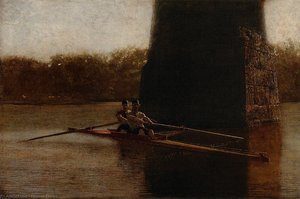
Eakins’s work is characterized by an unwavering commitment to realism—a refusal to idealize or romanticize his subjects. His portraits, numbering several hundred, are not flattering representations designed to appease the sitter; they are penetrating studies of character, revealing both strength and vulnerability. He painted individuals engaged in their professions – surgeons at work in *The Gross Clinic*, rowers straining against the current in *Max Schmitt in a Single Scull*—capturing not just their physical appearance but also the intensity of their focus and the demands of their craft. This dedication to truth extended to his technique. Eakins was fascinated by motion, and he employed innovative methods to capture it accurately. He studied anatomy meticulously, often dissecting cadavers to understand the underlying structure of the human body. He even experimented with photography, using it as a tool for analyzing movement and achieving greater accuracy in his paintings. His use of chiaroscuro—the dramatic contrast between light and dark—further enhanced the sense of realism and psychological depth in his work.Controversy and Legacy
Despite his artistic brilliance, Eakins’s career was marked by controversy. His insistence on painting directly from life, often including nude models, clashed with the conservative sensibilities of Victorian Philadelphia. His teaching methods at the Pennsylvania Academy were equally unconventional; he emphasized the importance of studying the human form from life and encouraged his students to challenge traditional artistic conventions. This led to friction with his colleagues and ultimately resulted in his forced resignation in 1886. Personal scandals further damaged his reputation during his lifetime, leaving him largely ostracized by the art establishment. However, Eakins remained undeterred, continuing to paint and teach privately until his health began to fail. After his death in 1916, his work gradually gained recognition, and he is now celebrated as a pivotal figure in American art history. His unflinching realism, his dedication to anatomical accuracy, and his profound understanding of the human condition continue to inspire artists and captivate audiences today. He left behind not just paintings, but a legacy of artistic integrity and a relentless pursuit of truth—a testament to the power of observation and the enduring beauty of the human form.Key Works and Enduring Influence
Several works stand as hallmarks of Eakins’s genius. *Max Schmitt in a Single Scull* (1871), with its masterful depiction of movement and light, is arguably his most iconic painting. *The Gross Clinic* (1875)*, though controversial at the time for its unflinching portrayal of surgery, remains a powerful testament to the dedication and skill of medical professionals. *William Rush and His Model* (1908) showcases his later style, blending portraiture with allegorical elements. Beyond these specific paintings, Eakins’s influence can be seen in the work of countless artists who followed him—those who sought to capture the world around them with honesty, precision, and a deep understanding of the human spirit. His commitment to realism paved the way for later movements such as Ashcan School and continues to resonate with contemporary artists today. He remains a vital force in American art, a reminder that true artistry lies not in imitation or embellishment, but in the courageous pursuit of truth.
Thomas Eakins
1844 - 1916 , United States of America
Quick Facts
- Artistic Movement Or Style: Realism
- Artists Or Movements Influenced By This Artist: ['American Realism']
- Artists Who Influenced This Artist: ['Jean-Léon Gérôme']
- Date Of Birth: July 25, 1844
- Date Of Death: June 25, 1916
- Full Name: Thomas Eakins
- Nationality: American
- Notable Artworks:
- Max Schmitt in a Single Scull
- The Gross Clinic
- The Swimming Hole
- The Agnew Clinic
- Place Of Birth: Philadelphia, USA
Related Articles
Barbara Hepworth: A Sculptural Dialogue with Form, Space & the Human Condition
Explore the profound world of Barbara Hepworth's sculpture. Discover her artistic evolution, iconic forms, and lasting influence on modern art. A guide for collectors & enthusiasts.

Vladimir Makovsky: Realism, Social Commentary & Russian Life in Late 19th-Century Painting
Explore the captivating world of Vladimir Makovsky, a leading Russian realist painter. Discover his insightful depictions of 19th-century life, social commentary & legacy with OriginalUniqueArt.
R.B.A. John William Godward: A Study in Neoclassical Sensibility & Decadence
Explore the captivating Neo-Classical world of John William Godward. Discover his exquisite paintings, artistic influences, and investment potential. Expert analysis for discerning collectors.
R.A. Benjamin Williams: Victorian Genre Painting & Social Commentary
Explore the captivating world of Benjamin Williams Leader's Victorian genre paintings. Discover his mastery of naturalism, social commentary & lasting influence on British art. Expert insights at OriginalUniqueArt.

Vasily Surikov: Historical Epic & Psychological Realism in 19th-Century Russian Painting
Explore the powerful historical paintings of Vasily Surikov, a leading figure of Russian Realism. Discover his dramatic compositions, psychological depth & lasting influence on 19th-century art. Learn about collecting Surikov's masterpieces.