1904
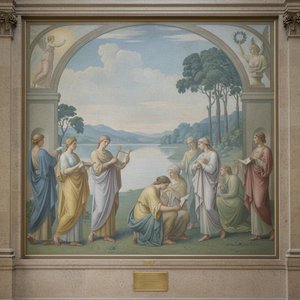
The Salon (Emile Baes, 1904)
Emile Baes (1879–1953) made The Salon. It dates from 1904. It measures 83 × 56 cm.
- 1904
- 83 × 56 cm

 Preview

 Hand Made Oil Painting
 Send
 Share
 Fact sheet


 Download
 Similars
 X-Ray
 Diaporama
 Q&A

 Stats
The Salon, in brief
- Title
- The Salon
- Artist
- Emile Baes (1879–1953)
- Artist born in
- Brussels, Belgium
- Date
- 1904
- Dimensions
- 83 × 56 cm
High-resolution images of The Salon


Emile Baes, The Salon (1904). Public domain.
Questions on The Salon, answered
What is the creation date of "The Salon" by Emile Baes?
"The Salon" by Emile Baes was created in 1904.
What are the dimensions of the original "The Salon" by Emile Baes?
The recorded dimensions of "The Salon" by Emile Baes are 83.0 x 56.0cm. Reproductions can be ordered in other sizes while keeping the same proportions.
Is "The Salon" free of copyright?
The copyright answer for "The Salon" by Emile Baes: the work is in the public domain - its copyright has expired. This determines whether reproductions of the image may be freely made.
Who created "The Salon"?
The artist behind "The Salon" is Emile Baes. The work is catalogued under Emile Baes's name.
How old was Emile Baes when creating "The Salon" in 1904?
When "The Salon" was created in 1904, Emile Baes - born in 1879 - was 25 years old.
Why is the copyright status of "The Salon" what it is?
"The Salon" by Emile Baes is in the public domain - its copyright has expired. Copyright terms are measured from the artist's death, and Emile Baes died in 1953.
About the artist, Emile Baes

1879–1953, Belgium
Emile Baes
A Versatile Master of Form and Line Emile Baes was a prolific Belgian artist whose creative reach extended across many disciplines, including painting, pastel, draughtsmanship, printmaking, and illustration. His diverse body of work encompassed a wide range of subjects, from portraits and landscapes to still lifes, genre scenes, and Orientalist depictions inspired by his travels to Morocco and Egypt. He was particularly noted for his skill in the pastel technique and his production of etchings. His artistic style evolved from his early academic training toward a Post-Impressionist approach, a transition that proved particularly suited to his depictions of nudes, interiors with elegant women, and his series of historical and mythological women known as Princesses d’Amour.
Essays around The Salon
 Echoes of an Era: Exploring Themes & Techniques in 19th-Century PaintingExplore the captivating world of 19th-century painting! Discover Realism & Impressionism's revolutionary techniques, key artists like Manet…
 Alexandre Cabanel: Sensuality, Tradition & the Salon's Embrace of Academic RealismExplore the captivating world of Alexandre Cabanel, master of French Academic painting. Discover his iconic works, Salon success & lasting …
 Pierre Puvis de Chavannes: Symbolism, Mural Painting, and the Pursuit of Ideal BeautyExplore the life & work of Pierre Puvis de Chavannes, a pivotal Symbolist painter renowned for his monumental murals. Discover his aestheti…