Preview
 Send
Send Share
Share
 Details
 Guide
Guide

 Download
 Similars
 X-Ray
X-Ray Diaporama
 Stats
StatsWorkers


 Read More
The artwork displayed on this page is protected by copyright law, which means we cannot legally create or sell an identical reproduction. This protection is enforced under international agreements such as the Berne Convention and by national laws, including those outlined by the U.S. Copyright Law - Title 17.
This method fully complies with copyright regulations because it does not involve copying or duplicating the protected artwork. Instead, it is a creative reinterpretation - a new painting that is influenced by the original but not identical to it.
Giclée / Art Print
Museum-quality giclée or canvas print with fast production and flexible finish options. ( Buy Hand Made Painting Switch to Digital Image)




P118B $10

P118H $10

P118W $10

P438Z $10

P508JH $12

P508YH $12

P805H $10

P805Z $10

P919BZ $10

P919G $10

P919XJ $10

P959ZH $10

P968JZ $12

W106C $8

W218G $10

W218JH $8

W218Y $10

W307PJ $10

W316G $10

W316PJ $8

W316Y $10

W398PJ $8

W4111J $10

W500HY $15

W500JH $15

W692G $12

W849H $8

W940BG $15

W953PJ $8




Pick from our preset sizes that match the artwork's original proportions.

Type the width and the height you need, to fit your frame or your wall. A print can only be cut, never made bigger than the picture, so a size with a different shape loses a part of the image. We send you a digital mockup to approve before we print anything. The picture shown on this page does not show the real cut — only the mockup does.
Worldwide Delivery () in 2 weeks instead of standard 4/5 weeks. (22 October)

Free Worldwide Express Shipping

High-Quality Linen Canvas

Full Shipping Insurance

Customs Tax Refund Guarantee

True Color Matching Guarantee

100-Day Return Policy (Defects Only)

100% Money-Back Guarantee

Bulk Discount Offer
 Glass option is only available in size under 110 CM

Workers
Giclée / Art Print
Reproduction Size
-


Total Price
$ 81
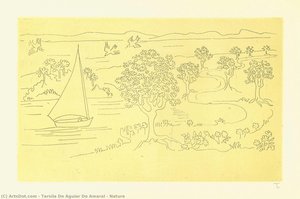
The Soul of the Soil: A Tribute to Labor
In the evocative masterpiece Workers, painted in 1938, Tarsila do Amaral invites us into a profound meditation on the dignity of human toil and the rugged beauty of the Brazilian landscape. This painting serves as more than just a depiction of agricultural life; it is a powerful narrative of connection between man and earth. The composition centers on four laborers positioned upon a verdant, sloping hillside, their presence anchored by the tools of their trade—the heavy hoes and shovels that define their daily existence. While one figure meets the viewer’s gaze with a quiet, piercing intensity, his companions look toward the horizon, suggesting a shared vision of endurance and the vastness of the world they cultivate. The inclusion of distant figures in the background adds a sense of communal scale, reminding us that this scene is but one heartbeat in a much larger cycle of productivity and survival.
The atmosphere of the work is profoundly shaped by its majestic setting. Behind the men, a range of mountains rises against the sky, providing a monumental backdrop that elevates the humble task of farming to something epic and timeless. This interplay between the intimate struggle of the workers and the eternal stillness of the mountains creates a tension that is both grounding and inspiring. For the collector or interior designer, this piece offers a unique emotional depth, bringing a sense of stability, strength, and organic warmth to any space. It is an artwork that does not merely decorate a wall but commands a room with its quiet, resolute spirit.
A Fusion of Modernity and National Identity
To understand Workers, one must look through the lens of Tarsila do Amaral’s revolutionary journey. Having been shaped by the avant-garde movements of Paris—absorbing the structural rigor of Cubism and the dynamic energy of Futurism under masters like Fernand Léger—Tarsila returned to Brazil with a mission to translate these global techniques into a uniquely Brazilian vernacular. In this 1938 work, we see the culmination of that artistic metamorphosis. The painting utilizes a sophisticated approach to form, where the figures possess a certain sculptural weight, yet they are rendered with a color palette and a sense of light that feel deeply rooted in the tropical landscape.
The technique reflects a masterful command over composition and symbolic weight. There is a rhythmic quality to the way the men are placed across the hillside, creating a visual flow that leads the eye from the foreground laborers toward the distant peaks. This structural clarity makes the painting an exceptional choice for high-quality reproductions, as the bold shapes and striking contrasts remain impactful even when scaled for different interior environments. The work stands as a testament to the Antropofagia (Anthropophagy) movement's ideals—the idea of consuming foreign influences to create something entirely new and authentically local. It is an invitation to celebrate heritage, resilience, and the enduring beauty of the natural world.
Questions & Answers
What subjects appear in "Workers" by Tarsila do Amaral?
The subjects of "Workers" are laborers, agriculture, field workers, mountains, brazilian art, hard work, portrait.
What stage of Tarsila do Amaral's career does "Workers" (1938) belong to?
The 1938 date places "Workers" in the Mature Period of Tarsila do Amaral's development.
Where can I see the original "Workers" by Tarsila do Amaral?
The original "Workers" by Tarsila do Amaral is held at the Museu de Valores do Banco Central do Brasil, Brasília, Brazil. A reproduction allows the work to be displayed at home.
Artist Biography
A Brazilian Visionary: The Life and Art of Tarsila do Amaral
Tarsila do Amaral emerged as a pivotal figure in the vibrant tapestry of early 20th-century Brazilian art, a painter who dared to distill the essence of her nation’s identity onto canvas with bold colors and an innovative spirit. Born on September 1, 1886, in Capivari, São Paulo, into a prosperous coffee-producing family, Tarsila's upbringing afforded her opportunities uncommon for women of her time. This privilege allowed her to pursue artistic training, initially under the guidance of Pedro Alexandrino Borges before embarking on a transformative journey to Paris in 1920. It was within the walls of the Académie Julian and later the Académie Moderne that she encountered the avant-garde currents reshaping the art world – Cubism, Futurism, and Expressionism – influences that would profoundly shape her artistic trajectory. The mentorship of Fernand Léger, Albert Gleizes, and André Lhote proved particularly impactful, encouraging her to synthesize European modernism with a distinctly Brazilian sensibility.Forging a National Identity Through Art
Upon returning to Brazil in the early 1920s, Tarsila became a central force in defining a uniquely Brazilian modernist tradition. She wasn’t simply importing European styles; she was actively seeking to create an art that spoke to the soul of her nation, reflecting its landscapes, people, and cultural complexities. This quest led her to collaborate with a group of like-minded artists and intellectuals – Anita Malfatti, Menotti Del Picchia, Mário de Andrade, and Oswald de Andrade – collectively known as *Grupo dos Cinco*. Together, they challenged conventional artistic norms and spearheaded a movement that sought to break free from academic constraints and embrace a new visual language. Tarsila’s contribution was particularly significant in articulating this vision through her paintings, which often depicted scenes of Brazilian life with a dreamlike quality and vibrant palette.The Power of *Abaporu* and the Antropofagia Movement
Perhaps no single work embodies Tarsila's artistic philosophy more powerfully than *Abaporu* (1928). This iconic painting, depicting a solitary figure with oversized feet seated amidst a surreal landscape, became the catalyst for one of Brazil’s most influential cultural movements: Antropofagia – or “cannibalism.” Inspired by Oswald de Andrade's manifesto of the same name, Antropofagia proposed that Brazilian artists should "devour" foreign influences and transform them into something uniquely their own. *Abaporu* visually captured this concept, representing a rejection of colonial imitation and an embrace of cultural hybridity. The painting’s imagery – the large feet rooted in the land, the enigmatic expression – resonated deeply with a nation grappling with its identity in the wake of independence. It wasn't merely a work of art; it was a declaration of artistic sovereignty. Beyond *Abaporu*, works like *A Negra* (1923) and *Morro da Favela* demonstrated her engagement with social themes, portraying marginalized communities and challenging prevailing societal norms.Legacy and Enduring Influence
Throughout her long and prolific career, Tarsila do Amaral continued to explore the complexities of Brazilian identity through a diverse body of work. Her paintings are characterized by their bold colors, simplified forms, and dreamlike atmosphere, often blending elements of realism with surrealism and abstraction. She didn’t shy away from experimentation, constantly evolving her style while remaining true to her core vision. Her influence extended beyond the realm of painting, inspiring generations of Brazilian artists and shaping the nation's cultural landscape. Today, Tarsila do Amaral’s works are held in prestigious collections worldwide, including the Museu de Valores do Banco Central do Brasil and the Museu de Arte do Rio Grande do Sul. Her art continues to captivate audiences with its vibrant energy, poetic imagery, and profound exploration of what it means to be Brazilian. She passed away on January 17, 1973, leaving behind a legacy as one of Latin America’s most important modernist artists – a visionary who dared to paint her nation's soul.
Tarsila do Amaral
1886 - 1973 , Brazil
Quick Facts
- Full Name: Tarsila do Amaral
- Nationality: Brazilian
- Date Of Birth: 1886
- Date Of Death: 1973
- Place Of Birth: Cachoeira do Sul, Brazil
- Notable Artworks:
- Abaporu
- A Negra
- Morro da favela
- Urutu Snake
- Landscape VII
- Artistic Movement Or Style: Brazilian Modernism
- Artists Who Influenced This Artist:
- Fernand Léger
- Albert Gleizes
- André Lhote
- Artists Or Movements Influenced By This Artist: ['Antropofagia movement']
Related Articles
Beyond the Brushstroke: A Definitive Guide to the Emotional Power of Color Field Painting
Explore the profound history and emotional depth of Color Field painting. From Mark Rothko to Barnett Newman, discover how pure color redefined modern art through our expert-led guide for students and collectors alike.
Chromatic Atmospheres: Exploring the Subtleties of Color Field Painting's Emotional Resonance
Explore the profound world of Color Field painting with OriginalUniqueArt. Discover key artists like Rothko & Newman, its philosophical roots, and lasting impact on modern art. Expert insights for collectors.

Chromatic Atmospheres: Exploring the Evolution & Impact of Color Field Painting
Explore the captivating world of Color Field painting! Discover its origins, key artists like Rothko & Newman, philosophical depth, and lasting influence on modern art. Expert insights for collectors.
Benedito Calixto: A Brazilian Modernist's Landscape of Memory & National Identity
Explore the captivating world of Benedito Calixto, a pivotal Brazilian Modernist painter. Discover his iconic landscapes, the story behind the famous Bandeirante portrait, and his lasting impact on Brazilian national identity. Learn more at OriginalUniqueArt.
Anthony Vandyke Copley Fielding: Rediscovering a Master of Romantic Landscape
Discover the captivating landscapes of Anthony Vandyke Copley Fielding, a master of Romantic watercolour painting. Explore his life, technique, and legacy with OriginalUniqueArt – your source for museum-quality art reproductions & expert appraisal.