Art Deco · 1929
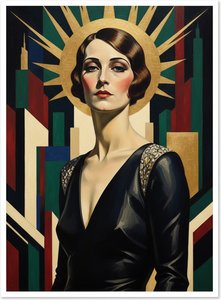
Andromeda (Tamara de Lempicka, 1929)
Tamara de Lempicka (1898–1980) made Andromeda. It dates from 1929. It belongs to the Art Deco movement.
- 1929

 Preview

 Hand Made Oil Painting
 Send
 Share
 Fact sheet


 Download
 Similars
 X-Ray
 Diaporama
 Q&A

 Stats
Andromeda, in brief
- Title
- Andromeda
- Artist
- Tamara de Lempicka (1898–1980)
- Artist born in
- Warsaw, Poland
- Date
- 1929
- Movement
- Art Deco
- Subject
- flowers
High-resolution images of Andromeda

Protected by copyright: these files are for personal reference, not a licence to republish.
Tamara de Lempicka, Andromeda (1929).
Questions on Andromeda, answered
In what year was "Andromeda" by Tamara de Lempicka created?
"Andromeda" dates from 1929. The date places the work within Tamara de Lempicka's career and its era.
What does "Andromeda" by Tamara de Lempicka depict?
"Andromeda" by Tamara de Lempicka depicts: flowers.
Is "Andromeda" by Tamara de Lempicka in the public domain?
Regarding copyright, "Andromeda" is still protected by copyright.
Which artist is "Andromeda" attributed to?
"Andromeda" was created by Tamara de Lempicka. The information on this page describes Tamara de Lempicka's original work.
What style does "Andromeda" belong to?
"Andromeda" by Tamara de Lempicka belongs to the Art Deco movement. This movement provides the stylistic context of the work.
At what age did Tamara de Lempicka make "Andromeda"?
When "Andromeda" was created in 1929, Tamara de Lempicka - born in 1898 - was 31 years old.
Why is the copyright status of "Andromeda" what it is?
"Andromeda" by Tamara de Lempicka is still protected by copyright. Copyright terms are measured from the artist's death, and Tamara de Lempicka died in 1980.
About the artist, Tamara de Lempicka

1898–1980, Poland
Tamara de Lempicka
The Aristocrat of the Jazz Age Born Maria Teresa Górska in Warsaw, Poland, the woman who would become known to the world as Tamara de Lempicka lived a life that mirrored the sharp, polished edges of her own canvases. Her early years were spent within the sophisticated circles of a wealthy Polish-Jewish family, a world of European spas and high society that instilled in her a lifelong devotion to elegance. This sheltered existence was upended by the tremors of the Russian Revolution, forcing her and her husband, Tadeusz Łempicki, to flee toward the promise of Paris. In the city of light, she sought to reinvent herself, adopting a name that carried a certain aristocratic weight, and began to transform from a socialite into a professional force.
About Tamara de Lempicka Notable works by Tamara de Lempicka
Also by Tamara de Lempicka
 in the Green Bugatti
 Self-Portrait in the Green Bugatti1925
 Portrait of Marjorie Ferry1932
 Adam and Eve1932
Essays around Andromeda
 10 Iconic Art Deco Masterpieces That Defined an EraExplore 10 iconic Art Deco masterpieces and their stories. Discover museum-quality art on OriginalUniqueArt.com.
 Art Nouveau vs. Art Deco: Understanding the Two Great Decorative StylesMaster the differences between Art Nouveau and Art Deco through expert historical analysis. Discover the visual language of these iconic er…
 Tamara de Lempicka: Art Deco Iconoclasm & the Construction of Modern FemininityExplore the captivating world of Tamara de Lempicka, Art Deco icon. Discover her life, groundbreaking paintings, and lasting influence on m…