Preview
 Send
Send Share
Share
 Details
 Guide
Guide

 Download
 Similars
 X-Ray
X-Ray Diaporama
 Q&A
Q&A Stats
StatsKiller pink


 Read More
The artwork displayed on this page is protected by copyright law, which means we cannot legally create or sell an identical reproduction. This protection is enforced under international agreements such as the Berne Convention and by national laws, including those outlined by the U.S. Copyright Law - Title 17.
This method fully complies with copyright regulations because it does not involve copying or duplicating the protected artwork. Instead, it is a creative reinterpretation - a new painting that is influenced by the original but not identical to it.
Giclée / Art Print
Museum-quality giclée or canvas print with fast production and flexible finish options. ( Buy Hand Made Painting Switch to Digital Image)




P118B $10

P118H $10

P118W $10

P438Z $10

P508JH $12

P508YH $12

P805H $10

P805Z $10

P919BZ $10

P919G $10

P919XJ $10

P959ZH $10

P968JZ $12

W106C $8

W218G $10

W218JH $8

W218Y $10

W307PJ $10

W316G $10

W316PJ $8

W316Y $10

W398PJ $8

W4111J $10

W500HY $15

W500JH $15

W692G $12

W849H $8

W940BG $15

W953PJ $8




Pick from our preset sizes that match the artwork's original proportions.

Type the width and the height you need, to fit your frame or your wall. A print can only be cut, never made bigger than the picture, so a size with a different shape loses a part of the image. We send you a digital mockup to approve before we print anything. The picture shown on this page does not show the real cut — only the mockup does.
Worldwide Delivery () in 2 weeks instead of standard 4/5 weeks. (30 October)

Free Worldwide Express Shipping

High-Quality Linen Canvas

Full Shipping Insurance

Customs Tax Refund Guarantee

True Color Matching Guarantee

100-Day Return Policy (Defects Only)

100% Money-Back Guarantee

Bulk Discount Offer
 Glass option is only available in size under 110 CM

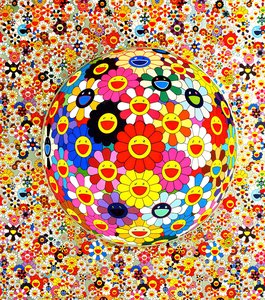
Killer pink
Giclée / Art Print
Reproduction Size
-


Total Price
$ 81
A Surface of Smiling Faces
Step closer and observe the way these flowers occupy the space. There is a certain flatness here, a deliberate lack of depth that pulls your eye across the surface rather than into it. Each bloom carries a wide, grinning face, arranged in a dense, kaleidoscopic pattern that seems to swarm across the gray background. The colors are intense—pinks ranging from soft pastels to electric neons—yet they feel strangely contained by the neutral backdrop. It is a composition of repetition. You might notice how the flowers appear almost as individual screens, each one beaming a fixed expression of joy directly at you.
The technique relies on a precise, clean application. Using 4c offset print with special gold and UV white, the artist achieves a slickness that feels almost artificial. There are no visible brushstrokes to interrupt the gaze; instead, there is only the immaculate, uniform layer of color. This smoothness creates a tension between the cheerful subject matter and the hyper-real, manufactured finish of the print.
The Duality of the Superflat
This work exists within the framework of the Superflat theory, where the boundaries between high art and low culture are intentionally blurred. The imagery draws heavily from the aesthetics of Japanese anime and manga, utilizing the kawaii or cute culture to engage the viewer. However, beneath the cheerful exterior of these smiling blossoms lies a more complex layer of meaning. The proliferation of such relentless positivity can be read as a way to mask deeper anxieties or even as a commentary on the nature of consumerism.
There is an unsettling quality to this muchness. While the flowers are undeniably pretty, their wide-eyed, unblinking expressions carry a sense of unease. It is a study in contradictions: the sweetness of the floral motifs paired with a sense of something more disturbing lurking just beneath the surface. The work does not ask you to look past the surface, but rather to consider what that surface is attempting to hide.
Questions & Answers
Who is "Killer pink" by Takashi Murakami recommended for as a gift?
As a present, "Killer pink" by Takashi Murakami is suggested for birthday. Other occasions can fit as well.
How do I download the image of "Killer pink" by Takashi Murakami?
The image of "Killer pink" by Takashi Murakami can be downloaded from the artwork's Download page: a high-resolution digital image download.
What color leads the composition of "Killer pink" by Takashi Murakami?
gray (#6b8492) is the leading color of "Killer pink" by Takashi Murakami.
Artist Biography
A Universe of Superflat: The World of Takashi Murakami
Born in Tokyo in 1962, Takashi Murakami emerged as a pivotal figure in contemporary art, challenging conventional boundaries and forging a unique aesthetic language that resonates globally. His journey began with a childhood fascination for anime and manga, initially fueling aspirations to work within the animation industry. This early passion would profoundly shape his artistic vision, but his formal training took an unexpected turn when he enrolled at Tokyo University of the Arts. Though intending to hone skills applicable to animation, Murakami ultimately gravitated towards Nihonga, the traditional Japanese painting style steeped in centuries-old techniques and philosophical underpinnings. He excelled, earning a Ph.D., yet found himself increasingly disillusioned by its insular nature and rigid adherence to established norms. This dissatisfaction sparked a period of exploration, leading him to venture beyond tradition and embrace the dynamic possibilities of contemporary art.From Critique to Creation: The Genesis of Superflat
Murakami’s initial artistic explorations were rooted in social critique and satire, evident in projects like the Osaka Mixer Project (1992) and the Randoseru project (1991). These early works demonstrated a keen awareness of societal structures and a willingness to challenge them through art. A crucial turning point arrived with the introduction of “Mr. DOB,” a recurring motif that evolved into a form of self-portraiture, embodying both personal identity and broader cultural anxieties. The year 1994 proved transformative; a fellowship from the Asian Cultural Council facilitated his participation in the PS1 International Studio Program in New York City. Exposure to Western contemporaries like Anselm Kiefer and Jeff Koons broadened his perspective and ignited new creative avenues. It was during this period that the concept of “Superflat” began to crystallize, culminating in his groundbreaking 2000 exhibition at MOCA Los Angeles. Superflat wasn’t merely an aesthetic style; it was a theoretical framework positing a historical continuity of flattened imagery within Japanese art—from the elegant simplicity of Ukiyo-e woodblock prints to the vibrant dynamism of manga and anime. Murakami argued that post-war Japanese society had experienced a “flattening” of social classes, blurring distinctions between high and low culture, and this phenomenon was reflected in the visual landscape.Influences and Themes: A Tapestry of Culture
Murakami’s artistic universe is built upon a rich tapestry of influences. The stylized characters and vibrant color palettes of anime and manga are immediately apparent, lending his work a playful yet unsettling quality. He draws inspiration from the Pop Art movement, particularly its embrace of mass-produced imagery and consumer culture references, but infuses it with a distinctly Japanese sensibility. The flat perspective and bold compositions found in his paintings echo the legacy of Ukiyo-e, traditional Japanese woodblock prints renowned for their exquisite craftsmanship and evocative depictions of everyday life. A central theme in Murakami’s work is the complex relationship between consumerism and commercialization. He deliberately blurs the lines between fine art and commercial products, creating merchandise like plush toys and t-shirts—a provocative gesture that challenges traditional notions of artistic value and authorship. His exploration extends to Japanese subcultures, particularly otaku culture, incorporating elements of anime, manga, video games, and a fascination with all things cute or kawaii.Achievements and Legacy: A Global Impact
Takashi Murakami’s impact on the art world is undeniable. He founded Kaikai Kiki Co., Ltd., not only as a platform for his own work but also as a nurturing environment for younger artists, overseeing various projects and fostering a collaborative spirit. The Geisai art fair, which he organized, provided an invaluable launching pad for emerging Japanese talent. His exhibitions in major galleries and institutions worldwide have cemented his international recognition, while collaborations with luxury brands like Louis Vuitton—designing iconic handbags adorned with his signature motifs—have further blurred the boundaries between high art and commercial design. His work is now held in prominent museum collections globally, solidifying his status as a leading contemporary artist. Murakami’s “Superflat” theory has profoundly impacted contemporary art discourse, offering a fresh perspective on Japanese artistic traditions and post-war culture. He challenged conventional notions of artistic value by integrating commercial elements into his practice, influencing the development of Pop Art and consumer culture in art. His work helped introduce Japanese subcultures to a global audience, fostering cross-cultural understanding and appreciation. Takashi Murakami’s innovative approach continues to inspire countless artists and shape the landscape of contemporary art for generations to come.
Takashi Murakami
1962 - , Japan
Quick Facts
- Full Name: Takashi Murakami
- Nationality: Japanese
- Date Of Birth: 1962
- Place Of Birth: Tokyo, Japan
- Notable Artworks:
- Tan tan bo
- The world of sphere
- Flowers Have Bloomed
- Artistic Movement Or Style: Superflat, Neo-Pop
- Artists Who Influenced This Artist:
- Anselm Kiefer
- Jeff Koons
- Artists Or Movements Influenced By This Artist:
- Pop Art
- Contemporary art
Related Articles

The Soup Can Swindle: What Pop Art Actually Is, What It Actually Costs, and Why the Critics Who Hated It Were Wrong Twice
Uncover the truth behind Pop Art. From Warhol's soup cans to Lichtenstein's dots, explore the real history, the debate over its value, and expert advice on buying authentic reproductions vs. prints. Master the art of collecting with insights from OriginalUniqueArt experts.

What Is Pop Art — and What Should It Cost You? A Buyer's Guide to Style, Dots and Editions
Master the art of Pop Art with our expert buyer's guide. Learn to distinguish between Warhol’s silkscreens and Lichtenstein’s Ben-Day dots, understand true market pricing, and discover how to invest in high-quality reproductions and hand-painted canvases for your collection.

What Is Pop Art, and What Should It Cost You? A Buyer's Guide to Style, Dots, and Editions
Master the world of Pop Art with OriginalUniqueArt's expert buyer's guide. Learn to distinguish between Warhol-style silkscreens and Lichtenstein dots, understand true market pricing, and discover how to invest in high-quality reproductions and hand-painted canvases for your collection.