Read More


 For artworks or reproductions larger than 105 cm (approximately 41 inches) on any side, the frame will be shipped as a kit, disassembled. This method ensures safe delivery and prevents damage during transport.


More about this painting
Text size

() ·
A painting made for you, by hand
Hand Made Oil Reproduction
Hand-painted oil on canvas in your size and frame, made to order by our artists. ( Switch to Print Switch to Digital Image)
Artist Biography
Explore the exquisite botanical art of Sydenham Teast Edwards (1768-1819). Welsh artist known for detailed floral paintings, including roses & lobelias. Discover his work!
from ·
Chapter 1
How large should it be?
Slide to change the size; the picture on the left shows the frame at its real width. The proportions of the original are kept.
Standard
custom
CM
INCH
Pick from our preset sizes that match the artwork's original proportions.
Loading sizes...

width
height
Type the width and the height you need, to fit your frame or your wall. This is hand-painted, so for a size with a different shape the artist can paint a bit more around the picture, or cut a bit — you choose. We send you a digital mockup to approve before the painting starts. The picture shown on this page does not show the real result — only the mockup does.
Chapter 2
How should it arrive?
Choose the edges of the stretched canvas
Choose your frame

White $1

Blurside $1

Extended $1

P118B $10

P118H $10

P118W $10

P438Z $10

P508JH $12

P508YH $12

P805H $10

P805Z $10

P919BZ $10

P919G $10

P919XJ $10

P959ZH $10

P968JZ $12

W106C $8

W218G $10

W218JH $8

W218Y $10

W307PJ $10

W316G $10

W316PJ $8

W316Y $10

W398PJ $8

W4111J $10

W500HY $15

W500JH $15

W692G $12

W849H $8

W940BG $15

W953PJ $8

H24-GOLD $30

H24-SILVER $30

H36-GOLD $45

H36-SILVER $45
Framed
Moulding: . Overall size with the frame: .
Chapter 3
Who paints it, and should anything change?
Examples of what can be changed: Replace face with customer photo; Add pet (e.g., replace cat with dog); Include hidden message in background; Change background landscape or elements.
After order, OriginalUniqueArt.com team will email client for instructions and provide a mockup preview
After order, OriginalUniqueArt.com team will email client for instructions and provide a mockup preview
Worldwide Delivery () in 3/4 weeks instead of standard 5 weeks. (30 October). No compromise on quality.
Chapter 4
The finishing touches
A nameplate, as in a museum?
Engraved Bronze Plaque Details
This elegant plaque features the artist's name and the title of the artwork, finely engraved for a timeless presentation.
It is made from bronze with a refined, elegant finish. The text is precisely laser-engraved for a sharp and permanent result. Measuring 9x2 cm, the plaque is compact yet easy to read. It's built to be durable and scratch-resistant, offering a professional, museum-quality look. Mounting is simple thanks to the included adhesive backing.
Transparent Acrylic Plaque Details
The plaque includes essential engraved details such as the artist's name, the title of the artwork, the date it was created, the type of media used-like oil on canvas or watercolor-a brief description of the piece, and a QR code that links to the complete artwork information.
It is crafted from clear acrylic, offering a sleek, modern appearance. The text is UV-engraved in black to ensure strong visual contrast. With a size of 10x15 cm, it ensures optimal readability. It comes equipped with two metal hooks for secure wall mounting. The plaque is designed to be weather-resistant, making it suitable for various environments, and it includes interactive features that work seamlessly with smartphone scanning.
Black Acrylic Plaque Details
This elegant plaque includes engraved information such as the artist's name, the title of the artwork, the date it was created, the type of media used (like oil on canvas or watercolor), a short description of the artwork, and a QR code for quick access to more information.
The plaque itself is made from refined black acrylic with a premium finish. The text is laser-engraved in white for high contrast and readability. Its size is 10x15 cm, designed to be easy to read. It comes with two metal hooks for professional mounting. The design is sleek and fits any interior style. It is also weather-resistant and durable, with built-in digital integration for mobile compatibility.
A protective varnish?
When do you need it?
Chapter 5
Your painting, as you ordered it
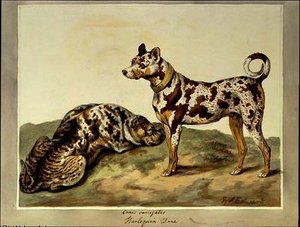
The terrier
Reproduction Medium
Reproduction Size
-
Elite Senior Artist
More detail, finesse, and extra production time
-
Reproduction Frame
-
-
For artworks or reproductions larger than 105 cm (approximately 41 inches) on any side, the frame will be shipped as a kit, disassembled. This method ensures safe delivery and prevents damage during transport.
Professional assembly required - this is not a DIY product.
The kit must be assembled and the canvas stretched by an experienced professional framer, using wood glue (not supplied), a canvas stretching plier and clamps to hold the bars square while the glue dries. Incorrect assembly or uneven canvas tension can permanently damage the artwork and is not covered by our warranty.
All solid wood bars are included, precisely cut to size.
Assembled with the screws provided, plus wood glue for the corner joints, which is not supplied and must be sourced by your framer.
Professional tools are required and not included: a canvas stretching plier (tensioner) and clamps to hold the bars square while the glue dries.
Important:
The corner joints require wood glue, the bars must be held with clamps until the glue is fully dry, and tightening the canvas on the assembled frame requires a canvas stretching plier. None of these are included in the kit. Please arrange an experienced professional framer before ordering this size.
Nameplate
-
-
Protective Varnish
Glossy Varnish (enhances colors, protects against light/moisture)
-
Customize My Artwork
Examples of what can be changed: Replace face with customer photo; Add pet (e.g., replace cat with dog); Include hidden message in background; Change background landscape or elements.
-
Urgent
Worldwide Delivery () in 3/4 weeks instead of standard 5 weeks. (30 October). No compromise on quality.
-
Express Shipping
Worldwide Delivery () in 5 weeks. (6 November).
Included
Total Price
$ 300
Glass option is only available in size under 110 CM
Included with every order
- Free Worldwide Express Shipping
- High-Quality Linen Canvas
- Full Shipping Insurance
- Customs Tax Refund Guarantee
- True Color Matching Guarantee
- 100-Day Return Policy (Defects Only)
- 100% Money-Back Guarantee
- Bulk Discount Offer
 Preview
 Send
Send Share
Share
 Details
 Guide
Guide

 Download
 Similars
 X-Ray
X-Ray Diaporama
 Q&A
Q&A Stats
StatsIn numbers
- 29frames to choose from
- standard sizes, in its own proportions
- 5weeks to paint and deliver it
About the original
Sydenham Teast Edwards
1768 - 1819, United Kingdom
Quick facts about Sydenham Teast Edwards
- Full Name: Sydenham Teast Edwards
- Nationality: British
- Date Of Birth: 1768
- Date Of Death: 1819
- Place Of Birth: Monmouthshire, United Kingdom
- Notable Artworks:
- Studies Of Insects
- Shells And Marine Flora
- Artistic Movement Or Style: Botanical Art
- Artists Who Influenced This Artist: ['William Curtis']
- Artists Or Movements Influenced By This Artist: ['The Pre-Raphaelites']
Artist Biography
Sydenham Teast Edwards (1768 – 1819): A Welsh Botanical Pioneer
Sydenham Teast Edwards, born in Brynbuga (Usk), Monmouthshire, on August 5th, 1768, was a natural history illustrator whose meticulous depictions of flora and fauna cemented his place as one of the most prolific botanical artists of the Regency era. His life’s work—characterized by an unwavering dedication to scientific observation combined with artistic brilliance—continues to inspire admiration for its precision and beauty.Early Life and Artistic Training
Edwards' formative years were spent in a household steeped in musical tradition, thanks to his father Lloyd Pittell Edwards, who served as organist at Usk and Abergavenny Grammar School. This upbringing fostered a keen appreciation for detail and meticulous craftsmanship—skills that would prove invaluable to his artistic pursuits. Recognizing his talent early on, William Curtis, botanist and author of *Flora Londinensis*, invited Edwards to London where he received instruction in drawing from the renowned artist John Ruskin.Early Life and Artistic Training
Sydenham Teast Edwards was born in Brynbuga (Usk), Monmouthshire, on August 5th, 1768, son of Lloyd Pittell Edwards, a schoolmaster and organist at Usk and Abergavenny Grammar School, and Mary Reese. His father instilled in him a love for learning and observation—qualities that would prove invaluable to his future artistic endeavors. From an early age, Edwards demonstrated exceptional talent as a draughtsman, capturing the beauty of the Welsh countryside with remarkable accuracy. Recognizing this potential, William Curtis, botanist and author of *Flora Londinensis*, invited Edwards to London where he was instructed in botanical illustration and began collaborating on groundbreaking scientific projects.Early Life and Education
Edwards’s formative years were spent in Usk, Monmouthshire, where he received a comprehensive education focused on classical studies and natural history. His father, Lloyd Pittell Edwards, served as schoolmaster and organist at Usk and Henry VIII Grammar School, fostering Sydenham's intellectual curiosity and artistic talent from an early age. Mary Reese, his mother, was a sister of William Reece, the curate of Llantilio Crossenny Church, who married in 1765. This familial connection instilled in him a deep appreciation for Welsh culture and tradition.Early Life and Education
Sydenham Teast Edwards was born in Brynbuga (Usk), Monmouthshire, on August 5th, 1768. His father, Lloyd Pittell Edwards, was a schoolmaster and organist at Usk and Henry VIII Grammar School, nurturing Sydenham’s artistic inclinations from a young age. Mary Reese, his mother, was a sister of William Reece, the curate of Llantilio Crossenny Church who had married shortly before Sydenham's birth. The family resided in a comfortable home overlooking the River Usk, fostering an environment conducive to intellectual curiosity and creative pursuits. His early education focused on classical subjects, equipping him with a foundational understanding of art history and scientific observation—skills that would prove invaluable throughout his career as a botanical illustrator. ## Early Life and Education Sydenham Teast Edwards was born in Monmouthshire, Wales, on August 5th, 1768. His father, Lloyd Pittell Edwards, served as schoolmaster and organist at Usk and Abergavenny, fostering a lifelong appreciation for both intellectual pursuits and musical artistry. Mary Reese, his mother, was a sister of William Reece, the curate of Llantilio Crossenny Church who married shortly before Sydenham’s birth. From an early age, Edwards demonstrated exceptional artistic talent—a gift nurtured by his family's encouragement and honed through diligent practice. Recognizing this potential, William Curtis, botanist and author of *Flora Londinensis*, invited him to London where he was instructed in botanical illustration and began collaborating with James Sowerby and William Kilburn on groundbreaking scientific projects.Early Life and Education
Sydenham Teast Edwards was born in Brynbuga (Usk), Monmouthshire, Wales, in 1768, the son of Lloyd Pittell Edwards, a schoolmaster and organist at Usk and Abergavenny, and Mary Reese. His father’s educational background instilled in him a lifelong appreciation for learning and observation—skills that would prove invaluable to his artistic pursuits. Early life experiences fostered a deep connection with the natural world, shaping his fascination with botany and zoology. ## Early Life and Artistic Training Edwards received his initial artistic training from William Curtis, botanist and author of *Flora Londinensis*, who recognized his exceptional talent as a draughtsman. Curtis invited Edwards to London where he honed his skills under Curtis’s guidance, focusing on botanical illustration techniques—a pivotal moment that cemented his future career path. This mentorship instilled in him a meticulous approach to observation and representation, characteristics that would define his distinctive style. ## Botanical Illustration: A Legacy of Detail Sydenham Teast Edwards achieved renown as one of the most prolific and talented botanical artists of his era. His contribution to *The Botanical Magazine* and *Flora Londinensis*, alongside collaborations with James Sowerby and William Kilburn, resulted in nearly 1,721 watercolor drawings showcasing exquisite precision and artistic sensitivity. He meticulously captured the nuances of plant form and color, elevating botanical illustration into a respected art form. His work exemplifies the Romantic spirit's fascination with nature and scientific observation.Early Life and Education
Sydenham Teast Edwards was born in Brynbuga (Usk), Monmouthshire, Wales, on August 5th, 1768, to Lloyd Pittell Edwards, a schoolmaster and organist at Usk and Abergavenny, and Mary Reese. His father instilled in him a love for learning and music—a foundation that would profoundly shape his artistic pursuits. From an early age, Edwards demonstrated exceptional drawing talent, attracting the attention of William Curtis, botanist and author of *Flora Londinensis*. Recognizing his potential, Curtis invited Edwards to London where he was instructed in botanical illustration and began collaborating on groundbreaking projects.Early Life and Education
Edwards’s formative years were spent in Monmouthshire, fostering a deep connection to the Welsh landscape and its flora. His father's role as schoolmaster ensured access to intellectual stimulation, nurturing his inquisitive mind and honing his observational skills—essential qualities for a naturalist artist. The Rev. William Reece, his uncle, instilled religious values alongside artistic appreciation, shaping his worldview and influencing his creative sensibilities.Botanical Illustration Career
A chance encounter with William Curtis ignited Edwards’s artistic trajectory. Recognizing his exceptional talent, Curtis invited him to London and entrusted him with the monumental task of illustrating *Flora Londinensis* and subsequently *The Botanical Magazine*. Collaborating closely with James Sowerby and William Kilburn, Edwards produced over 1,721 watercolor drawings—a staggering accomplishment that cemented his reputation as Britain’s foremost botanical artist. His meticulous attention to detail and masterful use of color captured the beauty and complexity of plant life, influencing generations of artists and botanists alike.Early Life and Education
Sydenham Teast Edwards was born in Brynbuga (Usk), Monmouthshire, Wales, on August 5th, 1768, to Lloyd Pittell Edwards, a schoolmaster and organist at Usk and Abergavenny, and Mary Reese. His father instilled in him a love for learning and music—a foundation that would prove crucial to his artistic pursuits. From an early age, Edwards demonstrated exceptional drawing talent, capturing the nuances of nature with remarkable precision. Recognizing this potential, William Curtis, botanist and author of *Flora Londinensis*, invited him to London where he was instructed in botanical illustration and set to work on Curtis’s seminal publication.Early Life and Education
Sydenham Teast Edwards (5 August 1768 – 8 February 1819) was born in Brynbuga (Usk), Monmouthshire, the son of Lloyd Pittell Edwards, a schoolmaster and organist at Usk and Abergavenny, and Mary Reese, who married on September 26th 1765, at Llantilio Crossenny Church. He was baptized at that very same church three years later by his uncle the Rev. William Reece. It seems that the initial ‘T’ in his name was acquired in later years as he was christened Sydenham Edwards and nothing more. Although the name ‘Teast’ or ‘Teaste’ frequently appears on his work, the ‘T’ does not appear in his obituary. However, ‘Teak’ appears on the certificate of burial and ‘Teast’ on the tablet erected to his memory at Chelsea Old Church. Several accounts claim that by 1779, his father was a teacher, probably at Henry VIII Grammar School, Abergavenny and church organist. However, the school has not been able to confirm that anyone of that name had ever taught there. Edwards was born in Brynbuga (Usk), Monmouthshire, Wales, on August 5th, 1768, the son of Lloyd
Explore artworks organized by themes, styles, and characteristics.