1935
Composition (Stuart Davis, 1935)
Stuart Davis (1892–1964) made Composition. It dates from 1935. It measures 56 × 77 cm (22 × 30.3 in).
- 1935
- 56 × 77 cm (22 × 30.3 in)

 Preview

 Hand Made Oil Painting
 Send
 Share
 Fact sheet


 Download
 Similars
 X-Ray
 Diaporama
 Q&A

 Stats
Composition, in brief
- Title
- Composition
- Artist
- Stuart Davis (1892–1964)
- Artist born in
- Philadelphia, United States
- Date
- 1935
- Dimensions
- 56 × 77 cm (22 × 30.3 in)
What does Composition depict?
Artist Background
Stuart Davis was an American painter, known for his bold and vibrant works that often incorporated elements of everyday life. His artistic journey began in the early 20th century, and he quickly gained recognition for his innovative style, which was influenced by the likes of Pablo Picasso and Georges Braque. Davis's work can be found in various museums, including the Portland Museum, which features an impressive collection of modern and contemporary art.Composition and Style
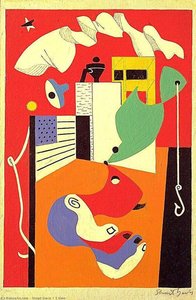
The painting Composition is a testament to Davis's ability to create complex, yet harmonious, compositions. The work features a mix of geometric shapes, bold colors, and abstract forms, which come together to form a dynamic visual experience. The use of oil on canvas adds depth and texture to the painting, making it a truly unique piece. For art enthusiasts interested in exploring similar works, Pavel Filonov's Shostakovich's First Symphony and Georgia Totto O'Keeffe's Ranchos Church, New Mexico are excellent examples of modern art.Influence and Legacy
Davis's work, including Composition, has had a significant impact on the development of modern art. His innovative style, which blended elements of Cubism and Abstract art, paved the way for future generations of artists. The history of painting is filled with examples of artists who have pushed the boundaries of creativity, and Davis is certainly one of them. For those interested in learning more about the evolution of modern art, the Modernism movement and 20th-century Western painting are essential topics to explore.In conclusion, Stuart Davis's Composition is a remarkable piece that showcases the artist's unique style and contribution to modern art. With its bold colors, geometric shapes, and abstract forms, this painting is a must-see for anyone interested in exploring the world of modern art. Visit OriginalUniqueArt.com to discover more about Davis and other prominent artists, and to explore their extensive collection of handmade oil painting reproductions.
High-resolution images of Composition

Protected by copyright: these files are for personal reference, not a licence to republish.
Stuart Davis, Composition (1935).
Stuart Davis (1892–1964), Composition, 1935. Image: OriginalUniqueArt.com.
Questions on Composition, answered
When was "Composition" made?
"Composition" by Stuart Davis was created in 1935.
What size is "Composition" by Stuart Davis in real life?
The original "Composition" by Stuart Davis measures 56 x 77 cm (22 × 30.3 in).
Is "Composition" free of copyright?
"Composition" by Stuart Davis is still protected by copyright. This status governs how the image of the work may be reproduced.
Who is the artist behind "Composition"?
"Composition" is attributed to Stuart Davis.
What was Stuart Davis's age when "Composition" was created?
When "Composition" was created in 1935, Stuart Davis - born in 1892 - was 43 years old.
What explains the copyright situation of "Composition" by Stuart Davis?
"Composition" by Stuart Davis is still protected by copyright. Copyright terms are measured from the artist's death, and Stuart Davis died in 1964.
About the artist, Stuart Davis
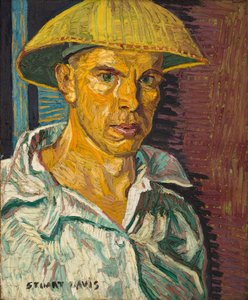
1892–1964, United States
Stuart Davis
Stuart Davis: A Pioneer of American Modernism Early Life and Training Born on December 7, 1892, in Philadelphia, Stuart Davis was immersed in an artistic environment from a young age. His father, Edward Wyatt Davis, served as the art editor for the Philadelphia Press, while his mother, Helen Stuart Davis, was a sculptor. This familial background undoubtedly fostered his early interest in visual arts. Davis received formal training at the Robert Henri School of Art in New York City from 1909 to 1912 under the guidance of Robert Henri.
Also by Stuart Davis
 Odol
 Lucky Strike1924
 T View1951
 Sixth Avenue El1931
Essays around Composition
 American neoclassical painters10 pivotal figures including John Singleton Copley and Benjamin West shaped the visual identity of the new republic through their art.
 Geometry with Purpose: Distinguishing Suprematism from ConstructivismKazimir Malevich hung his Black Square in the corner of a room in Petrograd in 1915. Why did this single gesture change the purpose of art?
 Stuart Davis: Modernist Abstraction & the Vibrant Spirit of the Jazz AgeExplore the vibrant world of Stuart Davis, a pioneer of American Modernism. Discover his jazz-inspired paintings, signature style & investm…