Preview
 Send
Send Share
Share
 Details
 Guide
Guide

 Download
 Similars
 X-Ray
X-Ray Diaporama
 Q&A
Q&A Stats
StatsThe Game Keeper's Larder

 Read More
Giclée / Art Print
Museum-quality giclée or canvas print with fast production and flexible finish options. ( Buy Hand Made Painting Switch to Digital Image)




































Pick from our preset sizes that match the artwork's original proportions.

Type the width and the height you need, to fit your frame or your wall. A print can only be cut, never made bigger than the picture, so a size with a different shape loses a part of the image. We send you a digital mockup to approve before we print anything. The picture shown on this page does not show the real cut — only the mockup does.
Worldwide Delivery () in 2 weeks instead of standard 4/5 weeks. (2 November)

Free Worldwide Express Shipping

High-Quality Linen Canvas

Full Shipping Insurance

Customs Tax Refund Guarantee

True Color Matching Guarantee

100-Day Return Policy (Defects Only)

100% Money-Back Guarantee

Bulk Discount Offer
 Glass option is only available in size under 110 CM

The Game Keeper's Larder
Giclée / Art Print
Reproduction Size
-


Total Price
$ 81
Artistic Style and Technique
Sr John E Ferneley's artistic style is characterized by his attention to detail and ability to convey a sense of realism in his paintings. In The Game Keeper's Larder, the artist uses a range of colors to create a warm and inviting atmosphere, drawing the viewer's eye to the central figure of the game keeper. The use of chiaroscuro, a technique that utilizes strong contrasts between light and dark, adds depth and dimension to the painting.Subject Matter and Symbolism
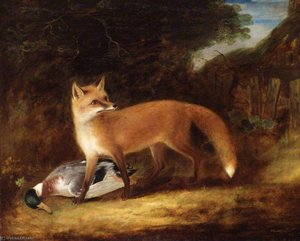
The subject matter of The Game Keeper's Larder is a fascinating glimpse into the daily life of a game keeper in 19th-century England. The painting depicts a man surrounded by the spoils of his labor, with various game birds and animals hanging from the ceiling or lying on the floor. This scene is not only a representation of the game keeper's profession but also a symbol of the harmony between humans and nature.- The painting showcases Sr John E Ferneley's ability to capture the intricate details of rural life.
- The use of color and light creates a sense of warmth and coziness in the scene.
- The subject matter provides a unique insight into the daily life of a game keeper during the 19th century.
The Mar Lodge Estate and other museums, such as the Musee des Beaux-Arts Besancon, can be found on /art/list/?Filter=A@D3AUTF-Discover-the-Masterpieces-of-Musee-des-Beaux-Arts-Besancon-France, providing a wealth of information on art and history.
Questions & Answers
What color leads the composition of "The Game Keeper's Larder" by Sr John E Ferneley?
The color that stands out most in "The Game Keeper's Larder" is driftwood (#a07e62). The dominant color is useful when matching an artwork to an interior.
How old was Sr John E Ferneley when creating "The Game Keeper's Larder" in 1836?
Sr John E Ferneley made "The Game Keeper's Larder" at the age of 54. The artist was born in 1782 and the work is dated 1836.
Can I order an oil reproduction of "The Game Keeper's Larder"?
You can order a hand-painted reproduction of "The Game Keeper's Larder" by Sr John E Ferneley directly on its Hand-Painted Reproduction page: a hand-painted oil reproduction on linen canvas, made to order.
Artist Biography
The Master of the English Hunt
In the golden age of British sporting art, few names evoke the thundering hooves and spirited pursuits of the Regency era quite like John Ferneley I. Born in 1782 in the quiet village of Thrussington, Leicestershire, Ferneley would grow to become a definitive chronicler of the English countryside. His life’s work serves as a vibrant window into a vanished world of aristocratic leisure, where the rhythm of rural life was dictated by the seasons and the exhilarating chase of the fox hunt. To study a Ferneley canvas is to step into the mist of an English morning, feeling the dampness of the dew and the palpable tension of the hounds in pursuit.
Ferneley’s artistic identity was forged through a profound connection to the landscape and the animals that inhabited it. His early training under the esteemed Benjamin Marshall provided him with more than just technical proficiency; it bestowed upon him a specialized vocabulary of movement. Under Marshall's mentorship, Ferneley learned to translate the raw energy of a galloping horse and the subtle shifts in a rider's posture onto canvas. This foundation allowed him to transition from a student of sporting art to a master of its most complex nuances, eventually leading him to the prestigious Royal Academy School where his talent was refined for the grandest stages of British society.
A Legacy of Motion and Detail
The true brilliance of Ferneley’s oeuvre lies in his ability to balance meticulous realism with an almost breathless sense of motion. His compositions are rarely static; instead, they pulse with the vitality of the hunt. He possessed a rare, anatomical understanding of equine musculature, allowing him to depict the strain of a horse in full stride or the sudden halt of a startled beast with startling accuracy. This dedication to detail extended to the human element as well, capturing the varied expressions of hunters—from the focused intensity of the seasoned rider to the breathless excitement of the spectator.
Throughout his prolific career, Ferneley secured the patronage of the highest echelons of British nobility. His studio in Melton Mowbray became a sanctuary for those seeking to immortalize their sporting triumphs. His catalog of work is vast, yet it maintains a consistent emotional resonance. Some of his most enduring contributions to the art world include:
- The Melton Mowbray Hunt: A sweeping tribute to the very heart of Leicestershire’s hunting traditions.
- Lord Henry Bentinck’s Chestnut Hunter ‘Firebird’: A masterful study in equine portraiture and individual character.
- St John’s Co-Cathedral: Demonstrating his ability to pivot from the kinetic energy of the hunt to more serene, architectural subjects.
Historical Significance and Enduring Influence
Beyond the mere documentation of social customs, Ferneley’s work holds a significant place in the evolution of British painting. While often categorized strictly within the genre of sporting art, his approach to light and atmosphere hinted at the burgeoning shifts in artistic thought that would later define the Impressionist movement. He did not merely paint horses; he painted the atmosphere in which they moved, capturing the fleeting qualities of light filtering through autumn leaves or the heavy gloom of a winter afternoon.
As we look back upon his life, which concluded in 1860, we see an artist who successfully bridged the gap between traditional sporting portraiture and a more expressive, atmospheric style. His legacy remains etched in the annals of art history, serving as a vital link to the traditions of the English landed gentry and providing a timeless celebration of the bond between man, horse, and the natural world. Today, his works continue to captivate collectors and historians alike, standing as enduring monuments to the elegance and vigor of a bygone era.

Sr John E Ferneley
1782 - 1860
Quick Facts
- Full Name: John E Ferneley Sr.
- Nationality: English
- Date Of Birth: 1782
- Date Of Death: 1860
- Place Of Birth: Thrussington, Leicestershire
- Notable Artworks:
- Three Hunters in a Landscape
- Bay Hunters with Their Groom
- Artistic Movement Or Style: Equine Painting
- Artists Who Influenced This Artist: ['Benjamin Marshall']
- Artists Or Movements Influenced By This Artist: ['British Art']