Send
Send Share
Share
 Details

 Download
 Similars
 Diaporama
 Stats
StatsPyramid
 Sculpture
- Sculpture
- Minimalism
 2005
2005- Contemporary
 121.0 x 121.0 cm
 Art Gallery of New South Wales
 Read More
Hand Made Oil Reproduction
Hand-painted oil on canvas in your size and frame, made to order by our artists. ( Switch to Print Switch to Digital Image)




































Pick from our preset sizes that match the artwork's original proportions.

You may enter your own dimensions to fit a specific frame or space. If your selected size does not match the original image's proportions, we will either crop the artwork or extend the painting with additional hand-painted elements. A digital mockup will be sent for your approval before production begins.
Please note that the on-screen preview does not reflect the actual cropping or extension. Only the mockup will accurately show the final composition.
While custom sizes are available, we recommend selecting a dimension from the predefined list to preserve the original proportions.
After order, OriginalUniqueArt.com team will email client for instructions and provide a mockup preview
Worldwide Delivery () in 3/4 weeks instead of standard 5 weeks. (8 September). No compromise on quality.

Free Worldwide Express Shipping

High-Quality Linen Canvas

Full Shipping Insurance

Customs Tax Refund Guarantee

True Color Matching Guarantee

100-Day Return Policy (Defects Only)

100% Money-Back Guarantee

Bulk Discount Offer
 Glass option is only available in size under 110 CM

Pyramid
Reproduction Medium
Reproduction Size
-


Total Price
$ 300
The Geometry of Presence: Exploring Solomon Lewitt's "Pyramid"
To stand before Solomon Lewitt’s "Pyramid" is not merely to observe an object; it is to engage in a quiet, intellectual dialogue with the very nature of form. This sculpture, rendered in pristine white and possessing a stacked, block-like geometry, immediately arrests the eye. It speaks volumes without uttering a single note—a hallmark of Lewitt’s profound commitment to conceptual rigor. The piece presents itself as an exercise in pure structure, a meditation on weight, balance, and the inherent beauty found within elemental shapes. Its clean lines and deliberate stacking suggest a journey from raw concept to tangible reality, inviting the viewer to trace the invisible intellectual scaffolding that supports its physical presence.
Minimalism's Intellectual Core
Within the grand narrative of 20th-century art, Lewitt stands as a pivotal figure, a pioneer whose work helped usher in the era of Minimalism and Conceptual Art. His journey away from traditional aesthetics toward an emphasis on idea over mere representation is palpable here. The "Pyramid," created in 2005, embodies this lineage perfectly. It eschews narrative drama for structural purity. One senses the influence of mathematics and geometry—disciplines that Lewitt himself was fascinated by—woven seamlessly into the artistic fabric. This piece challenges the viewer to look beyond the surface sheen of the material; instead, we are prompted to consider the underlying principles: proportion, repetition, and the satisfying logic of accumulation.
Materiality and Visual Impact
The choice of a lightweight, white material is crucial to the sculpture's emotional resonance. The uniform color strips away any distraction of narrative or texture, forcing the focus entirely onto the interplay of planes and negative space. Each block seems placed with meticulous consideration, creating an optical rhythm that guides the eye upward, mimicking both architectural ascent and intellectual breakthrough. For collectors and designers alike, this piece offers unparalleled versatility. It functions as a sculptural anchor in any sophisticated interior setting, its stark elegance providing a necessary counterpoint to ornate furnishings or cluttered environments. The 121 x 121 cm scale ensures it commands attention while maintaining an air of serene composure.
Symbolism and Emotional Resonance
What does the pyramid symbolize beyond mere geometry? Historically, pyramids evoke permanence, ascension, and monumental human endeavor. Lewitt updates this ancient symbolism through a decidedly modern lens. It suggests that true monumentality can be achieved not through sheer size or opulent material, but through clarity of thought and disciplined execution. Emotionally, viewing it is grounding; it offers a moment of visual stillness in a chaotic world. It whispers of order restored, of complexity resolved into elegant simplicity. Owning this reproduction is acquiring more than decoration; it is curating a focal point for contemplation—a quiet corner where the mind can settle and admire pure, distilled form.
Artist Biography
The Architect of Ideas: The Life and Legacy of Sol LeWitt
In the vast landscape of twentieth-century modernism, few figures cast as long or as intellectually profound a shadow as Solomon LeWitt. Born on September 9, 1928, in Hartford, Connecticut, to a family of Jewish immigrants from Russia, LeWitt’s journey was one defined by the pursuit of pure thought over mere physical execution. His early years were shaped by a rigorous analytical curiosity, a trait nurtured by his studies at Syracuse University between 1945 and 1949. This academic foundation in mathematics and geometry would later become the very heartbeat of his artistic language, allowing him to strip away the decorative excesses of traditional art to reveal the skeletal beauty of logic and structure.
LeWitt’s evolution as an artist was not a sudden rupture but a deliberate migration from the tangible to the conceptual. While his early explorations involved the tactile nature of painting and drawing, he soon found himself increasingly drawn to the idea behind the mark rather than the mark itself. This shift marked the birth of a pioneer who would bridge the gap between Minimalism and Conceptual Art. He began to view the artist not as a craftsman bound by the hand, but as an architect of instructions. By prioritizing the mental blueprint over the finished object, LeWitt challenged the very definition of authorship, suggesting that once an idea is conceived, its physical manifestation is merely a secondary consequence.
The Revolution of the Wall Drawing
The late 1960s witnessed one of the most radical transformations in contemporary art with the emergence of LeWitt’s iconic wall drawings. Rejecting the permanence and preciousness of traditional sculpture, he introduced "structures"—a term he preferred over "sculptures" to emphasize their mathematical essence—and a series of instructions that could be executed by anyone trained to follow them. These works were not merely decorations but lived experiences, often composed of precise geometric patterns, arcs, and interlocking shapes that breathed life into the architectural spaces they inhabited.
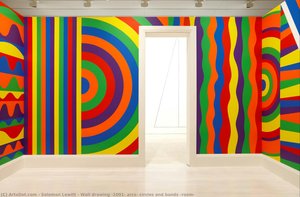
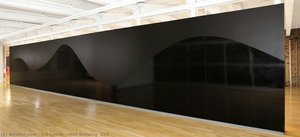
To witness a LeWitt wall drawing is to see logic transformed into poetry. Whether it was the stark, rhythmic repetition found in Black with White Lines, Vertical Not Touching or the vibrant, exuberant energy of Wall Drawing #1091: arcs, circles and bands, his work utilized the power of the line to command space. These pieces often relied on a system of logical, often mathematical instructions that guided assistants or museum installers in their production. This method democratized the act of creation while simultaneously elevating the importance of the concept, ensuring that the artwork existed fundamentally as an intellectual spark before it ever touched a wall.
A Lasting Impression on Modernity
Throughout his prolific career, which spanned decades and included mastery in printmaking, photography, and installation, LeWitt remained steadfast in his commitment to clarity and precision. His ability to find profound beauty in the simplest of forms—such as the striking white Pyramid or the complex, colorful rhythms of his crayon-based wall works—redefined the aesthetic boundaries of the late 20th century. He proved that art could be stripped of its ego and its ornament, yet still retain a soul that resonates deeply with the human desire for order and discovery.
The historical significance of Sol LeWitt cannot be overstated. He provided the vocabulary for generations of artists to explore the boundaries between thought and matter. His legacy lives on in every museum and gallery where the line between the creator and the executor is blurred, and where the strength of an idea is recognized as the ultimate medium. As we look back upon his life, from his beginnings in Hartford to his final days in New York City in 2007, we see a man who did not just make art, but who taught us how to see the profound architecture of thought itself.

solomon lewitt
1928 - 2007 , United States of America
Quick Facts
- Artistic Movement Or Style: Minimalism & Conceptual Art
- Artists Or Movements Influenced By This Artist: ['Minimalism']
- Artists Who Influenced This Artist: ['Frank Lloyd Wright']
- Date Of Birth: September 9, 1928
- Date Of Death: April 8, 2007
- Full Name: Solomon Lewitt
- Nationality: American
- Notable Artworks:
- Distorted Cubes Bozuk Küpler
- Kaldor Public Art Project 11: Sol LeWitt 1998
- Place Of Birth: Hartford, United States
Related Articles

Bronze Sculptures That Defined Art History | OriginalUniqueArt
Journey through art history with our Top 10 bronze sculptures! Explore masterpieces by Rodin, Michelangelo & more. Discover stories behind iconic statues and find museum-quality reproductions for your home decor at OriginalUniqueArt.com.

Bronze Age to Modern Masters: 10 Sculptures That Redefined Art | OriginalUniqueArt
Journey through art history with 10 legendary bronze sculptures – from Michelangelo's David to Rodin’s Thinker. Explore the stories, techniques & timeless beauty of these masterpieces. Find museum-quality reproductions & elevate your home decor on OriginalUniqueArt.com.

The Enduring Form: Exploring Themes & Techniques in Sculpture Across Historical Periods
Explore the rich history of sculpture from ancient masterpieces to contemporary innovations. Discover key techniques, influential artists & investment potential for discerning art collectors.

The Enduring Form: Sculpture Across History, Technique & Emotional Resonance
Explore the rich history of sculpture with OriginalUniqueArt. Discover key techniques, influential artists & investment potential for discerning collectors. Expert insights into valuing and collecting timeless masterpieces.

White on Canvas: 10 Masterpieces & Timeless Elegance for Your Home Decor
Explore 10 iconic white paintings by Monet, Whistler & Rothko! Discover the stories behind these serene masterpieces and their impact on art history. Find museum-quality reproductions for your home decor at .