Preview
 Send
Send Share
Share
 Details
 Guide
Guide

 Download
 Similars
 X-Ray
X-Ray Diaporama
 Stats
StatsReading

 Read More
Giclée / Art Print
Museum-quality giclée or canvas print with fast production and flexible finish options. ( Buy Hand Made Painting Switch to Digital Image)




































Pick from our preset sizes that match the artwork's original proportions.

Type the width and the height you need, to fit your frame or your wall. A print can only be cut, never made bigger than the picture, so a size with a different shape loses a part of the image. We send you a digital mockup to approve before we print anything. The picture shown on this page does not show the real cut — only the mockup does.
Worldwide Delivery () in 2 weeks instead of standard 4/5 weeks. (23 October)

Free Worldwide Express Shipping

High-Quality Linen Canvas

Full Shipping Insurance

Customs Tax Refund Guarantee

True Color Matching Guarantee

100-Day Return Policy (Defects Only)

100% Money-Back Guarantee

Bulk Discount Offer
 Glass option is only available in size under 110 CM

Reading
Giclée / Art Print
Reproduction Size
-


Total Price
$ 81
Sir Edward John Poynter's "Reading": A Victorian Moment of Contemplation
- Artist: Sir Edward John Poynter
- Birth Year: 1836
- Death Year: 1919
A Glimpse into Victorian Leisure and Intellectual Pursuit
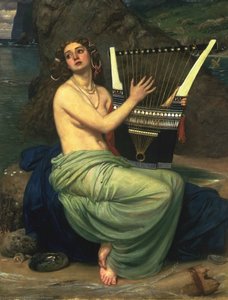
Sir Edward John Poynter's "Reading" offers a serene window into the world of late 19th-century England. The artwork depicts a young woman deeply engrossed in a book, set within an idyllic outdoor garden rendered in a classical style. This isn’t merely a portrait; it is a carefully constructed scene that speaks to Victorian ideals of leisure, learning, and introspection. The composition centers entirely on the figure of the woman, who occupies most of the frame, creating a sense of intimacy and drawing the viewer into her private world.
Style, Technique, and Influences
"Reading" exemplifies academic art, a style prevalent in the late 19th century characterized by its realism, meticulous attention to detail, and idealized representation of figures. Poynter’s training under Charles Gleyre in Paris, alongside artists like James McNeill Whistler and George du Maurier, instilled in him a classicist sensibility evident in the subject's attire and the architectural elements subtly woven into the background. The painting is executed in oil on canvas, showcasing Poynter’s mastery of blending colors and creating subtle gradations in tone. Brushstrokes are finely rendered, contributing to a polished and refined finish. The use of strong horizontal lines defining the ledge, vertical lines from the fence, and softer curves of the woman's form creates a balanced yet dynamic composition.
Symbolism and Emotional Resonance
Beyond its aesthetic appeal, "Reading" carries symbolic weight. The act of reading itself represents knowledge, wisdom, and perhaps an escape into another world – themes highly valued during the Victorian era. The woman’s serene expression suggests contentment and absorption in her thoughts, evoking a sense of tranquility and intellectual engagement. The classical setting further reinforces these ideals, hinting at notions of beauty, harmony, and refined culture. The warm color palette—creams, yellows, and muted oranges—enhances this feeling of warmth and serenity, while the touches of green and red add subtle visual interest.
Historical Context and Poynter's Legacy
Sir Edward John Poynter was a significant figure in Victorian art history. As President of the Royal Academy, he played a crucial role in shaping artistic trends of his time. "Reading," alongside other works like “Sheba” and “Israel in Egypt,” demonstrates his ability to blend historical narratives with intimate portrayals of everyday life. The painting reflects the broader cultural emphasis on education and self-improvement that characterized Victorian society. The work's connection to decorative design, as evidenced by Poynter’s involvement with William Burges and his designs for the V&A cafe, highlights his versatility as an artist who seamlessly bridged fine art and applied arts.
Questions & Answers
Does "Reading" by Sir Edward John Poynter use strong contrasts or soft harmonies?
In "Reading", a bold contrast is paired with a strong color unity harmony.
How do I download the image of "Reading" by Sir Edward John Poynter?
A download is available for "Reading": the artwork's Download page offers a high-resolution digital image download.
Toward which tone does "Reading" lean?
The dominant hue of "Reading" by Sir Edward John Poynter is ochre to sepia. The hue is the underlying tone of the palette.
Artist Biography
Sir Edward John Poynter: A Life in Art
Early Life and Education
Sir Edward John Poynter, 1st Baronet GCVO, PRA (born March 20, 1836 – died July 26, 1919) was a leading English painter, designer, and draughtsman. He served as President of the Royal Academy, solidifying his place in Victorian art history. Poynter was born in Paris, France, to architect Ambrose Poynter, though his family soon returned to Britain. His early education took place at Brighton College and Ipswich School, but ill health led him to spend winters in Madeira and Rome. It was in Rome in 1853 that he met Frederick Leighton, a pivotal encounter that profoundly influenced his artistic direction. He furthered his studies at Leigh's Academy in London and the Royal Academy Schools before venturing to Paris, where he studied under the classicist painter Charles Gleyre, alongside fellow students James McNeill Whistler and George du Maurier..Artistic Development and Influences
Poynter’s artistic development was shaped by a blend of classical ideals, historical narratives, and an emerging interest in exoticism. His early works demonstrated a strong foundation in academic technique, honed through his rigorous training. Leighton's influence is evident in Poynter’s meticulous attention to detail and refined aesthetic sensibility. The atmosphere of Paris and the teachings of Gleyre instilled in him an appreciation for classical form and composition. He was also influenced by archaeological discoveries and a growing Victorian fascination with ancient cultures, particularly those of Egypt and the Near East.Major Works and Themes
Poynter is best known for his large-scale historical paintings. Some of his most celebrated works include:- Israel in Egypt (1867): A dramatic depiction of the biblical exodus, showcasing Poynter’s skill in narrative composition and atmospheric effects.
- St George for England (1869): A mosaic created for the Palace of Westminster, embodying a patriotic theme and demonstrating his versatility as an artist.
- The Visit of the Queen of Sheba to King Solomon (1871-75): Perhaps his most famous work, this painting exemplifies Victorian Orientalism and showcases opulent detail and dramatic storytelling.
- King Solomon (1890): Another significant work exploring biblical themes with a focus on grandeur and historical accuracy.
Official Positions and Recognition
Poynter’s career extended beyond painting; he held several prestigious positions within the art establishment:- First Slade Professor at University College London (1871-1875)
- Principal of the National Art Training School (1875-1881)
- Director of the National Gallery (1894-1904), overseeing the opening of the Tate Gallery.
Historical Significance and Legacy
Sir Edward John Poynter’s contributions to Victorian art were substantial. As an artist, he captured the spirit of his age through grand historical paintings and evocative depictions of classical themes. His leadership roles within the Royal Academy helped shape artistic education and policy during a period of significant change. He bridged the gap between academic tradition and emerging modern trends. Furthermore, his family connections – including ties to Rudyard Kipling and Stanley Baldwin – placed him at the heart of Victorian society. His work continues to be admired for its technical skill, narrative power, and insightful reflection of the Victorian era’s cultural values.
Sir Edward John Poynter
1836 - 1919
Quick Facts
- Name: Sir Edward John Poynter
- Movement:
- Victorian art
- Academic art
- Orientalism
- Birth_Date: 1836
- Death_Date: 1919
- Birth_Place: Paris
- Nationality: British
- Date Of Birth: 1836
- Date Of Death: 1919
- Influenced_By:
- Frederick Leighton
- Charles Gleyre
- Notable_Works:
- Israel in Egypt
- St George for England
- The Visit of the Queen of Sheba to King Solomon
Related Articles

Sir Alfred Munnings' Masterpieces: 25 Paintings That Define Equine Art | OriginalUniqueArt
Explore 25 iconic Sir Alfred Munnings paintings! Discover the beauty of British Impressionism, equine art & rural England. Find museum-quality reproductions and elevate your home decor with OriginalUniqueArt. Explore the full collection online.
Edward Hopper's Masterpieces: 25 Iconic Paintings & Their Enduring Legacy | OriginalUniqueArt
Explore 25 iconic Edward Hopper paintings & their stories. Discover American realism, urban loneliness, and timeless beauty through his masterpieces. Find museum-quality art reproductions & curated decor ideas at OriginalUniqueArt.com.
Sir Edward Poynter: Aestheticism, Archaeology & Victorian Identity
Explore the captivating world of Sir Edward Poynter, a leading figure of Aestheticism & Victorian art. Discover his archaeological narratives, iconic paintings like 'Day Dream Fine,' and lasting influence on British art history.
Sir Frederic Leighton: Aestheticism, Academic Mastery & Victorian Masculinity
Explore the life & art of Sir Frederic Leighton, a master of Victorian Aestheticism. Discover his academic training, sculptural innovations, and captivating depictions of beauty. Expert insights for collectors.
Sir Joshua Reynolds' Masterpieces: 25 Portraits of Power & Refinement | OriginalUniqueArt
Explore 25 captivating portraits by Sir Joshua Reynolds, a master of British art. Discover stories behind his iconic paintings, elegant style & historical influence. Find museum-quality reproductions and elevate your home decor on OriginalUniqueArt.com.