Preview
 Send
Send Share
Share
 Details
 Guide
Guide

 Download
 Similars
 X-Ray
X-Ray Diaporama
 Q&A
Q&A Stats
StatsGranada

- 201.0 x 88.0 cm


 Read More
Giclée / Art Print
Museum-quality giclée or canvas print with fast production and flexible finish options. ( Buy Hand Made Painting Switch to Digital Image)




P118B $10

P118H $10

P118W $10

P438Z $10

P508JH $12

P508YH $12

P805H $10

P805Z $10

P919BZ $10

P919G $10

P919XJ $10

P959ZH $10

P968JZ $12

W106C $8

W218G $10

W218JH $8

W218Y $10

W307PJ $10

W316G $10

W316PJ $8

W316Y $10

W398PJ $8

W4111J $10

W500HY $15

W500JH $15

W692G $12

W849H $8

W940BG $15

W953PJ $8




Pick from our preset sizes that match the artwork's original proportions.

Type the width and the height you need, to fit your frame or your wall. A print can only be cut, never made bigger than the picture, so a size with a different shape loses a part of the image. We send you a digital mockup to approve before we print anything. The picture shown on this page does not show the real cut — only the mockup does.
Worldwide Delivery () in 2 weeks instead of standard 4/5 weeks. (4 November)

Free Worldwide Express Shipping

High-Quality Linen Canvas

Full Shipping Insurance

Customs Tax Refund Guarantee

True Color Matching Guarantee

100-Day Return Policy (Defects Only)

100% Money-Back Guarantee

Bulk Discount Offer
 Glass option is only available in size under 110 CM

Granada
Giclée / Art Print
Reproduction Size
-


Total Price
$ 81
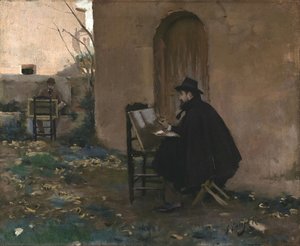
A Portrait of Contemplation: Santiago Rusiñol’s “Granada”
Santiago Rusiñol’s “Granada,” painted in 1895, is more than just a portrait; it's a carefully constructed tableau of quiet observation and the burgeoning spirit of Catalan Modernisme. This intimate scene captures a woman – likely self-portraiture – lost in thought as she gazes out a window, her presence imbued with a serene melancholy that speaks to the anxieties and aspirations of late 19th-century Spain. Measuring 201 x 88 cm, the painting invites viewers into a private moment, offering a glimpse into the soul of one of its era’s most significant artists.
- Subject & Composition: The central figure dominates the canvas, her posture and expression conveying a deep sense of introspection. The composition is deliberately balanced, drawing attention to the woman's face while subtly incorporating the surrounding elements – the potted plants, the bench, and the distant view – as integral parts of her contemplative state.
- Style & Technique: Rusiñol’s style aligns perfectly with Catalan Modernisme, a movement characterized by its emphasis on realism, emotional intensity, and a deep connection to Catalan identity. His brushwork is loose yet controlled, creating a textured surface that adds depth and richness to the scene. The use of color is particularly noteworthy – warm earth tones dominate, punctuated by the vibrant red of the scarf, drawing the eye and intensifying the woman’s gaze.
Historical Context & Catalan Modernisme
“Granada” was created during a pivotal moment in Spanish history—the rise of Catalan nationalism and the burgeoning artistic movement known as Modernisme. Born in Barcelona in 1861, Santiago Rusiñol witnessed firsthand the social and political changes sweeping across Catalonia. This painting reflects this context through its focus on individual experience and emotional depth, hallmarks of Modernisme’s rejection of academic conventions. The inclusion of traditional Spanish clothing further anchors the work within its historical setting, subtly referencing a cultural heritage that was increasingly under threat.
- Catalan Identity: Rusiñol's work often explored themes related to Catalan identity and landscape, reflecting his deep connection to his homeland.
- Modernist Principles: The painting embodies key Modernist principles – a focus on emotional expression, the use of vibrant color, and an interest in exploring the relationship between art and nature.
Symbolism & Interpretation
Beyond its surface beauty, “Granada” is rich with symbolic meaning. The woman’s contemplative gaze suggests a yearning for something beyond her immediate surroundings – perhaps a reflection on the political turmoil of the time or a deeper exploration of her own identity. The potted plants, strategically placed in the foreground, could represent growth, resilience, and the enduring beauty of nature. The bench itself offers a space for quiet contemplation, reinforcing the painting’s overall theme of introspection.
- The Red Scarf: The vibrant red scarf is likely symbolic, perhaps representing passion, defiance, or even a connection to Catalan nationalism.
- The Window & View: The window and the distant view serve as a visual metaphor for the woman’s thoughts – an open space for reflection and imagination.
Emotional Impact & Artistic Value
“Granada” possesses a remarkable emotional resonance, inviting viewers to share in the woman's quiet contemplation. Rusiñol masterfully captures a fleeting moment of vulnerability and introspection, creating a work that is both timeless and deeply personal. As a significant example of Catalan Modernisme, this painting holds considerable artistic value and offers a compelling window into the life and vision of one of Spain’s most important artists. A hand-painted reproduction allows you to bring this evocative piece into your own space, fostering a sense of serenity and contemplation.
Questions & Answers
Is "Granada" by Santiago Rusiñol Prats in the public domain, and why?
"Granada" by Santiago Rusiñol Prats is in the public domain - its copyright has expired. Copyright terms are measured from the artist's death, and Santiago Rusiñol Prats died in 1931.
What is a reproduction of "Granada" by Santiago Rusiñol Prats recommended for?
The recommended use of a print of "Granada" is reflective.
How popular is "Granada" within Catalan Modernisme?
Within the Catalan Modernisme movement, "Granada" has a recognized popularity level.
Artist Biography
The Visionary of Catalan Modernisme
Santiago Rusiñol i Prats was far more than a mere painter; he was a polymathic force of nature whose creative spirit breathed life into the Catalan Modernisme movement. Born in Barcelona in 1861 to a prosperous textile industrialist family, Rusiñol possessed a rare duality of means and passion. While his lineage was rooted in the industrious mills of Manlleu, his soul belonged to the ephemeral beauty of the canvas, poetry, and the stage. His early training under Tomás Moragas provided him with a foundation in realism, yet the rigid boundaries of traditional Spanish art could not contain his burgeoning curiosity. This restlessness eventually led him to the bohemian heart of Paris in 1889, a transformative sojourn that would forever alter the trajectory of his brushwork.
In the vibrant, smoke-filled cafes of Montmartre, Rusiñol found himself immersed in a whirlwind of new ideas. Alongside contemporaries like Ramón Casas and Ignacio Zuloaga, he absorbed the light-drenched techniques of Impressionism and the dreamlike, evocative depths of Symbolism. This period was not merely an education in style but a spiritual awakening. He began to move away from strict representation toward a more atmospheric approach, where color and form served to evoke mood rather than just document reality. It was during these formative years that he developed the ability to capture the quiet, often melancholic essence of landscapes and the psychological depth of his subjects, a skill that would later make him a pivotal figure in the European avant-garde.
A Tapestry of Light, Gardens, and Soul
The breadth of Rusiñol’s oeuvre is nothing short of extraordinary, spanning a thousand works that traverse the boundaries of different genres. He was a master of the garden scene, utilizing the aesthetic ideals of Art Nouveau to create tranquil, lush environments that seemed to breathe with life. In works such as Gardens of Aranjuez, one can witness his ability to weave vibrant colors into a peaceful tapestry, inviting the viewer into a sanctuary of stillness. His landscapes often carry a Romantic fervor, where the natural world is imbued with a sense of mystery and profound emotion, reflecting the shifting light of the Mediterranean coast.
Beyond the landscape, Rusiñol’s portraits stand as enduring testaments to his psychological acuity. He possessed a unique talent for capturing the contemplative moods of his sitters, often imbuing them with a sense of quiet introspection. Whether it is the poignant The Girl with Carnation or the more somber Tirano (Portrait of Salvador Robert), his portraits are studies in human emotion and social nuance. His versatility extended into the realms of literature and theater, as he was equally adept at crafting words as he was at applying pigment, making him a true architect of the cultural renaissance occurring in Catalonia during his lifetime.
Legacy and Historical Significance
The historical importance of Santiago Rusiñol extends far beyond the borders of Spain. He acted as a vital bridge between the traditionalist roots of Spanish art and the radical innovations of the 20th century. His presence in the Parisian art scene and his role as a mentor and collaborator meant that he played an indirect yet profound role in the development of modern masters, most notably influencing the early artistic trajectory of Pablo Picasso. By fostering a spirit of experimentation and cross-pollination between cultures, Rusiñol helped prepare the ground for the seismic shifts of Cubism and beyond.
His commitment to the cultural identity of Catalonia is perhaps best immortalized in his dedication to the Cau Ferrat Museum in Sitges. This museum, which serves as a testament to his passion for collecting and preserving art, remains a sanctuary for the very spirit of Modernisme he helped define. As we look back upon his life—from the industrial roots of his youth to the bohemian heights of his maturity—we see an artist who refused to be confined by a single medium or movement. Rusiñol remains a luminous figure in art history, a painter of light and shadow whose work continues to enchant, haunt, and inspire.

Santiago Rusiñol Prats
1861 - 1931 , Spain
Quick Facts
- Full Name: Santiago Rusiñol y Prats
- Nationality: Spanish
- Date Of Birth: 1861
- Date Of Death: 1931
- Place Of Birth: Barcelona, Spain
- Notable Artworks:
- Gardens of Aranjuez
- Rouen
- Fulls de la vida
- Artistic Movement Or Style: Modernisme
- Artists Who Influenced This Artist:
- Tomás Moragas
- Pablo Picasso
- Artists Or Movements Influenced By This Artist: ['Symbolism']
Related Articles

Josep Cusachs i: Exploring Catalan Modernism Through Social Commentary & Artistic Innovation
Explore the captivating world of Josep Cusachs i, a key figure in Catalan Modernism. Discover his realist paintings, social commentary, and influence on 19th-century Spanish art. Hand-painted reproductions available at OriginalUniqueArt.

Crimson Threads of Narrative: Exploring Symbolism & Representation in Artworks Featuring the Red Dress
Explore the rich symbolism of the red dress in art history! From ancient power displays to iconic portraits like Cézanne’s 'Madame Cezanne', discover the cultural and artistic significance behind this captivating color. Expert analysis & insights.

Giclée Prints: Archival Quality & Aesthetic Nuances for the Discerning Collector
Explore the world of giclée prints with OriginalUniqueArt. Learn about archival quality, aesthetic nuances & investment potential. Expert guidance for discerning art collectors seeking museum-quality reproductions and lasting value.

The Enduring Legacy of Fine Art Prints: Technique, History & Aesthetic Impact
Explore the rich history & techniques of fine art prints. Discover investment potential, assess authenticity, and learn how to preserve your collection with expert guidance. Trusted insights for discerning collectors.

Echoes of Time: Exploring the Enduring Appeal & Historical Context of Vintage Art Prints
Explore the captivating world of vintage art prints! Discover their history, collecting tips & enduring appeal. Expert insights on chromolithography and building a legacy collection with OriginalUniqueArt.