Preview
 Send
Send Share
Share
 Details
 Guide
Guide

 Download
 Similars
 X-Ray
X-Ray Diaporama
 Stats
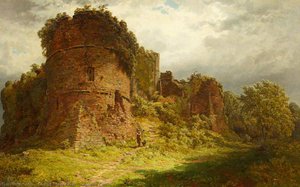
StatsGoodrich Castle
 69.0 x 109.0 cm
 Read More
Giclée / Art Print
Museum-quality giclée or canvas print with fast production and flexible finish options. ( Buy Hand Made Painting Switch to Digital Image)




































Pick from our preset sizes that match the artwork's original proportions.

Type the width and the height you need, to fit your frame or your wall. A print can only be cut, never made bigger than the picture, so a size with a different shape loses a part of the image. We send you a digital mockup to approve before we print anything. The picture shown on this page does not show the real cut — only the mockup does.
Worldwide Delivery () in 2 weeks instead of standard 4/5 weeks. (24 October)

Free Worldwide Express Shipping

High-Quality Linen Canvas

Full Shipping Insurance

Customs Tax Refund Guarantee

True Color Matching Guarantee

100-Day Return Policy (Defects Only)

100% Money-Back Guarantee

Bulk Discount Offer
 Glass option is only available in size under 110 CM

Goodrich Castle
Giclée / Art Print
Reproduction Size
-


Total Price
$ 81
Artist Biography
The Observational Eye: The Life and Legacy of Samuel Henry Baker
In the vibrant tapestry of nineteenth-century British art, few threads are as delicately woven as those left by Samuel Henry Baker (1824–1909). A master of light and atmosphere, Baker possessed a rare ability to transform the mundane realities of the Victorian era into profound visual poetry. While many of his contemporaries sought refuge in the grandiosity of mythological epics or historical dramas, Baker turned his gaze toward the quiet dignity of the everyday. His work serves as a luminous window into a bygone era, capturing the rhythmic pulse of European cities and the serene stillness of the English countryside with an intimacy that feels remarkably modern.
Born in Birmingham to a family deeply rooted in scientific inquiry—his father, Thomas Baker, was a manager at the famed Soho Works—the artist’s early life was defined by a rigorous devotion to detail. This scientific lineage likely informed his meticulous approach to the canvas, fostering an innate curiosity about how light interacts with texture and form. His formal training began under the guidance of James Chaplin, a painter of magic lantern slides, which undoubtedly sharpened his ability to manipulate light for dramatic effect. Later, his studies at the Birmingham School of Design and lessons from landscape painter Joseph Paul Pettitt provided him with the technical foundation necessary to navigate the complex nuances of watercolor and oil.
A Mastery of Light and Architectural Soul
Baker’s artistic evolution was profoundly shaped by his association with the Pre-Raphaelite movement, specifically through the influence of George Frederic Watts. From Watts, Baker inherited a philosophy that art should transcend mere imitation to achieve psychological depth and beauty. This instruction led him away from idealized, artificial compositions toward a more authentic rendering of the world. He became particularly renowned for his architectural studies, where he treated stone, glass, and timber not merely as structures, but as vessels for light. His watercolor depictions of church interiors are legendary for their subtle luminosity; one can almost feel the warmth of candlelight filtering through stained glass or witness the soft, diffused glow of a London afternoon settling upon ancient masonry.
His repertoire was remarkably diverse, spanning both the urban and the pastoral. In his cityscapes, Baker captured the bustling energy of Paris, London, Rome, and Venice, rendering the complex layers of street life with an astonishing level of realism. Conversely, his landscape works, such as The Wye at Kern Bridge, reveal a different facet of his soul—one of profound tranquility. In these pieces, he utilized muted palettes of greens and browns to evoke the peaceful, rhythmic flow of nature, creating balanced compositions that draw the viewer into a state of meditative calm.
Recognition and Historical Significance
Throughout his prolific career, Baker earned the respect of the most prestigious artistic institutions of his time. His membership in the Royal Birmingham Society of Artists (RBSA) and the Royal Society of Painter-Etchers and Engravers (RE) stands as a testament to his technical prowess and his standing within the professional art community. His influence even extended into the next generation, as his son, Oliver Baker, followed in his footsteps to become a celebrated painter and designer.
The historical significance of Samuel Henry Baker lies in his role as a chronicler of the human and built environment. He did not merely paint scenes; he preserved the atmosphere of an era. His ability to marry the precision of a scientific observer with the soul of a romantic poet ensures that his work remains much more than a historical record. Instead, his paintings continue to breathe with the light of the nineteenth century, offering contemporary viewers a chance to reconnect with the quiet, beautiful complexities of the world as it once was.

Samuel Henry Baker
1824 - 1909
Quick Facts
- Artistic Movement Or Style: Romanticism
- Artists Or Movements Influenced By This Artist: ['John Constable']
- Artists Who Influenced This Artist:
- George Frederic Handel
- William Hayley
- Date Of Birth: 1824
- Date Of Death: 1909
- Full Name: Samuel Henry Baker
- Nationality: British
- Notable Artworks:
- The Shepherdess
- The Old Mill
- The Stonecutter
- Place Of Birth: London, England