Read More


 For artworks or reproductions larger than 105 cm (approximately 41 inches) on any side, the frame will be shipped as a kit, disassembled. This method ensures safe delivery and prevents damage during transport.


More about this painting
Text size

() ·
A painting made for you, by hand
Hand Made Oil Reproduction
Hand-painted oil on canvas in your size and frame, made to order by our artists. ( Switch to Print Switch to Digital Image)
Collectible Description
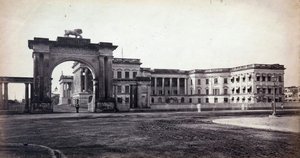
A charming black and white photograph capturing a lush Victorian garden gathering by Samuel Dixon Bourne from 1865 that invites you to explore the timeless elegance of this historic outdoor scene.
Artist Biography
Samuel Dixon Bourne (1834-1912) was a pioneering British photographer renowned for his stunning landscapes & architectural studies of 19th-century India. Explore museum-quality prints capturing the beauty and culture of colonial India at OriginalUniqueArt.
from ·
Chapter 1
How large should it be?
Slide to change the size; the picture on the left shows the frame at its real width. The proportions of the original are kept.
Standard
custom
CM
INCH
Pick from our preset sizes that match the artwork's original proportions.
Loading sizes...

width
height
Type the width and the height you need, to fit your frame or your wall. This is hand-painted, so for a size with a different shape the artist can paint a bit more around the picture, or cut a bit — you choose. We send you a digital mockup to approve before the painting starts. The picture shown on this page does not show the real result — only the mockup does.
Chapter 2
How should it arrive?
Choose the edges of the stretched canvas
Choose your frame

White $1

Blurside $1

Extended $1

P118B $10

P118H $10

P118W $10

P438Z $10

P508JH $12

P508YH $12

P805H $10

P805Z $10

P919BZ $10

P919G $10

P919XJ $10

P959ZH $10

P968JZ $12

W106C $8

W218G $10

W218JH $8

W218Y $10

W307PJ $10

W316G $10

W316PJ $8

W316Y $10

W398PJ $8

W4111J $10

W500HY $15

W500JH $15

W692G $12

W849H $8

W940BG $15

W953PJ $8

H24-GOLD $30

H24-SILVER $30

H36-GOLD $45

H36-SILVER $45
Framed
Moulding: . Overall size with the frame: .
Chapter 3
Who paints it, and should anything change?
Examples of what can be changed: Replace face with customer photo; Add pet (e.g., replace cat with dog); Include hidden message in background; Change background landscape or elements.
After order, OriginalUniqueArt.com team will email client for instructions and provide a mockup preview
After order, OriginalUniqueArt.com team will email client for instructions and provide a mockup preview
Worldwide Delivery () in 3/4 weeks instead of standard 5 weeks. (10 November). No compromise on quality.
Chapter 4
The finishing touches
A nameplate, as in a museum?
Engraved Bronze Plaque Details
This elegant plaque features the artist's name and the title of the artwork, finely engraved for a timeless presentation.
It is made from bronze with a refined, elegant finish. The text is precisely laser-engraved for a sharp and permanent result. Measuring 9x2 cm, the plaque is compact yet easy to read. It's built to be durable and scratch-resistant, offering a professional, museum-quality look. Mounting is simple thanks to the included adhesive backing.
Transparent Acrylic Plaque Details
The plaque includes essential engraved details such as the artist's name, the title of the artwork, the date it was created, the type of media used-like oil on canvas or watercolor-a brief description of the piece, and a QR code that links to the complete artwork information.
It is crafted from clear acrylic, offering a sleek, modern appearance. The text is UV-engraved in black to ensure strong visual contrast. With a size of 10x15 cm, it ensures optimal readability. It comes equipped with two metal hooks for secure wall mounting. The plaque is designed to be weather-resistant, making it suitable for various environments, and it includes interactive features that work seamlessly with smartphone scanning.
Black Acrylic Plaque Details
This elegant plaque includes engraved information such as the artist's name, the title of the artwork, the date it was created, the type of media used (like oil on canvas or watercolor), a short description of the artwork, and a QR code for quick access to more information.
The plaque itself is made from refined black acrylic with a premium finish. The text is laser-engraved in white for high contrast and readability. Its size is 10x15 cm, designed to be easy to read. It comes with two metal hooks for professional mounting. The design is sleek and fits any interior style. It is also weather-resistant and durable, with built-in digital integration for mobile compatibility.
A protective varnish?
When do you need it?
Chapter 5
Your painting, as you ordered it
Untitled
Reproduction Medium
Reproduction Size
-
Elite Senior Artist
More detail, finesse, and extra production time
-
Reproduction Frame
-
-
For artworks or reproductions larger than 105 cm (approximately 41 inches) on any side, the frame will be shipped as a kit, disassembled. This method ensures safe delivery and prevents damage during transport.
Professional assembly required - this is not a DIY product.
The kit must be assembled and the canvas stretched by an experienced professional framer, using wood glue (not supplied), a canvas stretching plier and clamps to hold the bars square while the glue dries. Incorrect assembly or uneven canvas tension can permanently damage the artwork and is not covered by our warranty.
All solid wood bars are included, precisely cut to size.
Assembled with the screws provided, plus wood glue for the corner joints, which is not supplied and must be sourced by your framer.
Professional tools are required and not included: a canvas stretching plier (tensioner) and clamps to hold the bars square while the glue dries.
Important:
The corner joints require wood glue, the bars must be held with clamps until the glue is fully dry, and tightening the canvas on the assembled frame requires a canvas stretching plier. None of these are included in the kit. Please arrange an experienced professional framer before ordering this size.
Nameplate
-
-
Protective Varnish
Glossy Varnish (enhances colors, protects against light/moisture)
-
Customize My Artwork
Examples of what can be changed: Replace face with customer photo; Add pet (e.g., replace cat with dog); Include hidden message in background; Change background landscape or elements.
-
Urgent
Worldwide Delivery () in 3/4 weeks instead of standard 5 weeks. (10 November). No compromise on quality.
-
Express Shipping
Worldwide Delivery () in 5 weeks. (17 November).
Included
Total Price
$ 300
Glass option is only available in size under 110 CM
Included with every order
- Free Worldwide Express Shipping
- High-Quality Linen Canvas
- Full Shipping Insurance
- Customs Tax Refund Guarantee
- True Color Matching Guarantee
- 100-Day Return Policy (Defects Only)
- 100% Money-Back Guarantee
- Bulk Discount Offer
 Send
Send Share
Share
 Details
 Guide
Guide

 Download
 Similars
 Diaporama
 Q&A
Q&A Stats
StatsIn numbers
- 1865the year it was painted
- 29frames to choose from
- standard sizes, in its own proportions
- 5weeks to paint and deliver it
About the original

- 23.0 x 29.0 cm


Samuel Dixon Bourne
1834 - 1912, United Kingdom
Quick facts about Samuel Dixon Bourne
- Artistic Movement Or Style: Victorian Landscape Photography
- Artists Or Movements Influenced By This Artist: ['Photogravure']
- Artists Who Influenced This Artist: ['William Henry Fox Talbot']
- Date Of Birth: 1834
- Date Of Death: 1912
- Full Name: Samuel Dixon Bourne
- Nationality: British
- Notable Artworks:
- Paigah Tomb
- Group of bhooteas, Darjeeling
- Interiors of Moti Masjid, Agra Fort
- Marochetti
- Tomb of Itmad-ud Daulah
- Bombay, The Said-Memon Street
- The Taj Mahal from the corner of the quadrangle
- Place Of Birth: Neasden, United Kingdom
Artist Biography
A Visionary Through the Lens: The Life of Samuel Dixon Bourne
Samuel Dixon Bourne (1834–1912) was far more than a mere chronicler of landscapes; he was a pioneer who redefined the visual vocabulary of an empire. Born in Neasden, United Kingdom, Bourne’s early life was shaped by the disciplined atmosphere of a classical education, yet his heart belonged to the burgeoning medium of photography. While his professional beginnings were rooted in the stable, predictable world of banking at Moore & Robinson’s Bank in Nottingham, the call of the visual arts proved irresistible. This transition from the ledger to the lens marked the beginning of a profound journey that would eventually lead him away from the comforts of England toward the sun-drenched, culturally rich expanses of the Indian subcontinent. As his technical mastery grew, so did his reputation as an educator and intellectual within the photographic community. Bourne was not simply a practitioner but a scholar of light and chemistry, contributing insightful discourse to the prominent journals of the Victorian era. His deep understanding of photographic techniques allowed him to move beyond simple documentation, seeking instead to capture the sublime essence of the natural world. This pursuit of the extraordinary eventually culminated in his transformative decision to abandon his banking career entirely, setting sail for India—a move that would forever alter the course of colonial photography.The Dawn of Bourne & Shepherd and the Indian Odyssey
Upon arriving in Calcutta in 1863, Bourne embarked on one of the most significant collaborative ventures in photographic history. Alongside Charles Shepherd, he established the legendary Bourne & Shepherd Studios, a partnership that would become synonymous with the visual identity of British India. Their operations were strategically brilliant, spanning from the misty, high-altitude retreats of Shimla to the bustling, humid streets of Calcutta. This dual presence allowed Bourne to explore two distinct yet equally captivating realms: the majestic, sweeping grandeur of the Himalayan landscapes and the intricate, human-centric architectural studies of the urban centers. His work during this period serves as a breathtaking window into a vanished era. Through his lens, the monumental scale of the Mughal Empire was rendered with both precision and poetic grace. One might gaze upon his formal architectural study, The Taj Mahal from the corner of the quadrangle, and witness the meticulous way he utilized light to highlight the intricate details of Mughal artistry. His ability to capture the interplay of shadow and stone transformed static monuments into living histories, making him a master of the photogravure process and a premier documentarian of the era's architectural splendor.Legacy of Light and the Documentation of a Civilization
Beyond the grand monuments, Bourne possessed a rare sensitivity for the pulse of everyday life. His photographic repertoire extended into the intimate corners of Indian urbanity, capturing the vibrant energy of streets such as Bombay, The Said-Memon Street. In these black and white compositions, the viewer is transported to the 1860s, witnessing the movement, commerce, and social fabric of colonial India. This ability to balance the epic with the intimate—to capture both the soaring peaks of the Himalayas and the quiet, spiritual stillness of a Christ statue in a peaceful setting—is what distinguishes his oeuvre from that of his contemporaries. The historical significance of Samuel Dixon Bourne cannot be overstated. He did not merely take photographs; he constructed a visual archive that remains an indispensable resource for historians, architects, and art lovers alike. His work stands as a testament to the power of the photographic medium to bridge distances and eras. Through his dedication to capturing the beauty, culture, and complexity of India, Bourne left behind a legacy of light that continues to illuminate our understanding of the nineteenth-century world, ensuring that the grandeur of the past remains eternally accessible to the present.Related Articles
Cultivating Paradise: A Historical & Artistic Exploration of Gardens in Painting
Explore the rich history of gardens in painting! Discover masterpieces from Renaissance to Impressionism & beyond. Learn about symbolism, artists like Monet & Klimt, and find your perfect artwork at OriginalUniqueArt.

Dark Masterpieces: 10 Iconic Paintings Dominated by Black Tones |
Explore 10 iconic paintings dominated by black tones, from Rembrandt’s chiaroscuro to Goya's dark expressions. Discover the stories behind these masterpieces & find museum-quality art reproductions for your home at .

White on Canvas: 10 Masterpieces & Timeless Elegance for Your Home Decor
Explore 10 iconic white paintings by Monet, Whistler & Rothko! Discover the stories behind these serene masterpieces and their impact on art history. Find museum-quality reproductions for your home decor at .

Monochrome Visions: Exploring the Aesthetic & Historical Significance of Black & White Photography
Explore the rich history & artistic power of black and white photography. From early techniques to iconic masters like Ansel Adams, discover why monochrome continues to captivate art lovers today. Expert insights for collectors.
Explore artworks organized by themes, styles, and characteristics.