Preview
 Send
Send Share
Share
 Details
 Guide
Guide

 Download
 Similars
 X-Ray
X-Ray Diaporama
 Stats
StatsEdinburgh from Leith Roads


 Read More
Giclée / Art Print
Museum-quality giclée or canvas print with fast production and flexible finish options. ( Buy Hand Made Painting Switch to Digital Image)




































Pick from our preset sizes that match the artwork's original proportions.

You may enter your own dimensions to fit a specific frame or space. If your selected size does not match the original image's proportions, we will either crop the artwork or extend the image with a mirrored or solid-fill edge. A digital mockup will be sent for your approval before production begins.
Please note that the on-screen preview does not reflect the actual cropping or extension. Only the mockup will accurately show the final composition.
While custom sizes are available, we recommend selecting a dimension from the predefined list to preserve the original proportions.
Worldwide Delivery () in 2 weeks instead of standard 4/5 weeks. (4 October)

Free Worldwide Express Shipping

High-Quality Linen Canvas

Full Shipping Insurance

Customs Tax Refund Guarantee

True Color Matching Guarantee

100-Day Return Policy (Defects Only)

100% Money-Back Guarantee

Bulk Discount Offer
 Glass option is only available in size under 110 CM

Edinburgh from Leith Roads
Giclée / Art Print
Reproduction Size
-


Total Price
$ 81
The Artist and His Style
Samuel Bough was an English-born landscape painter who spent much of his career working in Scotland. He was known for his bold and expressive style, which captured the beauty and drama of the natural world. Light and color were essential elements in his paintings, and he often used a limited palette to create a sense of atmosphere and mood.The Painting
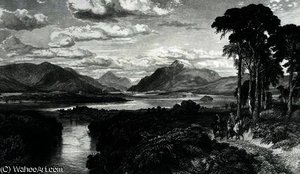
Edinburgh from Leith Roads depicts a stormy sea with several boats sailing in it. The scene is set against the backdrop of the city of Edinburgh, with the Firth of Forth stretching out into the distance. The painting is characterized by its expressive sky and turbulent sea, which convey the power and energy of nature. The use of grey-toned palette adds to the sense of drama and tension in the scene.Reproductions and Inspiration
For those who appreciate the beauty of Samuel Bough's work, https://OriginalUniqueArt.com offers handmade oil painting reproductions of his pieces, including Edinburgh from Leith Roads. These reproductions are created using high-quality materials and techniques, ensuring that they capture the essence and spirit of the original paintings. Visit https://OriginalUniqueArt.com to explore their collection and discover more about the artist and his work.Some notable works by Samuel Bough include: For more information about Samuel Bough and his work, visit https://OriginalUniqueArt.com or check out his page on Wikipedia: https://en.wikipedia.org/wiki/Samuel_Bough.
Questions & Answers
When was "Edinburgh from Leith Roads" made?
"Edinburgh from Leith Roads" dates from 1854. The date places the work within Samuel Bough's career and its era.
Is "Edinburgh from Leith Roads" by Samuel Bough a portrait, landscape or square composition?
"Edinburgh from Leith Roads" by Samuel Bough is a landscape composition. The proportions are worth checking before choosing a print size.
Who is the artist behind "Edinburgh from Leith Roads"?
"Edinburgh from Leith Roads" is attributed to Samuel Bough.
Is "Edinburgh from Leith Roads" by Samuel Bough in the public domain, and why?
The copyright status of "Edinburgh from Leith Roads" - in the public domain - its copyright has expired - follows from the artist's death in 1878.
What is the dominant hue of "Edinburgh from Leith Roads" by Samuel Bough?
"Edinburgh from Leith Roads" leans toward a green to violet spectrum tone.
Does "Edinburgh from Leith Roads" by Samuel Bough use strong contrasts or soft harmonies?
The color composition of "Edinburgh from Leith Roads" by Samuel Bough combines a gentle contrast with a unified palette harmony.
At what age did Samuel Bough make "Edinburgh from Leith Roads"?
When "Edinburgh from Leith Roads" was created in 1854, Samuel Bough - born in 1822 - was 32 years old.
Artist Biography
Early Life and Artistic Beginnings
Samuel Bough, born in Carlisle, England in 1822, was destined to become one of the most celebrated landscape painters of his generation. His early life unfolded against the backdrop of a rapidly industrializing Britain, yet it was the untamed beauty of Scotland that would ultimately capture his artistic soul. Though initially trained as a topographical draughtsman – a practical skill in demand for engineering projects and estate maps – Bough’s inherent sensitivity to light and atmosphere soon steered him towards a more expressive form of landscape painting. He wasn't merely recording what he *saw*; he was striving to convey the *feeling* of a place, the very essence of its character. This nascent artistic inclination led him to study under prominent artists like David Roberts, whose influence is visible in Bough’s early attention to detail and architectural elements within his compositions. However, it wasn't long before Bough began to forge his own distinct path, drawn inexorably towards the dramatic landscapes of Scotland.The Scottish Highlands: A Defining Influence
Bough’s relocation to Scotland in 1847 proved pivotal. The rugged grandeur of the Highlands, with its towering mountains, shimmering lochs, and ever-changing skies, ignited a passion that would define his artistic career. He settled in Edinburgh, becoming deeply immersed in the Scottish art scene and quickly gaining recognition for his evocative depictions of the country’s natural beauty. Unlike many of his contemporaries who focused on idealized or picturesque scenes, Bough embraced the raw, often melancholic power of the Scottish landscape. His paintings weren't simply pretty views; they were imbued with a sense of atmosphere, capturing the fleeting effects of light and weather – a dramatic sunset over a turbulent sea, the mist clinging to a lonely glen, the golden glow of autumn on a heather-covered hillside. He became particularly adept at rendering water, whether it was the crashing waves of the coastline or the still reflections of inland lochs.Technique and Style: A Blend of Realism and Romanticism
Bough’s artistic style represents a fascinating blend of realism and romanticism. He possessed a remarkable technical skill, evident in his precise rendering of detail – the texture of rocks, the foliage of trees, the intricate patterns of waves. Yet, this meticulous attention to accuracy was always subservient to his overriding goal of capturing mood and atmosphere. His brushwork is often loose and expressive, particularly in his skies, where he masterfully employed a range of tones and textures to convey the drama of changing weather conditions. Watercolour became his preferred medium, allowing him to achieve the delicate washes and luminous effects that were so central to his vision. While influenced by earlier masters like J.M.W. Turner in his exploration of light and atmosphere, Bough developed a uniquely Scottish sensibility, characterized by a more restrained palette and a focus on the specific qualities of the Highland landscape. He wasn’t interested in grand, theatrical displays; rather, he sought to capture the subtle nuances of nature, the quiet beauty that often goes unnoticed.Major Achievements and Recognition
Throughout his career, Samuel Bough enjoyed considerable success and recognition. He exhibited extensively at the Royal Scottish Academy and other prestigious venues, quickly establishing himself as a leading landscape painter. His works were highly sought after by collectors, both in Britain and abroad.- He became an Associate of the Royal Scottish Academy in 1861.
- In 1870 he was elected a full Academician – a testament to his artistic achievements and standing within the art community.
- Bough’s paintings were particularly popular with Queen Victoria, who acquired several of his works for her private collection. This royal patronage further cemented his reputation as one of Britain's foremost landscape artists.
Historical Significance and Legacy
Samuel Bough’s work occupies an important place in the history of British landscape painting. He stands as a key figure in the development of Scottish art, bridging the gap between the traditions of earlier topographical painters and the more expressive approaches of later generations. His paintings are not merely historical records of specific locations; they are evocative interpretations of nature, imbued with emotion and atmosphere. Bough’s influence can be seen in the work of numerous subsequent landscape artists who sought to capture the beauty and drama of Scotland. Today, his paintings continue to captivate audiences with their serene compositions, masterful technique, and enduring sense of place. He remains a beloved artist, celebrated for his ability to transport viewers to the heart of the Scottish Highlands and evoke a deep appreciation for the natural world.
Samuel Bough
1822 - 1878 , United Kingdom