
 Preview
 Send
Send Share
Share
 Details
 Guide
Guide

 Download
 Similars
 X-Ray
X-Ray Diaporama
 Q&A
Q&A Stats
StatsSandal


 Read More
Get a print-ready file that goes far beyond the web preview. Every digital image we sell comes from a high-resolution master in our stock database — usually 5,000 to 15,000 pixels wide — so you can print large, crop tightly, or reproduce fine detail with confidence.
No file leaves our studio untouched. A digital expert checks the colors against the original painting and corrects them if needed, then improves clarity and detail with professional retouching tools — always staying faithful to the artist's brushwork and style. The result is an image that looks like the painting, not like a filtered scan.
You approve before you're done: our expert sends the image by e-mail within 72 hours for your review. Not satisfied? Ask for improvements or corrections, or request a refund if the quality falls short.
This is the quality relied on by publishers, design studios, galleries and print shops.
Digital Image
Download a high-resolution file for personal display, printing, and creative projects. ( Switch to Print Buy Hand Made Painting)
Included in Every Digital Image Order
Expert Digital Delivery, Guaranteed
When you choose OriginalUniqueArt.com, you're not just getting an image - you're receiving a professionally enhanced digital artwork, crafted with precision and backed by a satisfaction guarantee. Here's everything that comes with your order, automatically:

Fast Email Delivery
Your high-resolution digital image file will be emailed to you within 72 hours of ordering - ready for immediate use.

AI-Enhanced Digital File
Your artwork is professionally optimized using advanced AI tools and manual editing, ensuring maximum detail, clarity, and color accuracy.

Free Lifetime Re-Delivery
Accidentally deleted or lost your file? No worries - we'll resend it to you anytime, free of charge.

No Import Fees - Ever
Enjoy your artwork instantly with zero customs, duties, or delivery fees - digital downloads are always tax-free.

Color Accuracy Guarantee
We ensure your digital image reflects the original colors as closely as possible using professional tools and color management.

100-Day Satisfaction Guarantee
If you're not satisfied with your digital image, we'll revise it or refund 100% within 100 days - no questions asked.

100% Money-Back Guarantee
Not satisfied? Get a full refund within 100 days of receiving your digital file - no questions asked.

Bulk Order Discounts
Buy 3 images, save 10% - Buy 5, save 15% - Buy 10+, save 20%. Great for creative projects, galleries, and agencies.
A Whisper of Leather and Dreams: Unpacking Ferragamo's Iconic Sandal
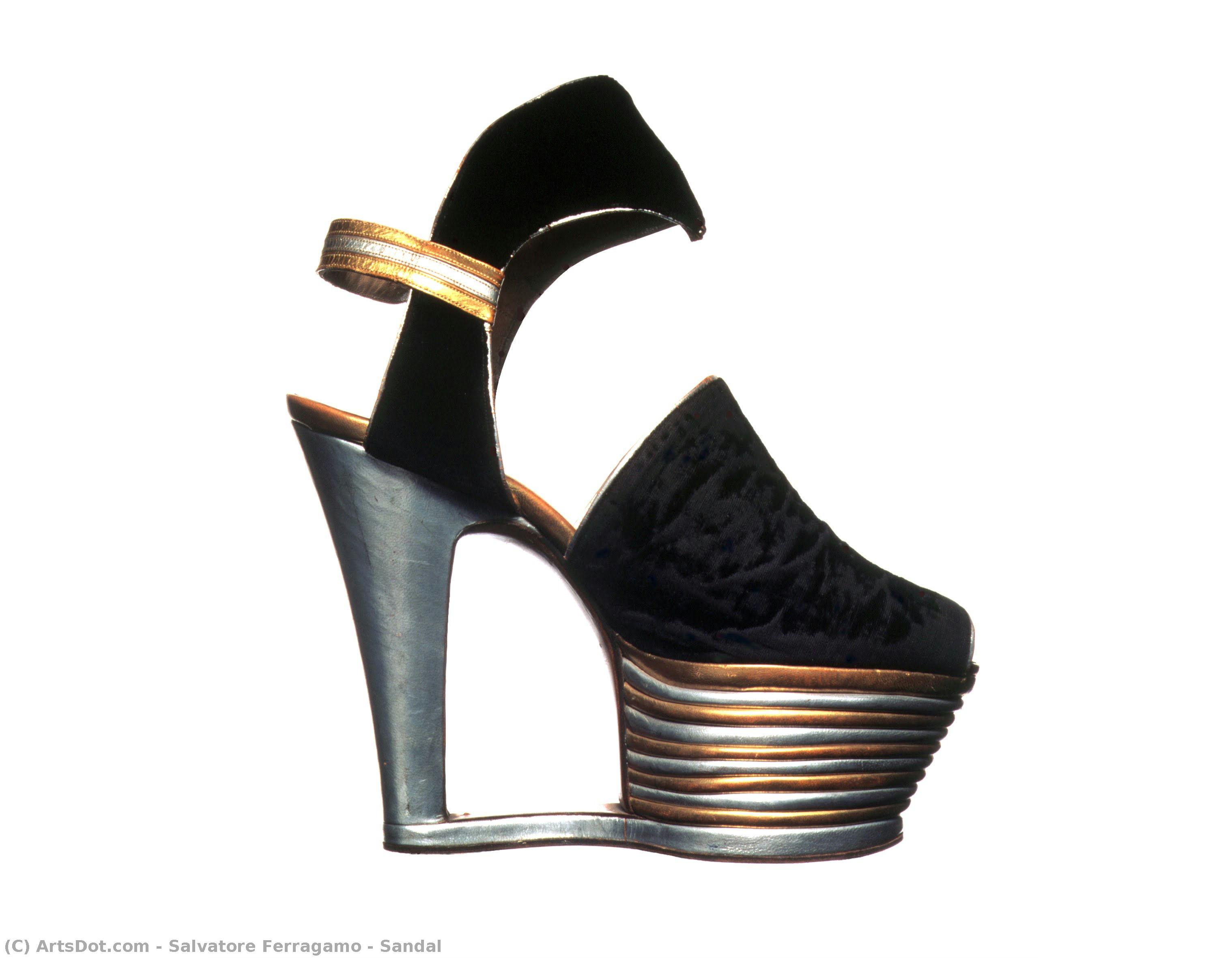
The image before us—a meticulously rendered photograph of Salvatore Ferragamo’s 1940 “Sandal”—isn’t merely a depiction of footwear; it’s a portal to an era defined by Hollywood extravagance, Italian artistry, and the audacious vision of a man who redefined luxury. This isn't simply a shoe; it’s a testament to meticulous craftsmanship, a symbol of daring design, and a poignant reflection of a bygone glamour. The stark black background immediately draws attention to the intricate details of the sandal itself – a study in elegant restraint and subtle power.
Ferragamo’s journey began not amidst the glittering lights of Tinseltown, but in the humble workshops of rural Italy. His early life, marked by hardship and a deliberate rejection of his family's traditional shoemaking expectations, instilled within him an unwavering determination to forge his own path. This foundational experience profoundly shaped his approach to design – a deep understanding of materials, a respect for construction, and a refusal to simply replicate existing forms. The “Sandal,” born from this ethos, embodies these principles perfectly.
The Architecture of Elegance: Form and Technique
Examining the photograph reveals a masterful interplay of form and technique. The sandal’s silhouette is immediately striking – a sleek, almost architectural structure that defies the conventional notions of footwear. The high heel, a bold statement in itself, isn't merely for height; it’s an integral element of the design, adding a sense of poised confidence to the wearer. The velvet upper, rendered with exquisite detail, speaks volumes about the quality of materials and the precision of the stitching. Notice the subtle curve of the toe, the delicate shaping of the straps – each element meticulously considered to enhance both aesthetics and comfort.
The use of silver kidskin trim adds a layer of luxurious texture and visual interest, contrasting beautifully with the deep black velvet. The wooden heel and sole, grounded in traditional shoemaking techniques, provide stability and durability while maintaining an air of understated sophistication. The photograph’s lighting is deliberately soft and even, highlighting the textures and reflective surfaces of the materials without creating harsh shadows. This diffused illumination emphasizes the sandal's tactile quality, inviting the viewer to almost reach out and feel its supple leather.
A Symbol of Transformation: History and Context
The “Sandal” is more than just a beautiful shoe; it’s a pivotal artifact in the history of fashion. Salvatore Ferragamo's early work with Hollywood stars—including Joan Crawford, Greta Garbo, and Marlene Dietrich—established him as the go-to designer for those seeking footwear that was both stylish and comfortable. His innovative designs, particularly the platform heel introduced in the late 1930s, revolutionized the industry and set a new standard for luxury footwear.
The sandal itself represents a deliberate departure from the restrictive styles of the time. It’s a symbol of liberation—a rejection of convention and an embrace of individual expression. Ferragamo's designs were often imbued with a sense of theatricality, reflecting the glamour and excitement of the Hollywood era. The “Sandal” perfectly encapsulates this spirit, suggesting a woman who is confident, stylish, and unafraid to make a statement.
Echoes of Glamour: Emotional Resonance
Looking at this photograph evokes a powerful sense of nostalgia—a longing for the golden age of Hollywood. The sandal’s elegant lines, luxurious materials, and subtle details transport us back to a time when fashion was an art form, and style was synonymous with glamour. It speaks to a desire for sophistication, refinement, and timeless beauty. The piece isn't simply decorative; it carries within it the legacy of a visionary designer who dared to challenge conventions and redefine luxury.
Questions & Answers
What space is suggested for "Sandal" by Salvatore Ferragamo?
A reproduction of "Sandal" fits well in a living room.
What space matches the colors of "Sandal" by Salvatore Ferragamo?
With its pastels palette, "Sandal" by Salvatore Ferragamo is recommended for a living room. The colors are part of the reason for this suggestion.
Is there a factsheet about "Sandal" by Salvatore Ferragamo for students?
The Guide page of "Sandal" by Salvatore Ferragamo offers a printable two-sheet factsheet: the artwork with its identity table, a decade band placing it in the artist's lifetime, other works by the artist, the measured color palette, and ready-to-copy citations in four styles.
Artist Biography
A Legacy Forged in Leather: The Life and Vision of Salvatore Ferragamo
Salvatore Ferragamo, a name synonymous with elegance, innovation, and the golden age of Hollywood glamour, was born into humble beginnings in 1898 in Bonito, Italy. Far from the glittering world he would come to define, young Salvatore’s early life was steeped in rural simplicity, yet it was here that his extraordinary journey began. The eleventh of fourteen children, he displayed an innate fascination with shoemaking, spending countless hours observing the local cobbler – a craft initially discouraged by his father who considered it a trade of low social standing. However, young Salvatore’s passion proved unyielding; at just nine years old, he crafted his first pair of shoes for his sister's First Communion, a testament to his burgeoning talent and determination. This act wasn’t merely the creation of footwear; it was the forging of a destiny. It signaled the birth of an artistic vision that would reshape the landscape of fashion.From Boston to Hollywood: A Transatlantic Ascent
Driven by ambition, Ferragamo emigrated to America in 1915, joining his brothers in Boston before eventually gravitating towards the burgeoning film industry of California. This move proved pivotal. He initially established a repair shop, but quickly recognized an unmet need for exquisitely crafted footwear tailored to the demands of the silver screen. Hollywood’s stars – Lillian Gish, Mary Pickford, and soon, countless others – became his devoted clientele. Ferragamo wasn't simply making shoes; he was crafting illusions, enhancing the on-screen personas that captivated a nation. He understood the power of visual storytelling and how footwear could contribute to a character’s narrative. This understanding led him to study anatomy at the University of Southern California, believing that true comfort and elegance stemmed from a deep comprehension of the foot's structure. His innovative use of steel shanks for arch support revolutionized shoe construction, prioritizing both aesthetics and well-being – a hallmark of his design philosophy.Returning Home: Florentine Renaissance and Artistic Flourishing
In 1927, Ferragamo returned to his native Italy, settling in Florence—a city steeped in artistic tradition and craftsmanship. He established a workshop that quickly became a laboratory for innovation. Despite facing financial hardship during the Great Depression, filing for bankruptcy in 1933, he persevered, driven by an unwavering belief in his vision. Re-establishing his business in 1938 within the historic Palazzo Spini Feroni, Ferragamo embarked on a period of prolific creativity. He fearlessly experimented with unconventional materials – cork, fish skin, even metal – pushing the boundaries of what was considered possible in shoemaking. This willingness to challenge convention became his signature. His designs weren’t merely functional objects; they were sculptural works of art, reflecting a deep appreciation for history and an audacious spirit of modernity. The iconic wedge heel, born from wartime material shortages, stands as a testament to his resourcefulness and ingenuity, earning him the prestigious Neiman Marcus Award in 1947.A Lasting Impression: Legacy and Influence
Salvatore Ferragamo’s impact extends far beyond the realm of footwear. He founded Salvatore Ferragamo S.p.A., a luxury goods empire that continues to thrive today, operating hundreds of boutiques worldwide. While celebrated for his designs for Hollywood icons like Marilyn Monroe – he created her signature stiletto heel – and Audrey Hepburn, his influence resonates in contemporary fashion. His commitment to anatomical comfort, innovative materials, and sculptural forms paved the way for generations of designers. The Ferragamo Museum in Florence serves as a living tribute to his legacy, showcasing not only his groundbreaking shoe designs but also his broader artistic interests, including collections like La Collezione Bonello (Malta) and the Palumbo-Fossati Collection (Venice). His work transcends mere fashion; it is a celebration of artistry, innovation, and the enduring power of Italian craftsmanship. Though he passed away in 1960, Salvatore Ferragamo’s spirit continues to inspire, reminding us that true style lies not just in what we wear, but in the story it tells.Notable Works & Collections
- Pollicino: A vibrant Pop Art shoe sculpture showcasing bold color and playful design.
- Sandal (1952): An iconic example of luxurious craftsmanship and geometric design, embodying the elegance of the era.
- Prototipo di sandalo (1938): A stunning antique shoe demonstrating intricate embroidery and artisanal skill.
- La Collezione Bonello (Malta): A curated collection featuring works by masters like Caravaggio and Alberto Morrocco, reflecting Ferragamo’s appreciation for fine art.
- The Palumbo-Fossati Collection (Venice, Italy): A renowned assembly of European paintings spanning centuries, highlighting Ferragamo's broader cultural interests.

Salvatore Ferragamo
1898 - 1960 , Italy
Quick Facts
- Full Name: Salvatore Ferragamo
- Nationality: Italian
- Date Of Birth: 1898
- Date Of Death: 1960
- Place Of Birth: Bonito, Italy
- Notable Artworks:
- Pollicino
- Sandal
- Prototipo di sandalo.
- Artistic Movement Or Style: Fashion design
- Artists Or Movements Influenced By This Artist: Shoe designers