Preview
 Send
Send Share
Share
 Details
 Guide
Guide

 Download
 Similars
 X-Ray
X-Ray Diaporama
 Q&A
Q&A Stats
StatsMonks Fishing


 Read More
Giclée / Art Print
Museum-quality giclée or canvas print with fast production and flexible finish options. ( Buy Hand Made Painting Switch to Digital Image)




P118B $10

P118H $10

P118W $10

P438Z $10

P508JH $12

P508YH $12

P805H $10

P805Z $10

P919BZ $10

P919G $10

P919XJ $10

P959ZH $10

P968JZ $12

W106C $8

W218G $10

W218JH $8

W218Y $10

W307PJ $10

W316G $10

W316PJ $8

W316Y $10

W398PJ $8

W4111J $10

W500HY $15

W500JH $15

W692G $12

W849H $8

W940BG $15

W953PJ $8




Pick from our preset sizes that match the artwork's original proportions.

Type the width and the height you need, to fit your frame or your wall. A print can only be cut, never made bigger than the picture, so a size with a different shape loses a part of the image. We send you a digital mockup to approve before we print anything. The picture shown on this page does not show the real cut — only the mockup does.
Worldwide Delivery () in 2 weeks instead of standard 4/5 weeks. (4 November)

Free Worldwide Express Shipping

High-Quality Linen Canvas

Full Shipping Insurance

Customs Tax Refund Guarantee

True Color Matching Guarantee

100-Day Return Policy (Defects Only)

100% Money-Back Guarantee

Bulk Discount Offer
 Glass option is only available in size under 110 CM

Monks Fishing
Giclée / Art Print
Reproduction Size
-


Total Price
$ 81
A Landscape of Solitude and Spiritual Depth
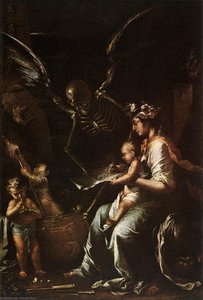
Salvator Rosa’s “Monks Fishing” isn't merely a depiction of two figures casting lines into a river; it’s a profound meditation on humanity’s relationship with the untamed forces of nature, rendered through the lens of the Baroque painter’s distinctive vision. Painted circa 1646-1648, this oil on canvas captures a moment suspended in time – a quiet ritual performed within a landscape that simultaneously invites and threatens the viewer. The scene unfolds against a dramatic backdrop of towering rock formations, a brooding sky pregnant with clouds, and a dense, almost claustrophobic forest, all rendered with an intensity characteristic of Rosa’s mature style.
Rosa, a figure perpetually at odds with the established artistic conventions of his day, rejected the polished elegance favored by many of his contemporaries. Instead, he embraced a raw, emotive approach, prioritizing naturalism and psychological depth over idealized beauty. “Monks Fishing” exemplifies this philosophy; it’s not a picturesque scene designed for easy consumption but rather a complex tableau brimming with symbolic weight and emotional resonance. The figures themselves – two weathered monks, their faces etched with contemplation – are dwarfed by the immensity of the landscape, emphasizing their vulnerability and suggesting a profound connection to something far greater than themselves.
The Language of Light and Shadow: A Baroque Masterclass
Rosa’s technical skill is immediately apparent in his masterful manipulation of light and shadow. The painting is dominated by a diffused, atmospheric light that seems to emanate from an unseen source, casting long, dramatic shadows across the rocks and foliage. This chiaroscuro effect – a hallmark of Baroque art – not only creates a sense of depth and volume but also imbues the scene with a palpable mood of melancholy and introspection. Notice how he uses subtle highlights to draw attention to the texture of the bark on the trees, the rough surface of the rocks, and the folds in the monks’ garments, inviting us to engage with the painting on a tactile level.
- Brushwork: Visible brushstrokes contribute to the ruggedness and immediacy of the scene. Layered application builds texture and depth, particularly evident in the depiction of the foliage and rock formations.
- Color Palette: The earthy tones – browns, ochres, greens – dominate the palette, reflecting the naturalistic subject matter. Subtle blues and greys in the sky add to the sense of drama and foreboding.
- Perspective: Atmospheric perspective is skillfully employed to create a sense of distance; distant elements are rendered paler and less distinct, reinforcing the vastness of the landscape.
Symbolism Woven into the Wilderness
Beyond its immediate visual appeal, “Monks Fishing” is rich in symbolic meaning. The solitary monks, engaged in their humble task, can be interpreted as metaphors for humanity’s search for spiritual enlightenment within the context of a challenging and often unforgiving world. Their isolation underscores the difficulty of achieving inner peace amidst the chaos of existence. The river itself – a recurring motif in Rosa's work – represents both sustenance and danger, life and death. The towering trees, with their gnarled branches reaching towards the sky, symbolize resilience and endurance, while the rocky terrain suggests the obstacles that must be overcome on the path to spiritual growth.
Rosa’s choice of subject matter—monks fishing in a wild landscape—was deliberately provocative. It challenged the prevailing artistic conventions of his time, which typically favored grand historical scenes or mythological narratives. By depicting a simple, everyday activity within an extraordinary setting, Rosa elevated the mundane to the level of profound contemplation.
A Legacy of Rustic Grandeur
“Monks Fishing” stands as a testament to Salvator Rosa’s unique artistic vision and his enduring influence on subsequent generations of artists. It's a painting that rewards careful observation, inviting viewers to lose themselves in its atmospheric depth and contemplate the timeless themes of solitude, spirituality, and the relationship between humanity and nature. Reproductions of this powerful work capture much of the original’s emotional intensity, offering a window into the soul of one of Italy’s most enigmatic and compelling Baroque masters.
Questions & Answers
What is the dominant hue of "Monks Fishing" by Salvator Rosa?
"Monks Fishing" leans toward an ochre to sepia tone.
What use and space are recommended for "Monks Fishing" by Salvator Rosa?
"Monks Fishing" by Salvator Rosa is recommended for statement, ideally in a living room. Use and space together guide where a reproduction fits.
Is "Monks Fishing" typical of what Salvator Rosa usually created?
Among Salvator Rosa's recorded themes - rosa’s baroque landscape style, nature, human vulnerability themes, religious allegory, moral lessons, reflects artist’s rebellious spirit, early romanticism influence - "Monks Fishing" brings its own focus on monks, fishing, landscape, rosa, baroque, italy, wilderness, nature.
Artist Biography
**early life and training**
salvator rosa, an italian baroque painter, poet, and printmaker, was born in arenella, naples, on either june 20 or july 21, 1615. his mother, giulia greca rosa, was a member of one of the greek families of sicily. despite his father's wishes for him to become a lawyer or priest, salvator showed a preference for the arts from an early age.**artistic career**
salvator rosa's artistic career was marked by his unorthodox and extravagant style, which set him apart from his contemporaries. he was active in naples, rome, and florence, and his work was influenced by the naturalism of ribera and the classicism of poussin. however, he refused to be tied down by any particular style or movement.- pythagoras emerging from the underworld (kimbell art museum, fort worth, united states), one of his most famous works, showcases his unique blend of philosophical and artistic themes.
- his the baptism of the eunuch (chrysler museum of art, norfolk, united states) demonstrates his ability to infuse high drama into even minor bible stories.
**influences and legacy**
salvator rosa's work had a significant impact on the development of baroque art. his influence can be seen in the works of later artists, such as luca giordano, who continued to push the boundaries of artistic expression. **important links:** salvator rosa's profile on OriginalUniqueArt wikipedia: salvator rosa pythagoras emerging from the underworld on OriginalUniqueArt**conclusion**
salvator rosa's life and work continue to fascinate art lovers and historians alike. his unorthodox style and perpetual rebellion against the norms of his time have cemented his place in the annals of baroque art. as a painter, poet, and printmaker, he remains an enigmatic figure, and his work continues to inspire new generations of artists and art enthusiasts.
Salvator Rosa
1615 - 1673 , Italy
Quick Facts
- Full Name: Salvator Rosa
- Nationality: Italian
- Date Of Birth: 1615
- Date Of Death: 1673
- Place Of Birth: Arenella, Italy
- Notable Artworks:
- View of the Gulf of Salerno
- Study for 'Il Genio di Rosa
- Grotto with Cascades
- Artistic Movement Or Style: Baroque art
- Artists Who Influenced This Artist: ['José de Ribera']
- Artists Or Movements Influenced By This Artist: ['Luca Giordano']
Related Articles
Epic Drama & Dark Vibes: The Ultimate Collector's Guide to Baroque Landscapes
Master the art of drama with our ultimate guide to Baroque landscapes. Discover the power of chiaroscuro, explore legendary masters, and learn how to curate epic, dark-vibe masterpieces for your collection with expert insights from OriginalUniqueArt.

Evocations of Place: A Historical Journey Through Landscape Art
Explore the rich history of landscape art with OriginalUniqueArt. Discover renowned artists, movements like Impressionism & Romanticism, and expert guidance for collecting timeless pieces. Find your perfect serene escape today!

Romantic Landscapes: 10 Masterpieces for Your Home | OriginalUniqueArt
Journey through 10 Romantic landscape masterpieces by Friedrich, Turner & Cole. Explore emotional art, sublime nature scenes & iconic 19th-century paintings. Find museum-quality reproductions for your home at OriginalUniqueArt.com – discover the full collection online!

Drama in Nature: The Captivating Grandeur of Baroque Landscapes and the Art of Emotional Spectacle
Explore the breathtaking drama of Baroque landscapes. From Rubens's grand vistas to the mastery of chiaroscuro, discover how 17th-century artists transformed nature into a theatrical stage of emotion and light. A deep dive for true art enthusiasts.

Salvator Rosa: A Baroque Rebel's Vision of Landscape, Allegory & the Human Condition
Explore the captivating world of Salvator Rosa, a rebellious Baroque master. Discover his dramatic landscapes, allegorical paintings & lasting influence on Romanticism. Hand-painted reproductions available at OriginalUniqueArt.