Preview
 Send
Send Share
Share
 Details
 Guide
Guide

 Download
 Similars
 X-Ray
X-Ray Diaporama
 Q&A
Q&A Stats
StatsHead - red and yellow

- 121.0 x 121.0 cm


 Read More
The artwork displayed on this page is protected by copyright law, which means we cannot legally create or sell an identical reproduction. This protection is enforced under international agreements such as the Berne Convention and by national laws, including those outlined by the U.S. Copyright Law - Title 17.
This method fully complies with copyright regulations because it does not involve copying or duplicating the protected artwork. Instead, it is a creative reinterpretation - a new painting that is influenced by the original but not identical to it.
Giclée / Art Print
Museum-quality giclée or canvas print with fast production and flexible finish options. ( Buy Hand Made Painting Switch to Digital Image)




P118B $10

P118H $10

P118W $10

P438Z $10

P508JH $12

P508YH $12

P805H $10

P805Z $10

P919BZ $10

P919G $10

P919XJ $10

P959ZH $10

P968JZ $12

W106C $8

W218G $10

W218JH $8

W218Y $10

W307PJ $10

W316G $10

W316PJ $8

W316Y $10

W398PJ $8

W4111J $10

W500HY $15

W500JH $15

W692G $12

W849H $8

W940BG $15

W953PJ $8




Pick from our preset sizes that match the artwork's original proportions.

Type the width and the height you need, to fit your frame or your wall. A print can only be cut, never made bigger than the picture, so a size with a different shape loses a part of the image. We send you a digital mockup to approve before we print anything. The picture shown on this page does not show the real cut — only the mockup does.
Worldwide Delivery () in 2 weeks instead of standard 4/5 weeks. (2 November)

Free Worldwide Express Shipping

High-Quality Linen Canvas

Full Shipping Insurance

Customs Tax Refund Guarantee

True Color Matching Guarantee

100-Day Return Policy (Defects Only)

100% Money-Back Guarantee

Bulk Discount Offer
 Glass option is only available in size under 110 CM

Head - red and yellow
Giclée / Art Print
Reproduction Size
-


Total Price
$ 81
A Bold Declaration in Red and Yellow: Decoding Lichtenstein’s ‘Head’
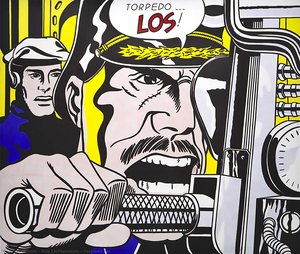
Roy Lichtenstein's *Head - red and yellow*, created in 1962, is more than just a portrait; it’s a vibrant manifesto of the burgeoning Pop Art movement. Emerging from a post-war America saturated with consumerism and mass media, Lichtenstein dared to elevate the imagery of comic books and advertising to the realm of fine art. This particular work, measuring 121 x 121 cm, encapsulates his revolutionary approach – a deliberate blurring of boundaries between “high” and “low” culture that challenged artistic conventions and captivated a generation. The painting depicts a woman’s face, cropped tightly, focusing on her expression and the striking simplicity of form. Her subtle smile hints at an inner world, yet remains tantalizingly ambiguous, inviting viewers to project their own narratives onto her visage.The Mechanics of Emotion: Ben-Day Dots and Artistic Process
What immediately distinguishes *Head - red and yellow* is Lichtenstein’s masterful appropriation of industrial printing techniques. He didn't simply copy the aesthetic of comic books; he painstakingly recreated it, most notably through his signature use of Ben-Day dots. Originally developed by Benjamin Day in 1879 as a cost-effective method for reproducing tones in newspapers, these tiny colored dots were stylized and became integral to the visual language of mid-century comics. Lichtenstein didn’t employ mechanical reproduction; instead, he meticulously hand-painted each dot, a labor-intensive process that ironically highlighted the artist's hand within a seemingly impersonal technique. This deliberate contrast is crucial – it underscores the tension between mass production and individual artistic expression, a central theme in his work. The limited palette of red and yellow further intensifies the visual impact, creating a dynamic interplay of color that draws the eye and evokes a sense of energy and immediacy.Pop Art’s Provocative Dialogue with Consumer Culture
To understand *Head - red and yellow*, one must consider its historical context. The early 1960s were a period of unprecedented economic prosperity in America, coupled with an explosion of advertising and mass-produced goods. Lichtenstein wasn't necessarily celebrating this consumer culture; rather, he was holding up a mirror to it, prompting viewers to question the values and aesthetics that shaped their world. The source image for this painting – a smiling woman from a commercial advertisement – is telling. By isolating her head and stripping away the surrounding context, Lichtenstein transforms her into an icon, a symbol of idealized femininity and the pervasive influence of advertising on societal perceptions. He forces us to confront the artifice inherent in these images, revealing the constructed nature of beauty and desire.A Lasting Legacy: Collecting and Interior Design
Today, *Head - red and yellow* remains a powerful and instantly recognizable work of art. Its bold graphic style and vibrant colors make it a captivating focal point for any collection or interior space. A high-quality reproduction allows art enthusiasts to experience the energy and impact of Lichtenstein’s vision without the constraints of rarity and cost. The painting's simplicity lends itself well to various design schemes, from modern minimalist settings to more eclectic environments. Its pop aesthetic adds a playful touch, injecting a dose of mid-century cool into any room. More than just a decorative element, *Head - red and yellow* is a conversation starter – a testament to the enduring power of Pop Art and its ability to challenge our perceptions of art, culture, and ourselves.Questions & Answers
What is the art-historical place of "Head - red and yellow" by Roy Lichtenstein?
"Head - red and yellow" by Roy Lichtenstein belongs to the Pop Art movement, within the Modern period. Together they give the work its place in art history.
Is Roy Lichtenstein, creator of "Head - red and yellow", known under other names?
Roy Lichtenstein appears under the alternate names Roy Fox Lichtenstein.
Can I see "Head - red and yellow" by Roy Lichtenstein on my own wall before buying?
"Head - red and yellow" has an augmented reality preview: the artwork's AR Preview page shows it in your own space on a compatible device.
Artist Biography
The Genesis of a Pop Visionary
Roy Fox Lichtenstein, born in the vibrant metropolis of New York City on October 27, 1923, indelibly altered the landscape of twentieth-century art. Emerging as a pivotal figure within the Pop Art movement, Lichtenstein didn’t simply reflect his era; he actively interrogated it, transforming commonplace imagery into compelling artistic statements. His upbringing in an upper-middle-class Jewish family fostered both a cultural awareness and an early artistic inclination. Childhood exposure to museums and concerts, coupled with a deep appreciation for jazz music, laid the groundwork for a creative spirit that would challenge conventional notions of fine art. Though initially drawn to realistic drawing and painting during his formative years, Lichtenstein’s formal training commenced at the Art Students League in 1939 under Reginald Marsh, followed by studies at Ohio State University – interrupted briefly by wartime service in the Army. These experiences provided a robust technical foundation that would later be brilliantly re-contextualized through the lens of mass culture and commercial aesthetics. The seeds of his signature style weren’t sown within the hallowed halls of artistic tradition but rather in the often-overlooked world of everyday imagery, particularly comic books and advertising.From Abstraction to Appropriation: A Pivotal Shift
Lichtenstein's early work demonstrated a clear engagement with Abstract Expressionism, mirroring the dominant aesthetic trends of the post-war period. However, this phase proved transitional, a stepping stone towards his revolutionary style. A crucial moment arrived during his tenure at Rutgers University where he encountered Allan Kaprow, whose influence reignited Lichtenstein’s interest in proto-pop imagery. This encounter sparked a critical shift in his artistic trajectory, leading him to question the established boundaries between “high” and “low” art. He began looking beyond the subjective expression of Abstract Expressionism towards the objective language of popular culture – specifically, comic books and advertising. The year 1961 marked a turning point with *Look Mickey*, a work that boldly appropriated characters from Disney comics, signaling the beginning of his signature style. This wasn’t mere imitation; it was an act of artistic re-evaluation, elevating commonplace imagery to the status of fine art. He didn't simply copy comic strips; he meticulously recreated them using techniques mimicking commercial printing processes, a deliberate blurring of the lines between original artwork and mass production. This appropriation wasn’t about celebrating consumerism uncritically but rather examining its pervasive influence on American society and challenging traditional artistic hierarchies.The Language of Ben-Day Dots and Bold Lines
Lichtenstein's artistic vocabulary is instantly recognizable: bold, primary colors, thick black outlines, and most famously, Ben-Day dots – a technique borrowed directly from the mechanical reproduction of comic books. These dots weren’t merely decorative; they were integral to his conceptual framework, representing the very process of mass production and challenging the traditional emphasis on the artist's hand. His paintings often enlarged details from comic strips to monumental scale, forcing viewers to confront the aesthetic qualities of an art form typically dismissed as trivial. Works like *Whaam!* (1963), *Drowning Girl* (1963), and *Oh, Jeff…I Love You, Too…But…* (1964) became iconic representations of Pop Art, capturing the anxieties and desires of a rapidly changing consumer culture. These weren’t simply depictions of comic book scenes; they were commentaries on themes of war, romance, and societal expectations, filtered through the visual language of mass media. He aimed to strip away any pretense of artistic subjectivity, presenting his work as objective reflections of American society – a mirror held up to its own manufactured reality. The deliberate flatness and lack of painterly gesture further emphasized this detachment, mimicking the impersonal nature of commercial printing.Legacy and Lasting Impact
Roy Lichtenstein’s influence extends far beyond the realm of painting. His innovative use of commercial techniques and appropriation paved the way for new generations of artists exploring themes of consumerism, media saturation, and cultural identity. The sale of *Masterpiece* in 2017 for $165 million solidified his position as one of the most commercially successful American artists of all time, but his legacy is not solely defined by monetary value. He challenged traditional notions of artistic authorship and originality, forcing a re-evaluation of what constitutes “art” itself. His work continues to inspire graphic designers, illustrators, and visual artists across various disciplines.- Major Achievements: Pioneered Pop Art style; achieved international recognition with groundbreaking exhibitions.
- Notable Works: *Whaam!*, *Drowning Girl*, *Oh, Jeff…I Love You, Too…But…*, *Masterpiece*.
- Teaching Career: Influenced aspiring artists at SUNY Oswego and Rutgers University.

Roy Lichtenstein
1923 - 1997 , United States of America
Quick Facts
- Artistic Movement Or Style: Pop Art
- Artists Or Movements Influenced By This Artist:
- Pop Art
- Graphic designers
- Illustrators
- Artists Who Influenced This Artist:
- Reginald Marsh
- Allan Kaprow
- Picasso
- Monet
- Matisse
- Full Name: Roy Fox Lichtenstein
- Nationality: American
- Notable Artworks:
- Whaam!
- Drowning Girl
- Oh, Jeff…I Love You, Too…But…
- Masterpiece
- Look Mickey
- Place Of Birth: Manhattan, United States of America
- Date Of Birth: 1923
- Date Of Death: 1997
Related Articles

Beyond the Ben-Day Dots: Roy Lichtenstein's Pop Art Revolution & Enduring Legacy
Explore Roy Lichtenstein's revolutionary Pop Art! Discover the story behind Ben-Day dots, iconic works like 'Whaam!', and investment insights for collectors. Expert analysis & high-quality reproductions at OriginalUniqueArt.

The Psychology of the Palette: Decoding Roy Lichtenstein's Bold Color Theory
Explore the psychological depth of Roy Lichtenstein's color theory. An expert analysis for art students and collectors on Ben-Day dots, primary palettes, and the intersection of Pop Art with mass media history.

The Psychology of the Palette: Decoding Roy Lichtenstein’s Bold Color Theory
Explore the vibrant psychology behind Roy Lichtenstein’s color theory. Discover how Ben-Day dots and primary colors revolutionized Pop Art, transforming mass media into timeless masterpieces for modern collectors and interior design enthusiasts.

25 Iconic Roy Lichtenstein Masterpieces That Defined Pop Art
Explore 25 iconic Roy Lichtenstein Pop Art masterpieces. Discover the stories behind these legends on OriginalUniqueArt.com.

Dots & Screens: The Industrial Secrets Behind 1960s Pop Art Masterpieces
Explore the industrial secrets of 1960s Pop Art. Discover how Ben-Day dots and silk screening transformed mass media into masterpieces by Roy Lichtenstein. An in-depth look at the intersection of mechanical printing and fine art history for students and collectors.