Preview
 Send
Send Share
Share
 Details
 Guide
Guide

 Download
 Similars
 X-Ray
X-Ray Diaporama
 Stats
StatsMelita
 Oil On Canvas
- WallArt
- Contemporary Realism
 1931
1931- Modern
 51.0 x 41.0 cm
 Leeds Art Gallery
 Read More
Hand Made Oil Reproduction
Hand-painted oil on canvas in your size and frame, made to order by our artists. ( Switch to Print Switch to Digital Image)




P118B $10

P118H $10

P118W $10

P438Z $10

P508JH $12

P508YH $12

P805H $10

P805Z $10

P919BZ $10

P919G $10

P919XJ $10

P959ZH $10

P968JZ $12

W106C $8

W218G $10

W218JH $8

W218Y $10

W307PJ $10

W316G $10

W316PJ $8

W316Y $10

W398PJ $8

W4111J $10

W500HY $15

W500JH $15

W692G $12

W849H $8

W940BG $15

W953PJ $8




Pick from our preset sizes that match the artwork's original proportions.

You may enter your own dimensions to fit a specific frame or space. If your selected size does not match the original image's proportions, we will either crop the artwork or extend the painting with additional hand-painted elements. A digital mockup will be sent for your approval before production begins.
Please note that the on-screen preview does not reflect the actual cropping or extension. Only the mockup will accurately show the final composition.
While custom sizes are available, we recommend selecting a dimension from the predefined list to preserve the original proportions.
After order, OriginalUniqueArt.com team will email client for instructions and provide a mockup preview
Worldwide Delivery () in 3/4 weeks instead of standard 5 weeks. (26 September). No compromise on quality.

Free Worldwide Express Shipping

High-Quality Linen Canvas

Full Shipping Insurance

Customs Tax Refund Guarantee

True Color Matching Guarantee

100-Day Return Policy (Defects Only)

100% Money-Back Guarantee

Bulk Discount Offer
 Glass option is only available in size under 110 CM

Melita
Reproduction Medium
Reproduction Size
-


Total Price
$ 300
A Moment of Quiet Contemplation
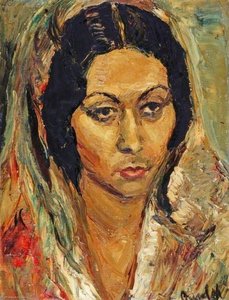
In the soft, evocative depths of Ronald Ossory Dunlop’s 1931 masterpiece, Melita, we encounter a scene that transcends mere portraiture to become an intimate study of the human soul. The painting presents a woman with dark, cascading hair, her gaze cast downward in a gesture of profound introspection. Draped in a rich, sapphire-blue dress that anchors the composition, she exists in a space of quietude, seemingly lost in a private reverie. There is a palpable sense of stillness within the frame, as if the viewer has stumbled upon a fleeting, sacred moment of thought. This downward tilt of the head and the subtle shadows playing across her features invite us to wonder about the nature of her reflections—is it melancholy, or perhaps a peaceful acceptance of the world around her?
The technique employed by Dunlop is a testament to his mastery of the alla prima method, a style characterized by the application of paint in a single, fluid session. This approach lends Melita a remarkable vitality; the brushwork feels spontaneous yet controlled, allowing the textures of the fabric and the softness of the skin to emerge with lifelike presence. The interplay of light and shadow—the chiaroscuro effect—creates a sense of three-dimensional volume, pulling the subject forward from the canvas. For collectors and interior designers, this painterly texture offers a sophisticated tactile quality that brings a sense of movement and life to any curated space.
A Legacy of Irish Spirit and Artistic Brilliance
To understand the emotional resonance of Melita, one must look toward the rich cultural tapestry from which Ronald Ossory Dunlop emerged. Born in Dublin in 1894, Dunlop was raised amidst the vibrant currents of the Irish Literary Renaissance. His upbringing, surrounded by the mystical and spiritualist influences of figures such as W.B. Yeats, infused his work with a subtle, poetic depth. While his training took him from the Manchester School of Art to the studios of Paris, his aesthetic remained deeply rooted in this atmospheric, soulful tradition. In Melita, we see this confluence of international technique and Irish sensibility—a portrait that is as much about an internal landscape as it is about the external subject.
For those seeking to adorn a home or gallery with a piece of historical significance, this work serves as a bridge to the early 20th century. The painting does not merely decorate a wall; it commands attention through its emotional gravity and classical elegance. Whether placed in a sunlit study or a moody, dimly lit library, a high-quality reproduction of Melita acts as a focal point of sophistication, offering an enduring sense of grace and a timeless connection to the golden age of portraiture.
Artist Biography
Ronald Ossory Dunlop: A Life in Paint
Early Life and Education
- Born: Dublin, Ireland, June 28, 1894.
- Dunlop came from a Scottish-Irish Quaker family with artistic inclinations; his mother was a watercolour painter.
- His early life was steeped in the atmosphere of the Irish Literary Renaissance, as his father was close friends with prominent figures like W.B. Yeats and George Russell (Æ).
- The family moved to New York in 1899, then London in 1902, maintaining a strong connection to Dublin through annual visits.
- He studied at Manchester School of Art, Wimbledon College of Art, and Paris, gaining a diverse artistic foundation.
Artistic Development & Influences
- Dunlop’s early career involved time in an advertising agency before dedicating himself fully to painting.
- Influences: The artistic and literary environment of his upbringing, particularly the mystical and spiritualist currents surrounding figures like Yeats and Russell, profoundly shaped his aesthetic sensibility.
- He associated with a group of young artists exhibiting at the Hurricane Lamp Gallery in Chelsea, contributing to the development of ‘Emotionism’.
- His style evolved towards a painterly exuberance, characterized by bold brushwork and vibrant color palettes. He became known as an 'alla prima' painter – working directly onto the canvas in a single session.
The Emotionist Group & Artistic Philosophy
- In 1923, Dunlop founded the Emotionist Group, advocating for art as an expression of inner essence and emotional experience.
- He penned a manifesto for the group, stating “Art is the expression of the essence of life,” reflecting their belief in subjective interpretation and artistic freedom.
- Dunlop joined The London Group in 1931, further solidifying his position within the avant-garde art scene.
Exhibition & Recognition
- Dunlop was a prolific exhibitor, showcasing his work at prestigious venues including the Royal Academy, New English Art Club, Leicester Galleries, and the Royal Hibernian Academy.
- His first one-man show took place in 1928 at the Redfern Gallery in London.
- Major Achievement: Elected a full member of the Royal Academy in 1950, marking the pinnacle of his professional recognition.
- His work is held in numerous public collections, including the Tate Gallery, Crawford Gallery (Cork), Cheltenham Art Gallery & Museum, and the National Portrait Gallery (London).
Themes & Style
- Dunlop’s oeuvre encompasses landscapes, seascapes, figure studies, portraits, and still life.
- He frequently depicted scenes of the English countryside, particularly around Barnham, West Sussex, where he lived later in life.
- Style: Characterized by a vibrant palette, energetic brushwork, and an emphasis on capturing atmosphere and emotional resonance. His work often possesses a sense of immediacy and spontaneity.
Later Life & Legacy
- Dunlop spent much of his life in England, eventually settling in Barnham, West Sussex.
- He continued to paint and exhibit until his death on May 18, 1973.
- Historical Significance: Dunlop’s work represents a bridge between traditional painting techniques and the expressive freedom of modernism. His vibrant style and dedication to capturing emotional truth continue to resonate with audiences today. However, his popularity has also led to numerous forgeries appearing on the market.

Ronald Ossory Dunlop
1894 - 1973 , Ireland
Quick Facts
- Birth Date: 1894-06-28
- Birth Place: Dublin, Ireland
- Death Date: 1973-05-18
- Influenced By: W. B. Yeats, James Stephens, George Russell
- Movement: Emotionism, British Impressionism
- Name: Ronald Ossory Dunlop
- Nationality: Irish
- Notable Works:
- Self Portrait
- Walberswick
- Mrs R. O. Dunlop
- Snow at Stratford on Avon
- St Tropez, South of France
- The Thames at Sunbury
Related Articles
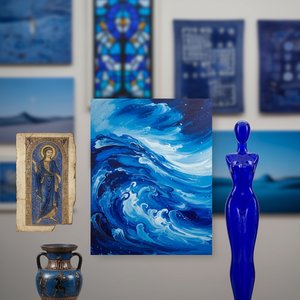
The Allure of Azure: Exploring the Symbolic & Aesthetic Depths of Blue in Art History
Explore the rich history of blue in art! Discover its symbolism, from ancient pigments to modern masterpieces by Kandinsky & Seurat. Uncover the psychological impact and cultural meanings behind this captivating hue.
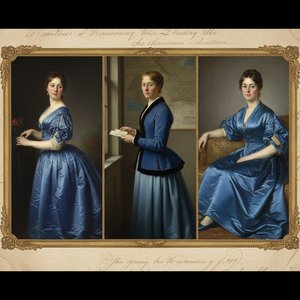
Azure Visions: Exploring Representations of the Blue Dress in Western Art History
Explore the rich history of the blue dress in Western art! Discover its symbolism, from Renaissance masterpieces to modern interpretations by artists like Martin & Schiele. Uncover cultural meanings and artistic techniques.

Slate Blue Masterpieces: 10 Iconic Paintings & Timeless Home Decor Ideas
Immerse yourself in the captivating world of slate blue! Explore 10 iconic paintings by Monet, Van Gogh & Renoir. Discover their stories, techniques & find museum-quality art reproductions for your home at .

Oil on Canvas: A Historical & Technical Exploration of a Timeless Artistic Medium
Explore the rich history & enduring techniques of oil painting on canvas. Discover the science behind its longevity, conservation practices, and contemporary relevance. Expert insights for art enthusiasts.

The Enduring Legacy of Oil on Canvas: Technique, History & Aesthetic Impact
Explore the rich history & techniques of oil painting – from Renaissance masters to Impressionism. Discover pigments, layering methods, and why this timeless medium endures. Expert insights for artists & art enthusiasts.