Preview
 Send
Send Share
Share
 Details

 Download
 Similars
 X-Ray
X-Ray Diaporama
Crossroad

 Read More
Hand Made Oil Reproduction
Hand-painted oil on canvas in your size and frame, made to order by our artists. ( Buy Print Buy Image)




































Pick from our preset sizes that match the artwork's original proportions.

You may enter your own dimensions to fit a specific frame or space. If your selected size does not match the original image's proportions, we will either crop the artwork or extend the painting with additional hand-painted elements. A digital mockup will be sent for your approval before production begins.
Please note that the on-screen preview does not reflect the actual cropping or extension. Only the mockup will accurately show the final composition.
While custom sizes are available, we recommend selecting a dimension from the predefined list to preserve the original proportions.
After order, OriginalUniqueArt.com team will email client for instructions and provide a mockup preview
Worldwide Delivery () in 3/4 weeks instead of standard 5 weeks. (7 September). No compromise on quality.

Free Worldwide Express Shipping

High-Quality Linen Canvas

Full Shipping Insurance

Customs Tax Refund Guarantee

True Color Matching Guarantee

100-Day Return Policy (Defects Only)

100% Money-Back Guarantee

Bulk Discount Offer
 Glass option is only available in size under 110 CM

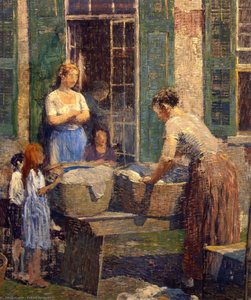
Crossroad
Reproduction Medium
Reproduction Size
-


Total Price
$ 300
Artistic Style and Technique
Robert Spencer's artistic style is characterized by his use of warm colors and gentle brushstrokes, which creates a sense of serenity and tranquility in his paintings. In Crossroad, he uses a combination of earthy tones and soft lighting to capture the quiet atmosphere of the small town. The painting also features several other people visible in the scene, some standing or walking along the street, contributing to the lively atmosphere of the town. Key Features of the Painting:- The use of warm colors and gentle brushstrokes to create a sense of serenity
- The depiction of a charming rural setting with houses and a horse and buggy
- The inclusion of several people in the scene, adding to the lively atmosphere
Similar Paintings by Robert Spencer
Robert Spencer has created several other notable paintings, including A Gray Day and The Red Boat. These paintings can be found on OriginalUniqueArt.com and are available as handmade oil painting reproductions. For more information on Robert Spencer and his artwork, visit OriginalUniqueArt.com.The Crossroad painting by Robert Spencer is a beautiful example of his artistic style and technique. With its warm colors and gentle brushstrokes, it creates a sense of serenity and tranquility that draws the viewer in. For art lovers and collectors, OriginalUniqueArt.com offers handmade oil painting reproductions of this and other notable paintings by Robert Spencer.
Artist Biography
Robert Spencer: A Painter of Industrial America
Robert Carpenter Spencer (1879-1931) stands as a compelling figure within the American Impressionist movement, yet his legacy is often intertwined with a poignant narrative of struggle and artistic evolution. Born in Harvard, Nebraska, into a family rooted in Swedenborgian ministry, Spencer’s early life was marked by constant relocation, shaping his perspective on community and labor – themes that would become central to his distinctive artistic vision. His formative years, spent amidst the burgeoning industrial landscape of Pennsylvania and New Jersey, provided an intimate understanding of the lives of working-class Americans, a subject rarely explored with such directness in contemporary art.
Spencer’s artistic journey began modestly, initially as a draftsman for a civil engineering firm. However, his true calling lay in capturing the essence of his surroundings through paint. He honed his skills at the National Academy of Design in New York City, where he benefited from instruction under William Merritt Chase and, crucially, Robert Henri – a key figure in the Ashcan School movement that championed realism and social commentary. This period laid the foundation for his later focus on depicting the realities of industrial life, particularly the mills and factories dominating the Delaware River region.
The New Hope Group and Early Style
In 1913, Spencer joined a collective of artists known as The New Hope Group, alongside figures like Charles Rosen, Daniel Garber, and William Lathrop. This group, centered in New Hope, Pennsylvania, provided a vital platform for exhibiting and discussing their work. It was during this time that Spencer’s style truly began to coalesce – characterized by short, tight brushstrokes, a vibrant palette, and an emphasis on capturing fleeting moments of light and atmosphere. His early works, such as “The Silk Mill” (1912) and “Grey Mills” (1913), are particularly notable for their evocative portrayal of the mills and the women who labored within them. These paintings weren’t simply depictions of factories; they were intimate studies of human experience, revealing the dignity and resilience of those whose lives were inextricably linked to the machinery.
Influenced by Daniel Garber, Spencer developed a distinctive approach to landscape painting, often incorporating figures into his scenes – a deliberate choice that underscored the interconnectedness between humanity and its environment. His paintings frequently featured workers engaged in their daily routines, bathed in the dramatic light of dawn or dusk. These images weren’t romanticized; they presented a raw and honest portrayal of industrial labor, reflecting the hardships and challenges faced by these individuals.
Themes of Isolation and Resilience
Spencer's work is deeply imbued with themes of isolation and resilience. His subjects – often solitary figures amidst vast industrial landscapes – convey a sense of quiet contemplation and stoic endurance. Paintings like “The Closing Hour” (1913) and "Repairing the Bridge" (1913) capture the final moments of the workday, suggesting both exhaustion and a quiet determination to persevere. The Delaware River region, with its mills and canals, became a recurring motif in his work, symbolizing not only the economic heartland of Pennsylvania but also the complex relationship between humanity and nature.
Despite achieving recognition within the art world – including acquisitions by institutions like the Metropolitan Museum of Art – Spencer’s personal life was marked by instability. His marriage to Margaret Fulton proved difficult, and he struggled with periods of depression and mental illness. These challenges undoubtedly influenced his artistic output, adding a layer of melancholy and introspection to his work.
Legacy and Historical Significance
Robert Spencer's contribution to American art lies in his unflinching portrayal of industrial America during a period of rapid transformation. He offered a rare glimpse into the lives of working-class Americans, challenging conventional notions of beauty and elevating the dignity of labor. His paintings are not merely representations of factories and mills; they are powerful statements about human resilience, social inequality, and the enduring spirit of community.
While his life was tragically cut short by suicide in 1931, Spencer’s artistic legacy endures. His evocative depictions of the Delaware River region continue to resonate with viewers today, reminding us of the importance of documenting and understanding the experiences of ordinary people – a mission that remains profoundly relevant in our own time.

Robert Spencer
1879 - 1931 , United States of America
Quick Facts
- Artistic Movement Or Style: Impressionism
- Artists Or Movements Influenced By This Artist: ['New Hope Group']
- Artists Who Influenced This Artist:
- William Merritt Chase
- Daniel Garber
- William Lathrop
- Date Of Birth: 1 December 1879
- Date Of Death: 11 July 1931
- Full Name: Robert Carpenter Spencer
- Nationality: American
- Notable Artworks:
- The Silk Mill (1912)
- Grey Mills (1913)
- Repairing the Bridge (1913)
- Place Of Birth: Harvard, Nebraska, USA