 Preview
 Send
Send Share
Share
 Details
 Guide
Guide

 Download
 Similars
 X-Ray
X-Ray Diaporama
 Stats
StatsTomato Plants
 Expressionism
 1942
1942- Modern
 46.0 x 62.0 cm
 Government Art Collection
 Read More
The artwork displayed on this page is protected by copyright law, which means we cannot legally create or sell an identical reproduction. This protection is enforced under international agreements such as the Berne Convention and by national laws, including those outlined by the U.S. Copyright Law - Title 17.
This method fully complies with copyright regulations because it does not involve copying or duplicating the protected artwork. Instead, it is a creative reinterpretation - a new painting that is influenced by the original but not identical to it.
Giclée / Art Print
Museum-quality giclée or canvas print with fast production and flexible finish options. ( Buy Hand Made Painting Switch to Digital Image)




P118B $10

P118H $10

P118W $10

P438Z $10

P508JH $12

P508YH $12

P805H $10

P805Z $10

P919BZ $10

P919G $10

P919XJ $10

P959ZH $10

P968JZ $12

W106C $8

W218G $10

W218JH $8

W218Y $10

W307PJ $10

W316G $10

W316PJ $8

W316Y $10

W398PJ $8

W4111J $10

W500HY $15

W500JH $15

W692G $12

W849H $8

W940BG $15

W953PJ $8




Pick from our preset sizes that match the artwork's original proportions.

Type the width and the height you need, to fit your frame or your wall. A print can only be cut, never made bigger than the picture, so a size with a different shape loses a part of the image. We send you a digital mockup to approve before we print anything. The picture shown on this page does not show the real cut — only the mockup does.
Worldwide Delivery () in 2 weeks instead of standard 4/5 weeks. (28 October)

Free Worldwide Express Shipping

High-Quality Linen Canvas

Full Shipping Insurance

Customs Tax Refund Guarantee

True Color Matching Guarantee

100-Day Return Policy (Defects Only)

100% Money-Back Guarantee

Bulk Discount Offer
 Glass option is only available in size under 110 CM

Tomato Plants
Giclée / Art Print
Reproduction Size
-


Total Price
$ 81
A Symphony of Verdant Life: Rediscovering Robert Colquhoun’s Tomato Plants
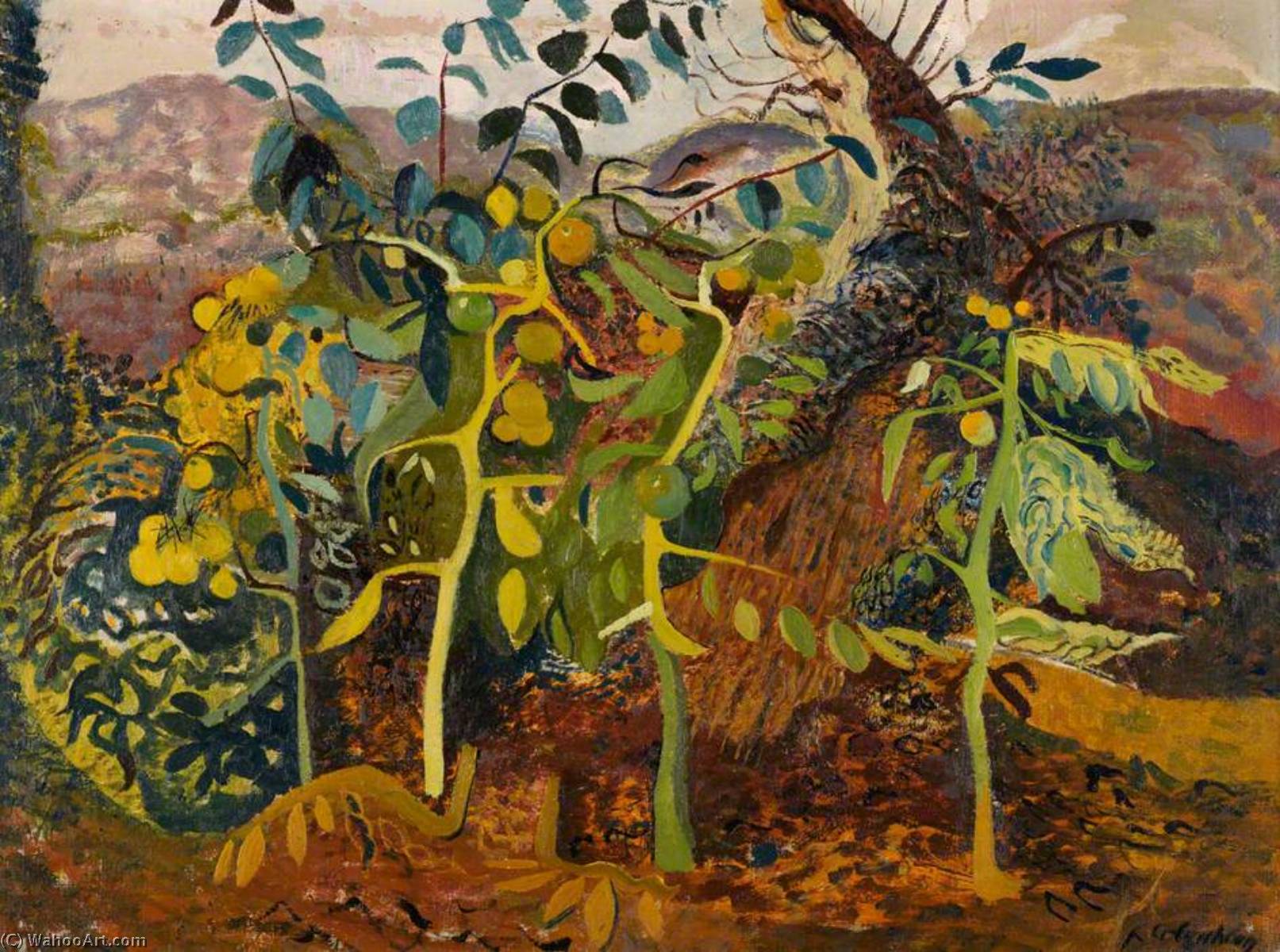
In the evocative realm of mid-century British expressionism, few works capture the pulse of the natural world with as much kinetic energy as Robert Colquanno’s 1942 masterpiece, Tomato Plants. At first glance, the canvas presents a lush, sprawling forest scene, yet beneath its vibrant surface lies a complex tapestry of movement and light. The composition is anchored by a magnificent tree adorned with luminous yellow leaves, a brilliant focal point that pierces through the deeper, more shadowed tones of the surrounding woodland. This interplay of light and shadow creates a sense of depth that draws the viewer into a secret, breathing ecosystem where every leaf and branch seems to vibrate with life.
Colquhoun, a painter renowned for his ability to translate raw emotion into simplified, powerful forms, utilizes a technique that balances structural clarity with expressive fluidity. The painting is not merely a static landscape; it is a stage for a delicate drama of fauna. Scattered throughout the verdant canopy, birds are captured in moments of both stillness and flight, their presence adding a rhythmic cadence to the work. Even more unexpected are the two cats—one positioned near the heart of the composition and another drifting toward the periphery—which introduce an element of domestic intimacy into the wild, untamed forest. This juxtaposition of the wild and the familiar creates a narrative tension that is both enchanting and deeply human.
The Emotional Resonance of Expressionist Nature
Beyond its botanical subject matter, Tomato Plants serves as a profound exploration of vitality and the interconnectedness of all living things. The year 1942 was a period of immense global upheaval, yet within this frame, Colquhoun offers a sanctuary of biological abundance. The use of stark color contrasts—the brilliant yellows against deep forest greens—functions as an emotional shorthand for resilience and the enduring cycle of growth. For the collector or interior designer, this piece offers more than just aesthetic beauty; it provides a window into a world where nature remains an indomitable force of joy and complexity.
The painting’s dynamic composition makes it an extraordinary choice for sophisticated interiors. Whether placed in a sun-drenched gallery or a quiet study, the work commands attention through its movement and warmth. The way the light seems to emanate from within the yellow foliage provides a natural luminosity that can brighten any space, making it a centerpiece of conversation. To possess a reproduction of this caliber is to invite the spirit of Colquhoun’s visionary expressionism into one's home, celebrating a moment in art history where the beauty of the earth was captured with unparalleled passion and poetic grace.
Questions & Answers
How can "Tomato Plants" by Robert Colquhoun be used in home decor?
"Tomato Plants" by Robert Colquhoun is recommended for focal, ideally in a restaurant (casual). Use and space together guide where a reproduction fits.
How old was Robert Colquhoun when creating "Tomato Plants" in 1942?
Robert Colquhoun was 28 years old when creating "Tomato Plants" in 1942. The age is computed from the artist's birth year, 1914.
How is the color composition of "Tomato Plants" by Robert Colquhoun built?
The color composition of "Tomato Plants" by Robert Colquhoun combines a balanced contrast with a strong color unity harmony.
Artist Biography
Robert Colquhoun: A Visionary Painter of Isolation and Expression
Robert Colquhoun (1914–1962) stands as a pivotal figure in British art of the mid-century, recognized for his distinctive expressionist style—characterized by stark contrasts of color, simplified forms, and an unflinching portrayal of human emotion. Born in Kilmarnock, Scotland, he possessed an innate artistic sensibility nurtured by early exposure to the landscapes of Ayrshire, which would profoundly inform his visual vocabulary. His formal education at Glasgow School of Art cemented a lifelong partnership with fellow artist Robert MacBryde, forging a creative alliance that shaped their careers and intellectual discourse.- Early Influences & Artistic Formation: Colquhoun’s formative years were marked by an immersion in rural Ayrshire's vibrant hues and textures—a connection that translated into his initial paintings depicting agricultural laborers and workmen with remarkable sensitivity. These early works demonstrated a nascent understanding of color theory and compositional balance, foreshadowing the stylistic developments to come.
- The MacBryde Collaboration & Parisian Exploration: The meeting at Glasgow School of Art initiated a symbiotic relationship with MacBryde that extended beyond artistic collaboration into personal companionship. Together they embarked on a transformative journey to France and Italy in 1937–39, absorbing the influence of Picasso’s cubism and experimenting with innovative techniques. This period solidified their commitment to abstraction and established them as artists deeply attuned to the intellectual currents of their time.
World War II Service & London Studio Life
- Military Engagement: During World War II, Colquhoun served as an ambulance driver in the Royal Army Medical Corps, experiencing firsthand the anxieties and hardships of wartime. This experience undoubtedly deepened his understanding of human vulnerability and contributed to the melancholic tone that permeates much of his oeuvre.
- Collaborative Studio Space & Artistic Circle: Following the war, Colquhoun relocated to London and shared studio space with MacBryde, Jankel Adler, and John Minton—forming a vibrant artistic community centered around Bedford Gardens. This environment fostered intellectual exchange and fueled their creative output, attracting influential figures like Michael Ayrton, Francis Bacon, Lucian Freud, Dylan Thomas, and George Barker.
Theatre Design & Artistic Recognition
- Stagecraft Contributions: Colquhoun’s artistic talents extended beyond painting into theatre design. He collaborated extensively with MacBryde on productions of Macbeth and King Lear at Stratford-upon-Avon, as well as Donald of the Burthens for Sadler's Wells Ballet, demonstrating his versatility and commitment to visual storytelling.
- Critical Acclaim & Galerie Lefevre: Throughout the 1940s and early 1950s, Colquhoun achieved considerable acclaim within the British art world. His work was regularly showcased at Galerie Lefevre in London, securing his reputation as one of the foremost artists of his generation.
Mature Style & Legacy
- Expressionist Vision: Colquhoun’s mature style embraced a powerfully expressive aesthetic—characterized by bold color palettes and simplified geometric forms. He relentlessly pursued themes of isolation, anguish, and psychological complexity, reflecting the anxieties of postwar Europe.
- Printmaking & Continuing Influence: Colquhoun was a prolific printmaker, producing numerous lithographs and monotypes that further explored his artistic ideas. His work continues to resonate with contemporary artists and scholars alike, serving as an enduring testament to his singular vision and contribution to British art history.
His oeuvre remains a poignant reflection of the human condition—a haunting exploration of emotion conveyed through masterful technique and imbued with the indelible mark of Ayrshire’s landscape. Robert Colquhoun's legacy endures not merely as an artist but as a symbol of artistic integrity and unwavering dedication to conveying profound psychological truths.

Robert Colquhoun
1914 - 1962 , United Kingdom
Quick Facts
- Artistic Movement Or Style: Expressionism
- Artists Or Movements Influenced By This Artist: ['MacBryde']
- Artists Who Influenced This Artist: ['Picasso']
- Date Of Birth: 1914
- Date Of Death: 1962
- Full Name: Robert Colquhoun
- Nationality: Scottish
- Notable Artworks:
- Seated Figure
- The Lock Gate
- Place Of Birth: Kilmarnock, United Kingdom
Related Articles
Golden Hues: 10 Masterpieces Dominated by Chrome Yellow | OriginalUniqueArt
Immerse yourself in golden light! Explore 10 famous paintings dominated by 'Chrome Yellow', from Van Gogh’s Sunflowers to Monet's Haystacks. Discover the stories behind these iconic Impressionist & Post-Impressionist masterpieces and find museum-quality art reproductions at OriginalUniqueArt.com.

Golden Hues & Crimson Leaves: Capturing the Magic of Autumn Colors in Fine Art
Embark on a visual journey through the golden hues of autumn fine art. Discover how masters like Van Gogh capture seasonal magic through vibrant oil landscapes and explore expert tips for collecting timeless autumnal masterpieces.
The Golden Hue: Exploring Symbolism & Emotion in Yellow Art
Explore the rich symbolism & emotional power of yellow in art history! From Van Gogh to Kandinsky, discover how artists used this vibrant hue. Expert analysis & high-quality reproductions at OriginalUniqueArt.
Feathered Visions: A Historical & Artistic Exploration of Birds in Painting
Explore the rich history of birds in painting! Discover symbolism, artistic movements & master artists like Audubon. High-quality reproductions available at OriginalUniqueArt.
Golden Hues: Top 10 Paintings Dominated by Yellow Ochre |
Explore 10 iconic paintings bathed in golden yellow ochre! From Van Gogh's sunflowers to Monet’s haystacks, discover the stories behind these masterpieces. Find museum-quality art reproductions & elevate your home decor on .