Preview
 Send
Send Share
Share
 Details
 Guide
Guide

 Download
 Similars
 X-Ray
X-Ray Diaporama
 Stats
StatsDeep waters
 Oil On Canvas
- WallArt
- Surrealism
 1941
1941- Modern
 65.0 x 50.0 cm
 Read More
The artwork displayed on this page is protected by copyright law, which means we cannot legally create or sell an identical reproduction. This protection is enforced under international agreements such as the Berne Convention and by national laws, including those outlined by the U.S. Copyright Law - Title 17.
As a respectful and legal alternative, we offer custom, hand-painted artworks inspired by the original. Our skilled and professional artists carefully study the original's style, mood, and artistic essence to create a new, unique piece that evokes the same feeling - while remaining an original creation in its own right.
This method fully complies with copyright regulations because it does not involve copying or duplicating the protected artwork. Instead, it is a creative reinterpretation - a new painting that is influenced by the original but not identical to it.
Hand Made Oil Reproduction
Hand-painted oil on canvas in your size and frame, made to order by our artists. ( Switch to Print Switch to Digital Image)




P118B $10

P118H $10

P118W $10

P438Z $10

P508JH $12

P508YH $12

P805H $10

P805Z $10

P919BZ $10

P919G $10

P919XJ $10

P959ZH $10

P968JZ $12

W106C $8

W218G $10

W218JH $8

W218Y $10

W307PJ $10

W316G $10

W316PJ $8

W316Y $10

W398PJ $8

W4111J $10

W500HY $15

W500JH $15

W692G $12

W849H $8

W940BG $15

W953PJ $8




Pick from our preset sizes that match the artwork's original proportions.

Type the width and the height you need, to fit your frame or your wall. This is hand-painted, so for a size with a different shape the artist can paint a bit more around the picture, or cut a bit — you choose. We send you a digital mockup to approve before the painting starts. The picture shown on this page does not show the real result — only the mockup does.
After order, OriginalUniqueArt.com team will email client for instructions and provide a mockup preview
Worldwide Delivery () in 3/4 weeks instead of standard 5 weeks. (23 October). No compromise on quality.

Free Worldwide Express Shipping

High-Quality Linen Canvas

Full Shipping Insurance

Customs Tax Refund Guarantee

True Color Matching Guarantee

100-Day Return Policy (Defects Only)

100% Money-Back Guarantee

Bulk Discount Offer
 Glass option is only available in size under 110 CM

Deep waters
Reproduction Medium
Reproduction Size
-


Total Price
$ 300
A Silent Dialogue Beneath the Surface
In the hauntingly beautiful expanse of René Magritte’s 1941 masterpiece, Deep Waters, the viewer is invited into a realm where the boundaries between reality and dream dissolve into a singular, breathless moment. The painting presents a scene of profound stillness: a solitary woman stands poised against a vast, muted seascape, her presence anchored by a bird perched intently on a pole beside her. There is an undeniable tension held within this composition, a quiet vibration that suggests something momentous is occurring just beneath the surface of the visible world. Magritte, a master of the Surrealist movement, utilizes meticulous realism to render these disparate elements with such clarity that the illogical juxtaposition of woman and bird feels both startling and strangely inevitable.
The technique employed in Deep Waters is a testament to Magritte’s ability to manipulate oil on canvas to evoke atmosphere rather than mere likeness. Through subtle tonal gradations and a palette of somber, muted hues, he creates a sense of immense depth and atmospheric weight. The sea and sky bleed into one another, creating an infinite backdrop that emphasizes the isolation of the subjects. This mastery of light and shadow does more than define form; it crafts a psychological landscape. For the collector or interior designer, this piece offers a sophisticated focal point—a work that does not shout for attention but rather commands it through its enigmatic gravity and the way it pulls the eye into its mysterious, receding horizons.
Symbolism and the Shadows of History
To gaze upon Deep Waters is to engage with a complex web of symbolism rooted in both personal trauma and global upheaval. Created during the dark, uncertain years of the Second World War and the German occupation of Belgium, the painting breathes the air of an era defined by isolation and unseen threats. The woman, often interpreted as a figure of vulnerability and quiet contemplation, stands as a sentinel of the human spirit amidst a turbulent world. Her stillness contrasts sharply with the predatory gaze of the bird, which serves as a symbol of vigilance, perhaps even a harbative omen. This silent dialogue between the observer and the observed mirrors the Surrealist fascination with the subconscious—the idea that what we see is merely a veil covering much deeper, more unsettling truths.
The emotional resonance of the work lies in this very duality: the harmony of the composition versus the underlying sense of melancholy. Magritte’s ability to weave together themes of loss, mystery, and the uncanny makes Deep Waters an enduring icon of art history. For those seeking to adorn a space with art that provokes thought and inspires introspection, this reproduction captures the essence of Magritte’s poetic Surrealism. It is a piece that transcends mere decoration, offering instead a window into the profound stillness found within the heart of chaos, making it an invaluable addition to any curated collection of fine art.
Questions & Answers
What atmosphere does "Deep waters" have?
"Deep waters" has a mystical atmosphere.
What color intensity does "Deep waters" by René Magritte have?
The color intensity of "Deep waters" is balanced. Intensity describes how strong the colors appear.
How do the colors of "Deep waters" relate to each other?
The colors of "Deep waters" by René Magritte show a strong color unity harmony. Harmony describes how the colors relate to each other.
Artist Biography
Early Life and the Seeds of Surrealism
René Magritte, born René François Ghislain Magritte on November 21, 1898, in Lessines, Belgium, emerged into a world that would profoundly shape his enigmatic artistic vision. His early years were marked by an unsettling event – the suicide of his mother when he was just thirteen. The image of her body being recovered from the River Sambre, with her dress obscuring her face, became a haunting motif that would subtly permeate his later work, manifesting in veiled figures and a persistent exploration of hidden realities. This early trauma instilled within him a fascination with mystery, loss, and the unsettling power of what remains unseen. While details of his childhood remain somewhat elusive, it’s clear this formative experience laid the groundwork for his lifelong questioning of perception and representation. He began drawing lessons at age ten, revealing an innate inclination towards visual expression, but initially explored Impressionism before embarking on a path that would lead him to become one of the most significant figures in Surrealist art.
Artistic Development and Influences
Magritte’s artistic journey was not immediate or straightforward. He studied at the Académie Royale des Beaux-Arts in Brussels, yet found its traditional methods stifling. His early work experimented with Futurism and Cubism, absorbing elements of these avant-garde movements but ultimately rejecting their purely formal concerns. It wasn't until encountering Giorgio de Chirico’s painting *The Song of Love* in 1922 that Magritte discovered a resonance that would irrevocably alter his artistic course. De Chirico’s dreamlike landscapes and unsettling juxtapositions unlocked within Magritte a new way of seeing – a world where the familiar could be rendered strange, and the ordinary imbued with profound mystery. This encounter sparked his commitment to Surrealism, though he often maintained a unique distance from its more overtly psychological or automatic approaches. He preferred a meticulous, almost clinical precision in his painting, using realistic techniques to depict illogical scenarios.
The Heart of Surrealism: Challenging Reality
By 1926, Magritte had fully embraced the tenets of Surrealism, producing *Le Jockey Perdu (The Lost Jockey)*, widely considered his first truly surrealist work. However, his brand of Surrealism was distinct. He wasn’t interested in exploring the subconscious through free association or dream imagery in the manner of some of his contemporaries. Instead, Magritte sought to challenge viewers' perceptions of reality by presenting ordinary objects in unexpected contexts, forcing them to question their assumptions about the world around them. Iconic works like *The Treachery of Images (This is not a pipe)* (1929) brilliantly deconstructs the relationship between image and object, reminding us that a representation is never the thing itself. *Les Amants (The Lovers)* (1927-1928), with its shrouded figures, echoes the trauma of his mother’s death while simultaneously exploring themes of concealment and intimacy. *Time Transfixed* (1938) presents a locomotive bursting through a brick wall, disrupting our sense of space and time. And *The Human Condition* (1933), a canvas within a canvas, blurs the boundaries between representation and reality, prompting us to consider how we perceive and interpret the world.
Later Life, Recognition, and Enduring Legacy
Despite initial struggles for recognition, Magritte’s work gradually gained prominence, particularly in the United States with exhibitions in 1936 and later retrospective shows at the Museum of Modern Art (1965) and the Metropolitan Museum of Art (1992). He remained politically engaged throughout his life, advocating for artistic autonomy. He continued to refine his signature style, exploring themes of repetition, illusion, and the power of language in paintings that are both intellectually stimulating and visually arresting. Magritte died on August 15, 1967, leaving behind a body of work that continues to captivate and challenge audiences worldwide. His influence extends far beyond the realm of painting, impacting pop art, minimalist art, conceptual art, and even advertising and film. Today, his paintings are held in major museum collections around the globe, including the Musées royaux des beaux-arts de Belgique in Brussels, which houses the Magritte Museum – dedicated entirely to his work and boasting the world’s largest collection of his creations.
- Museum Collections: Musées royaux des beaux-arts de Belgique, Brussels; Magritte Museum.
Magritte's enduring legacy lies in his ability to make us see the familiar anew, to question our assumptions about reality, and to appreciate the power of art to provoke thought and inspire wonder. He wasn’t simply painting images; he was crafting visual paradoxes that continue to resonate with viewers decades after their creation, solidifying his position as a true master of Surrealism and a pivotal figure in 20th-century art.
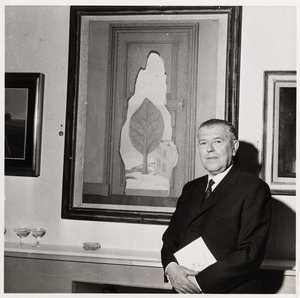
René Magritte
1898 - 1967 , Belgium
Quick Facts
- Artistic Movement Or Style: Surrealism
- Artists Or Movements Influenced By This Artist:
- Pop art
- Minimalist art
- Conceptual art
- Artists Who Influenced This Artist:
- Giorgio de Chirico
- Claude Monet
- Vincent van Gogh
- Paul Cézanne
- Full Name: René François Ghislain Magritte
- Nationality: Belgian
- Notable Artworks:
- The Treachery of Images
- The Lovers
- Time Transfixed
- The Human Condition
- Golconda
- Place Of Birth: Lesennes, Belgium
- Date Of Birth: 1898
- Date Of Death: 1967
Related Articles
The Treachery of Images: Decoding René Magritte’s Surrealist Philosophy and the Paradox of Representation
Explore the profound mystery of René Magritte’s 'The Treachery of Images.' Dive into an expert analysis of his Surrealist philosophy, the paradox of representation, and how he challenged reality through the interplay of language and visual perception.

The Treachery of Images: Decoding René Magritte’s Surrealist Vision and the Paradox of Representation
Delve into the profound mysteries of René Magritte’s Surrealism. Explore an expert analysis of 'The Treachery of Images,' decoding the philosophical paradoxes and visual subversions that redefined modern art history for collectors and connoisseurs alike.
Fluid Reflections: Exploring Water's Symbolism in Art History – From Myth to Impressionism
Explore the rich symbolism of water in art history – from ancient myths to Impressionism's fleeting beauty. Discover masterpieces & find your perfect serene artwork with OriginalUniqueArt.com.
Surrealism's Greatest Hits: 10 Masterpieces for Your Home |
Journey into the dreamlike world of Surrealism! Explore 10 masterpieces by Dali, Magritte & Miró. Discover the stories behind these iconic paintings and find museum-quality art reproductions for your home at .
Surrealist Expression: Unlocking the Power of Dreams and the Subconscious through Art History
Explore the profound depths of Surrealism. From Dalí’s dreamscapes to Magritte’s enigmas, master the history of the subconscious mind through our expert art guide and discover museum-quality oil reproductions of the world's most iconic surrealist masterpieces.