
 Preview
 Send
Send Share
Share
 Details
 Guide
Guide

 Download
 Similars
 X-Ray
X-Ray Diaporama
 Q&A
Q&A Stats
StatsDanae


 Read More
Get a print-ready file that goes far beyond the web preview. Every digital image we sell comes from a high-resolution master in our stock database — usually 5,000 to 15,000 pixels wide — so you can print large, crop tightly, or reproduce fine detail with confidence.
No file leaves our studio untouched. A digital expert checks the colors against the original painting and corrects them if needed, then improves clarity and detail with professional retouching tools — always staying faithful to the artist's brushwork and style. The result is an image that looks like the painting, not like a filtered scan.
You approve before you're done: our expert sends the image by e-mail within 72 hours for your review. Not satisfied? Ask for improvements or corrections, or request a refund if the quality falls short.
This is the quality relied on by publishers, design studios, galleries and print shops.
Digital Image
Download a high-resolution file for personal display, printing, and creative projects. ( Switch to Print Buy Hand Made Painting)
Included in Every Digital Image Order
Expert Digital Delivery, Guaranteed
When you choose OriginalUniqueArt.com, you're not just getting an image - you're receiving a professionally enhanced digital artwork, crafted with precision and backed by a satisfaction guarantee. Here's everything that comes with your order, automatically:

Fast Email Delivery
Your high-resolution digital image file will be emailed to you within 72 hours of ordering - ready for immediate use.

AI-Enhanced Digital File
Your artwork is professionally optimized using advanced AI tools and manual editing, ensuring maximum detail, clarity, and color accuracy.

Free Lifetime Re-Delivery
Accidentally deleted or lost your file? No worries - we'll resend it to you anytime, free of charge.

No Import Fees - Ever
Enjoy your artwork instantly with zero customs, duties, or delivery fees - digital downloads are always tax-free.

Color Accuracy Guarantee
We ensure your digital image reflects the original colors as closely as possible using professional tools and color management.

100-Day Satisfaction Guarantee
If you're not satisfied with your digital image, we'll revise it or refund 100% within 100 days - no questions asked.

100% Money-Back Guarantee
Not satisfied? Get a full refund within 100 days of receiving your digital file - no questions asked.

Bulk Order Discounts
Buy 3 images, save 10% - Buy 5, save 15% - Buy 10+, save 20%. Great for creative projects, galleries, and agencies.
Danaë: A Masterpiece of Light and Emotion
Rembrandt van Rijn’s Danaë stands as an unparalleled testament to Baroque artistry, capturing not merely a mythological narrative but also the profound psychological depth characteristic of the Dutch Golden Age. Completed in 1636, this monumental canvas—measuring eight by ten feet—immediately draws the eye with its dramatic chiaroscuro, Rembrandt's signature technique that masterfully manipulates light and shadow to convey emotion and create an atmosphere of palpable tension.
- Subject Matter: The painting depicts Danaë, Queen of Argos, besieged by Zeus in the form of a shower of gold—a retelling of the Greek myth concerning her impregnation without consent.
- Style: Rembrandt’s style is undeniably Baroque, prioritizing expressive realism over idealized beauty. He eschews conventional artistic conventions, favoring instead an unflinching portrayal of human vulnerability and emotion.
- Technique: Employing oil paint on canvas, Rembrandt utilized a layering technique—known as impasto—to build up thick textures that heighten the visual impact of the scene. This method is particularly evident in Danaë’s torso and arms, where the brushstrokes create a palpable sense of physicality.
Historical Context: Scandal and Restoration
Danaë's creation coincided with Rembrandt’s personal life—his marriage to Saskia van Uylenburgh—and he famously reworked the painting after her death in 1642, incorporating the likeness of his mistress Geertje Dircx. This subtle alteration underscores Rembrandt’s artistic sensitivity and his ability to imbue his work with biographical resonance.
However, Danaë's journey wasn't without peril. In June 1985, a man driven by mental instability attacked the painting with sulfuric acid and a knife, inflicting significant damage on its surface. The ensuing restoration effort—spanning from 1985 to 1997—involved meticulous cleaning, consolidation, and pigment retouching, overseen by experts at the Hermitage Museum.
The Mauritshuis Collection: An Icon of Dutch Art
Today, Danaë resides in the Mauritshuis in The Hague, Netherlands—a cornerstone of Dutch Golden Age art. Its presence embodies the museum’s commitment to preserving and presenting masterpieces from this era alongside other luminaries like Vermeer and Hals.
Beyond Reproduction: Experiencing Rembrandt's Vision
For those unable to visit the Mauritshuis, OriginalUniqueArt.com offers exceptional reproductions of Danaë—hand-painted by skilled artisans who strive to faithfully recreate Rembrandt’s original vision. These reproductions allow admirers worldwide to appreciate the grandeur and emotional complexity of this iconic artwork in their own homes.
- Discover More: Explore Rembrandt's oeuvre on OriginalUniqueArt.com Discover the Masterpieces of Mauritshhuis, The Hague
- Related Works: Rembrandt’s other celebrated paintings include “Danaë,” “Danaë, eremitaget,” “Portrait of Nicolaas van Bambeeck,” and “Flora.”
Questions & Answers
What does "Danae" share with the rest of Rembrandt van Rijn's output?
"Danae" belongs to Rembrandt van Rijn's Baroque work, whose recorded themes include dutch baroque mastery, rembrandt’s signature style, mythological narrative, light and shadow technique, husband-wife model inspiration, iconic depiction of divine love, notable masterpiece in rembrandt's oeuvre.
What is a reproduction of "Danae" by Rembrandt van Rijn recommended for?
The recommended use of a print of "Danae" is accent.
Where can I download "Danae" by Rembrandt van Rijn?
"Danae" by Rembrandt van Rijn can be downloaded from the artwork's Download page, as a high-resolution digital image download.
Artist Biography
The Light of Leiden
In the quiet streets of Leiden, Netherlands, a boy named Rembrandt Harmenszoon van Rijn grew up in a house filled with the scent of flour and grain. His father, Harmen, ran a mill, while his mother, Neeltgen, came from a family of bakers. This middle-class stability provided enough for a seat at the Leiden Latin School, where he spent seven years studying classical texts. He later sat in classrooms at the University of Leiden, though his eyes often drifted toward the brush and the plate.
His hands learned their trade through apprenticeships. First, there was Jacob van Swanenburg in Leiden, followed by a short, intense period under Pieter Lastman in Amsterdam. It was from Lastman that he learned to use shadow to create weight. He returned to Leiden to share a studio with Jan Lievens, working alongside a peer who understood the same pull of the dark and the light. By 1631, the pull of Amsterdam, a city of growing trade and heavy commerce, led him to relocate permanently.
Shadow and Substance
The way he applied paint changed as the years passed. In his early years, there was a focus on fine detail and clear lines, much like the style of his teachers. As he matured, the brushwork grew thicker and more textured. He began to use chiaroscuro, not merely as a trick of lighting, but as a way to sculpt faces out of the darkness. He used thick, textured paint to catch the light on a forehead or a cheek, while thin, transparent layers allowed the shadows to recede into deep, velvety blacks.
His subjects were as varied as the people he encountered in the Dutch Republic. He painted:
- Group portraits of civic militias, such as the 1642 work known as The Night Watch.
- Intimate self-portraits that tracked the physical changes in his own face over decades.
- Biblical scenes that used dramatic lighting to highlight human emotion.
- Etchings where he mastered the use of line and tone to create depth on paper.
A Life of Change
Personal shifts often dictated the mood of his canvases. His marriage to Saskia van Uylenburgh in 1634 brought a period of social connection and initial stability, yet it was also marked by the loss of several children. The death of Saskia in 1642 left a visible mark on his later work, which turned toward more somber, introspective themes. He lived through financial highs and the heavy reality of bankruptcy in 1656, a period that forced him to move from fashionable houses to more modest lodgings.
Despite the loss of wealth, his output remained steady. He continued to find models among the people of Amsterdam, including his son Titus and later Hendrickje Stoffels. His ability to capture the weight of an expression or the texture of a weathered hand ensured that his work remained a central part of the Dutch Golden Age. He died in 1669, leaving behind hundreds of paintings, etchings, and drawings that remain fixed in their study of the human condition.
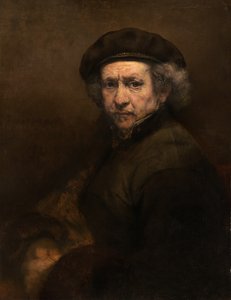
Rembrandt van Rijn
1606 - 1669 , Netherlands
Quick Facts
- Artistic Movement Or Style: Dutch Golden Age, Baroque
- Artists Or Movements Influenced By This Artist: Generations of artists
- Artists Who Influenced This Artist:
- Pieter Lastman
- Jacob van Swanenburg
- Full Name: Rembrandt Harmenszoon van Rijn
- Nationality: Dutch
- Notable Artworks:
- The Night Watch
- Anatomy Lesson of Dr. Nicolaes Tulp
- Belshazzar's Feast
- Place Of Birth: Leiden, Netherlands
- Date Of Birth: 1606
- Date Of Death: 1669