Preview
 Send
Send Share
Share
 Details
 Guide
Guide

 Download
 Similars
 X-Ray
X-Ray Diaporama
 Stats
StatsCardinal Tommaso Inghirami
 Oil On Panel
- Renaissance
 1515
1515- Renaissance
 91.0 x 61.0 cm
 Palazzo Pitti
 Read More
Giclée / Art Print
Museum-quality giclée or canvas print with fast production and flexible finish options. ( Buy Hand Made Painting Switch to Digital Image)




P118B $10

P118H $10

P118W $10

P438Z $10

P508JH $12

P508YH $12

P805H $10

P805Z $10

P919BZ $10

P919G $10

P919XJ $10

P959ZH $10

P968JZ $12

W106C $8

W218G $10

W218JH $8

W218Y $10

W307PJ $10

W316G $10

W316PJ $8

W316Y $10

W398PJ $8

W4111J $10

W500HY $15

W500JH $15

W692G $12

W849H $8

W940BG $15

W953PJ $8




Pick from our preset sizes that match the artwork's original proportions.

Type the width and the height you need, to fit your frame or your wall. A print can only be cut, never made bigger than the picture, so a size with a different shape loses a part of the image. We send you a digital mockup to approve before we print anything. The picture shown on this page does not show the real cut — only the mockup does.
Worldwide Delivery () in 2 weeks instead of standard 4/5 weeks. (22 October)

Free Worldwide Express Shipping

High-Quality Linen Canvas

Full Shipping Insurance

Customs Tax Refund Guarantee

True Color Matching Guarantee

100-Day Return Policy (Defects Only)

100% Money-Back Guarantee

Bulk Discount Offer
 Glass option is only available in size under 110 CM

Cardinal Tommaso Inghirami
Giclée / Art Print
Reproduction Size
-


Total Price
$ 81
Cardinal Tommaso Inghirami by Raphael: A Renaissance Masterpiece
- Title: Cardinal Tommaso Inghirami
- Artist: Raphael (Raffaello Sanzio Da Urbino)
- Date: 1515
- Dimensions: 91 x 61 cm
- Medium: Oil on panel
- Location: Pitti Palace Museum, Florence, Italy
The Subject and Historical Context
This captivating portrait depicts Cardinal Tommaso Inghirami, a prominent figure of the Italian Renaissance. Born in 1470, Inghirami served as a cardinal within the Catholic Church and was renowned for his scholarly pursuits and eloquence. The painting was commissioned around 1515, during a period of significant artistic flourishing in Rome under Pope Leo X. Raphael, already established as one of the leading artists of the High Renaissance alongside Leonardo da Vinci and Michelangelo, captured Inghirami's likeness with remarkable skill and insight.
Artistic Technique and Style
Raphael’s mastery is evident in every detail of this portrait. He employed chiaroscuro—the dramatic use of light and shadow—to sculpt the Cardinal’s face and robes, creating a sense of depth and volume. The rich red hues of Inghirami's vestments are rendered with vibrant precision, contrasting beautifully with the subdued background. Raphael’s signature style is characterized by its harmonious composition, balanced forms, and an overall sense of grace and serenity. The subtle blending of colors and meticulous attention to detail exemplify the High Renaissance aesthetic.
Symbolism and Interpretation
Beyond a mere likeness, the painting is rich in symbolic meaning. The books resting on the table represent Inghirami’s intellectual pursuits and his role as a scholar and theologian. The inkwell signifies his literary talents and dedication to writing. These objects were carefully chosen to convey the Cardinal's status and character. The contemplative pose of Inghirami, with his eyes gently closed, suggests introspection and spiritual depth. While other figures are present in the background, they serve to highlight the Cardinal’s central importance and serene demeanor.
Emotional Impact and Legacy
Cardinal Tommaso Inghirami evokes a sense of quiet dignity and intellectual gravitas. Raphael's ability to capture not only physical appearance but also the inner character of his subject is truly remarkable. This portrait stands as a testament to Raphael’s genius and provides a window into the world of Renaissance humanism. It remains an enduring symbol of artistic excellence and continues to inspire awe in viewers centuries later.
Questions & Answers
Where does "Cardinal Tommaso Inghirami" sit within Raphael's body of work?
"Cardinal Tommaso Inghirami" shares with Raphael's other works its Renaissance style and the recorded themes: classical portraiture, humanist ideals, renaissance realism, typical renaissance portraiture, demonstrates raphael's skill, reflects papal patronage, scholarship and intellect, religious authority.
Who is "Cardinal Tommaso Inghirami" by Raphael recommended for as a gift?
As a present, "Cardinal Tommaso Inghirami" by Raphael is suggested for anniversary. Other occasions can fit as well.
Is Raphael, creator of "Cardinal Tommaso Inghirami", known under other names?
Raphael appears under the alternate names Raffaello Sanzio Da Urbino, Raffaello Sanzio, Raffaello Santi, Raffaello Urbino.
Artist Biography
The Grace of Urbino
In the quiet, intellectual halls of Urbino, a young boy named Raffaello Sanzio grew up surrounded by the scent of ink and the rhythms of courtly life. His father, Giovanni Santi, was a man of letters and a painter for the Duke, ensuring that the child’s earliest memories were steeped in the humanist traditions of the Italian courts. This environment provided more than just a home; it offered a window into the advanced artistic ideas flowing through central Italy. When tragedy struck and his father passed away when Raphael was only eleven, the boy found himself managing the family workshop. He learned the weight of responsibility alongside the delicate touch of the brush.
His early training led him to the workshop of Pietro Perugino in Perugia. Under this master, he absorbed the Umbrian style, a method defined by soft modeling and serene religious scenes. By the time he was recognized as an independent master around 1500, his hand already showed a certain clarity and ease. He moved through the cities of northern Italy, gathering knowledge like a traveler collecting coins, before the pull of larger artistic centers began to reshape his vision.
The Florentine Crucible
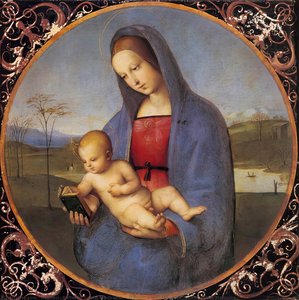
When Raphael arrived in Florence in 1504, he entered a city pulsing with the energy of new discoveries. He did not merely observe the works of Leonardo da Vinci and Michelangelo; he studied them with an insatiable hunger. From Leonardo, he learned the subtle gradations of light and shadow known as sfumato. From Michelangelo, he drew an understanding of anatomical precision and the power of dramatic composition. This period was a transformation. His earlier, gentler Madonnas began to take on a new psychological depth and physical presence.
The Florentine influence allowed him to synthesize these diverse techniques into something uniquely his own. He possessed a rare ability to take the scientific shadows of one master and the muscular strength of another, blending them into a style characterized by balance and luminous color. His portraits from this era reflect a growing sophistication, capturing not just the likeness of his subjects but a sense of their inner dignity.
The Roman Triumph
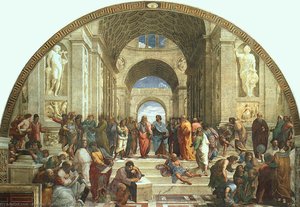
A summons from Pope Julius II in 1508 brought Raphael to Rome, an event that changed the trajectory of his life. The Eternal City offered him the grandest stage imaginable. Tasked with decorating the papal apartments in the Vatican, he began work on the Stanze della Segnatura. It was here that he produced the School of Athens, a vast fresco where he brought together the great thinkers of antiquity—Plato, Aristotle, and Euclid—into a single, harmonious space. This work celebrated human reason through a masterful use of perspective and classical allegory.
His productivity in Rome was immense. Working for successive Popes, including Leo X, he expanded his reach from painting to architecture, even overseeing projects at St. Peter's basilica. His hands decorated the halls of the Vatican with scenes that spoke of justice, prudence, and fortitude. Even as he managed an unusually large workshop to meet these monumental demands, the clarity of his original vision remained intact. He became a central figure in the High Renaissance, a painter whose work embodied the Neoplatonic ideal of human grandeur.
A Legacy of Harmony
The sudden end of his life in 1520, at only thirty-seven years of age, left the papal court in deep mourning. Though his career was cut short, the foundation he laid was unshakable. His emphasis on order, proportion, and idealized beauty became a standard for European painting for centuries. While later movements would occasionally reject his polished grace, his influence remained a cornerstone of the academic tradition.
The impact of his work can be seen in several key areas:
- The Development of the High Renaissance: He perfected the balance between classical structure and human emotion.
- Architectural Influence: His work on papal projects helped shape the physical landscape of the Vatican.
- Artistic Lineage: His workshop trained pupils like Giulio Romano, ensuring his methods endured.

Raphael
1483 - 1520 , Italy
Quick Facts
- Artistic Movement Or Style: High Renaissance
- Artists Or Movements Influenced By This Artist: ['Neoclassical painting']
- Artists Who Influenced This Artist:
- Pietro Perugino
- Leonardo da Vinci
- Michelangelo
- Full Name: Raffaello Sanzio da Urbino
- Nationality: Italian
- Notable Artworks:
- The School of Athens
- Madonnas
- The Transfiguration
- Place Of Birth: Urbino, Italy
- Date Of Birth: 1483
- Date Of Death: 1520
Related Articles

Oil on Canvas: A Historical & Technical Exploration of a Timeless Artistic Medium
Explore the rich history & enduring techniques of oil painting on canvas. Discover the science behind its longevity, conservation practices, and contemporary relevance. Expert insights for art enthusiasts.

The Enduring Legacy of Oil on Canvas: Technique, History & Contemporary Practice
Explore the rich history & enduring techniques of oil painting on canvas. Discover the science behind its longevity, conservation practices, and contemporary relevance. Expert insights for art enthusiasts.
Raphael's Masterpieces: 25 Iconic Paintings & Renaissance Art for Your Home
Explore 25 breathtaking Raphael paintings! Journey through the Italian Renaissance with masterpieces like 'School of Athens' & iconic Madonnas. Find museum-quality art reproductions and elevate your home decor on OriginalUniqueArt.com.

The Enduring Power of Painting: A Historical & Contemporary Exploration of Form and Emotion
Explore the rich history & enduring techniques of oil painting with OriginalUniqueArt. Discover masterpieces, learn about art collecting, and find authentic handmade reproductions crafted by skilled artists.

The Enduring Legacy of Oil on Canvas: Technique, History & Aesthetic Impact
Explore the rich history & techniques of oil painting – from Renaissance masters to Impressionism. Discover pigments, layering methods, and why this timeless medium endures. Expert insights for artists & art enthusiasts.