Preview
 Send
Send Share
Share
 Details
 Guide
Guide

 Download
 Similars
 X-Ray
X-Ray Diaporama
 Stats
StatsMadonna and Child


 Read More
Giclée / Art Print
Museum-quality giclée or canvas print with fast production and flexible finish options. ( Buy Hand Made Painting Switch to Digital Image)




P118B $10

P118H $10

P118W $10

P438Z $10

P508JH $12

P508YH $12

P805H $10

P805Z $10

P919BZ $10

P919G $10

P919XJ $10

P959ZH $10

P968JZ $12

W106C $8

W218G $10

W218JH $8

W218Y $10

W307PJ $10

W316G $10

W316PJ $8

W316Y $10

W398PJ $8

W4111J $10

W500HY $15

W500JH $15

W692G $12

W849H $8

W940BG $15

W953PJ $8




Pick from our preset sizes that match the artwork's original proportions.

Type the width and the height you need, to fit your frame or your wall. A print can only be cut, never made bigger than the picture, so a size with a different shape loses a part of the image. We send you a digital mockup to approve before we print anything. The picture shown on this page does not show the real cut — only the mockup does.
Worldwide Delivery () in 2 weeks instead of standard 4/5 weeks. (26 October)

Free Worldwide Express Shipping

High-Quality Linen Canvas

Full Shipping Insurance

Customs Tax Refund Guarantee

True Color Matching Guarantee

100-Day Return Policy (Defects Only)

100% Money-Back Guarantee

Bulk Discount Offer
 Glass option is only available in size under 110 CM

Madonna and Child
Giclée / Art Print
Reproduction Size
-


Total Price
$ 81
A Divine Encounter: The Tender Grace of Batoni’s Madonna
In the quiet intimacy of Pompeo Batoni’s Madonna and Child, viewers are invited into a moment of profound tenderness that transcends the centuries. Painted in 1742, this masterpiece serves as a breathtaking testament to the artist's ability to blend the grandiosity of the late Baroque with an emerging, delicate clarity. The scene captures the Virgin Mary in a moment of maternal devotion, cradling the infant Jesus as he appears to nurse. There is a palpable warmth radiating from the canvas, a soft light that illuminates the gentle curve of the Madonna’s cheek and the innocent features of the Christ child. Batoni, a master who bridged the gap between the dramatic flourishes of the Baroque and the poised restraint of Neoclassicism, uses this subject to evoke a sense of peace and sacredness that resonates deeply with the soul.
The composition is a masterful study in balance and subtle symbolism. Beyond the central figures, Batoni weaves a narrative of abundance and earthly vitality through carefully placed details. A fruit basket, laden with ripe apples, rests in the background—a classic iconographic element often representing both the sweetness of life and the fallen state of humanity, redeemed by the child held in Mary's arms. The Madonna herself is adorned with a delicate veil and a fine necklace, elements that lend a touch of aristocratic elegance to her divine persona, reflecting Batoni’s skill as one of Rome’s most celebrated portraitists. Every brushstroke on this oil on canvas contributes to a texture that feels both lifelike and ethereal, making the scene feel less like a distant icon and more like a living, breathing encounter.
A Legacy of Elegance for the Discerning Collector
For the art enthusiast or the interior designer seeking to infuse a space with timeless sophistication, this reproduction offers much more than mere decoration. It is an opportunity to bring the prestige of the Galleria Borghese into a private residence. The painting’s palette—rich, warm, and harmoniously balanced—makes it a versatile centerpiece capable of anchoring a room with its historical weight and emotional depth. Whether placed in a sunlit library or a formal dining hall, the work commands attention through its quiet strength rather than through loud, jarring colors.
Owning a high-quality oil painting reproduction of such a significant work allows for a continuous dialogue with art history. Batoni’s technique, characterized by his academic refinement and inspiration from masters like Raphael, provides a level of detail that rewards close inspection. As the light shifts in a room throughout the day, the subtle shadows and luminous highlights of the painting transform, offering a dynamic visual experience. This piece is not simply an object of beauty; it is an invitation to contemplate the enduring themes of love, divinity, and the human connection, making it an incomparable acquisition for any collection dedicated to the heights of Italian classical art.
Questions & Answers
What are the author and date of "Madonna and Child"?
The author of "Madonna and Child" is Pompeo Batoni, and the work is dated 1742.
How does the subject of "Madonna and Child" relate to Pompeo Batoni's usual themes?
Among Pompeo Batoni's recorded themes - classical antiquity, french rococo style, religious devotion, portrait genre, batoni legacy - "Madonna and Child" brings its own focus on virgin mary, child jesus, religious painting, allegory, fruit basket, renaissance art, pompeo batoni.
How do I discover artworks close to "Madonna and Child" by Pompeo Batoni?
Artworks similar to "Madonna and Child" by Pompeo Batoni are gathered on the artwork's Similars page.
Artist Biography
Early Life and Training
- Born: Lucca, Italy (1708)
- Died: 1787
- Pompeo Batoni moved to Rome in 1727.
- He apprenticed with Agostino Masucci, Sebastiano Conca, and/or Francesco Imperiali.
- His first independent commission came as a result of rains that struck Rome in April 1732.
- The painting "The Ecstasy of Saint Catherine of Siena" illustrates his academic refinement of the late-Baroque style.
Artistic Style and Influences
- Batoni's style drew inspiration from classical antiquity, French Rococo, Bolognese Classicism, and artists such as Nicolas Poussin, Claude Lorrain, and especially Raphael.
- He is considered a precursor of Neoclassicism.
- His work can be found in various museums, including the Pinacoteca di Brera in Milan, Italy.
Notable Works and Commissions
- Virgin and Child with Saints
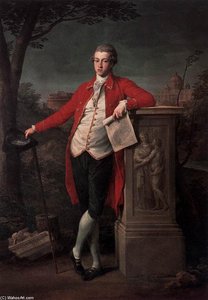
- A Knight in Rome: Charles Cecil Roberts – A celebrated portrait of a British traveler set against Roman ruins.
- The Triumph of Venice
- Numerous altarpieces for churches in Italy, such as the Museum Duomo in Siena.
- He was in high demand for portraits, particularly by British travelers on the Grand Tour who commissioned standing portraits within antique settings.
Development and Historical Significance
- Batoni became a highly fashionable painter in Rome after his rival, Anton Raphael Mengs, departed for Spain in 1761.
- He befriended Winckelmann and aimed to restrain classicism in his painting.
- His portraits captured the spirit of the Grand Tour era, reflecting the fascination with classical antiquity among European elites.
- Batoni’s ability to blend Baroque techniques with emerging Neoclassical ideals positioned him as a transitional figure in Italian art history.
Legacy
- Pompeo Batoni passed away on February 4, 1787, in Rome.
- He left behind a legacy as one of the most renowned Italian painters of his time.
- His work continues to be admired for its technical skill, elegant compositions, and insightful portrayals of individuals within their historical context.

Pompeo Batoni
1708 - 1787 , Italy
Quick Facts
- Artistic Movement Or Style: Baroque and Neoclassicism
- Artists Who Influenced This Artist:
- Nicolas Poussin
- Claude Lorrain
- Raphael
- Full Name: Pompeo Girolamo Batoni
- Nationality: Italian
- Notable Artworks:
- Madonna and Child
- Diana and Cupid
- A Knight in Rome: Charles Cecil Roberts
- Portrait of the Duke of Devonshire
- The Fall of Simon Magus
- Place Of Birth: Lucca, Italy
- Date Of Birth: 1708
- Date Of Death: 1787
Related Articles

The Allure of Elegance in Art: A Historical & Aesthetic Exploration of Refinement & Grace
Explore the exquisite world of Rococo art! Discover its history, masters (Watteau, Boucher & more), and defining elegance. Expert insights for collectors seeking museum-quality reproductions & custom portraits.
Raphael's Masterpieces: 25 Iconic Paintings & Renaissance Art for Your Home
Explore 25 breathtaking Raphael paintings! Journey through the Italian Renaissance with masterpieces like 'School of Athens' & iconic Madonnas. Find museum-quality art reproductions and elevate your home decor on OriginalUniqueArt.com.

Rococo's Radiant Legacy: 10 Masterpieces for Your Home |
Indulge in the elegance of Rococo! Explore 10 masterpieces by Fragonard, Boucher & Watteau. Discover the stories behind these iconic paintings and bring timeless art to your home with museum-quality reproductions from .
Divine Love: A Curated Guide to the Most Iconic Madonna and Child Masterpieces in Art History
Embark on a sophisticated journey through art history with our curated guide to the most iconic Madonna and Child masterpieces. Discover the profound beauty, theological depth, and enduring legacy of these sacred Renaissance treasures.

The Rococo Aesthetic: Opulence, Rebellion & the Pursuit of Pleasure in 18th-Century Art
Explore the opulent world of Rococo art! Discover its origins, key artists like Watteau & Boucher, and lasting influence on design. Expert insights for collectors & enthusiasts.