Switch to Print
 Read More







































 For artworks or reproductions larger than 105 cm (approximately 41 inches) on any side, the frame will be shipped as a kit, disassembled. This method ensures safe delivery and prevents damage during transport.


A Synthesis of Gothic Revival and Venetian Splendor: Pietro Alemanno’s Polyptych
Pietro Alemanno (c. 1430 – ca. 1498), born in Göttweich, Austria, represents a fascinating crossroads within the artistic landscape of fifteenth-century Europe—a conduit between the lingering vestiges of late Gothic stylistic conventions and the burgeoning dynamism of the Venetian Renaissance. While overshadowed by luminaries like Piero della Francesca and Fra Angelico, Alemanno’s singular vision—characterized by meticulous detail and an unwavering devotion to Christian iconography—garnered considerable acclaim during his lifetime and continues to captivate art historians today. His enduring legacy resides principally in his monumental Polyptych commissioned for San Pietro Martire in Venice, alongside a prolific output of altarpieces and devotional paintings that eloquently embody the stylistic convergence of two influential artistic movements.The Architectural Canvas: Venetian Influence and Spatial Harmony
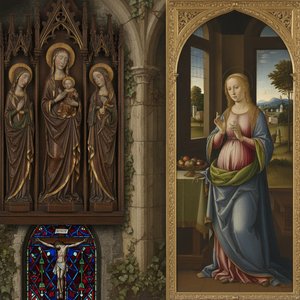
Alemanno’s artistic trajectory was profoundly shaped by the prevailing aesthetic sensibilities of Venice at the time—a city undergoing rapid transformation from a medieval principality into a burgeoning maritime republic. Venetian artists embraced Byzantine influences, prioritizing grandeur and luminosity to convey spiritual reverence. This ethos is palpably evident in Alemanno's Polyptych, where the architectural framework—featuring arches and columns—serves not merely as structural support but as an integral component of the overall composition. The deliberate use of perspective subtly enhances the illusion of depth, guiding the viewer’s gaze towards the central Virgin Mary figure and reinforcing the sanctity of the depicted scene. This careful consideration of spatial arrangement underscores Alemanno's commitment to achieving visual harmony—a hallmark of Venetian artistic practice.Detailed Iconography: Saints and Symbols Embodied in Form
The Polyptych’s narrative richness stems from its intricate iconography, meticulously rendered with painstaking precision. At the heart of the composition stands Mary holding Jesus Christ, surrounded by a constellation of saints – Saint Peter, Saint John the Evangelist, Saint Jerome—each identifiable through distinctive attributes symbolizing their respective roles within Christian theology. The drapery of these figures is executed with remarkable textural detail, reflecting Alemanno’s mastery of pigment layering and glazing techniques. Furthermore, symbolic elements permeate the artwork: lilies representing purity, doves signifying peace, and halos illuminating the saints' faces – all meticulously rendered to convey spiritual significance. These symbols resonate deeply within the viewer’s consciousness, prompting contemplation on themes of faith and divine grace.Technique and Materiality: Gilding and Color Palette—A Testament to Craftsmanship
Alemanno’s technique demonstrates a profound understanding of artistic materials and processes. The Polyptych is adorned with gold leaf—a lavish embellishment characteristic of Venetian altarpieces—which imparts an ethereal glow to the background sky and highlights certain architectural elements. This gilding process involved applying thin sheets of gold onto prepared surfaces, meticulously burnished to achieve a brilliant sheen. Alemanno’s palette favored rich hues—deep blues, reds, and golds—creating a visual experience that is both opulent and emotionally resonant. The artist skillfully blended pigments using oil mediums, resulting in luminous colors and subtle tonal variations that contribute significantly to the artwork's expressive power. Such meticulous craftsmanship speaks volumes about Alemanno’s dedication to artistic excellence and reflects the highest standards of Venetian art production.Emotional Resonance: A Moment of Spiritual Contemplation
Ultimately, Pietro Alemanno’s Polyptych transcends mere visual representation; it aspires to evoke a profound emotional response in the viewer. The serene expressions of the saints convey a palpable sense of devotion and prayerful reverence—a testament to the enduring power of Christian iconography. The overall atmosphere is imbued with tranquility and solemn beauty, inviting contemplation on themes of faith, humility, and divine compassion. Alemanno’s masterful execution captures not only the visual splendor of his time but also the spiritual essence of its subject matter – a legacy that continues to inspire admiration and appreciation among art connoisseurs worldwide.Questions & Answers
How intense are the colors in "Polyptych" by Pietro Alemanno?
The color intensity of "Polyptych" is balanced. Intensity describes how strong the colors appear.
What feeling do the colors of "Polyptych" by Pietro Alemanno create?
"Polyptych" by Pietro Alemanno combines an earthy palette with a tranquil tone.
Who created "Polyptych"?
The artist behind "Polyptych" is Pietro Alemanno. The work is catalogued under Pietro Alemanno's name.
More about this painting
 Preview
 Send
Send Share
Share
 Details
 Guide
Guide

 Download
 Similars
 X-Ray
X-Ray Diaporama
 Q&A
Q&A Stats
Stats