Send
Send Share
Share
 Details
 Guide
Guide

 Download
 Similars
 Diaporama
 Q&A
Q&A Stats
StatsHercules

- 151.0 x 126.0 cm


 Read More
Giclée / Art Print
Museum-quality giclée or canvas print with fast production and flexible finish options. ( Buy Hand Made Painting Switch to Digital Image)




































Pick from our preset sizes that match the artwork's original proportions.

Type the width and the height you need, to fit your frame or your wall. A print can only be cut, never made bigger than the picture, so a size with a different shape loses a part of the image. We send you a digital mockup to approve before we print anything. The picture shown on this page does not show the real cut — only the mockup does.
Worldwide Delivery () in 2 weeks instead of standard 4/5 weeks. (11 November)

Free Worldwide Express Shipping

High-Quality Linen Canvas

Full Shipping Insurance

Customs Tax Refund Guarantee

True Color Matching Guarantee

100-Day Return Policy (Defects Only)

100% Money-Back Guarantee

Bulk Discount Offer
 Glass option is only available in size under 110 CM

Hercules
Giclée / Art Print
Reproduction Size
-


Total Price
$ 81
Hercules by Piero della Francesca: A Renaissance Masterpiece
- Title: Hercules
- Artist: Piero della Francesca
- Date: 1465
- Medium: Fresco
- Dimensions: 151 x 126 cm
- Location: Isabella Stewart Gardner Museum, Boston, United States
A Vision of Strength and Classical Idealism
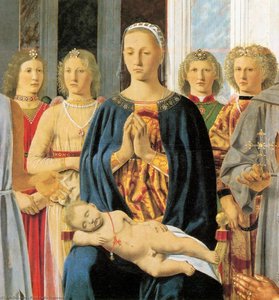
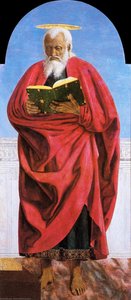
Piero della Francesca's "Hercules" is a remarkable fresco that embodies the spirit of the Early Renaissance. Created in 1465, this work stands as a testament to Piero’s mastery of perspective, anatomy, and his ability to infuse classical themes with humanist ideals. The painting depicts Hercules, the legendary Greek hero known for his extraordinary strength and courage, standing confidently within an architectural setting. His posture—hands resting on his hips—exudes power and self-assurance. The figure is not merely a depiction of physical prowess; it's a representation of human potential and virtue, reflecting the Renaissance fascination with classical antiquity and its heroes. The presence of other figures in the background adds depth to the narrative, suggesting a moment of contemplation or preparation before an important task. Piero’s meticulous attention to detail, particularly in the rendering of Hercules’ musculature and the textures of his clothing, showcases his technical skill and dedication to realism.Technique and Artistic Innovation
The fresco technique employed by Piero della Francesca is crucial to understanding this artwork's impact. Fresco involves painting directly onto wet plaster, a demanding process that requires speed and precision. The pigments become permanently bound to the wall as the plaster dries, resulting in vibrant colors and exceptional durability. Piero’s use of light and shadow creates a sense of volume and three-dimensionality, while his careful composition guides the viewer's eye through the scene. He skillfully utilizes geometric forms—evident in the architectural background—to create a balanced and harmonious visual experience. Piero’s approach to perspective was groundbreaking for its time, contributing significantly to the development of Renaissance art. The subtle use of color and the overall clarity of the image demonstrate his commitment to creating a work that is both aesthetically pleasing and intellectually stimulating.Historical Context and Symbolism
"Hercules" emerged during a period of significant cultural transformation in Italy. The Renaissance witnessed a renewed interest in classical Greek and Roman art, literature, and philosophy. Piero della Francesca’s work reflects this revival by drawing inspiration from ancient sculptures and incorporating humanist ideals into his compositions. Hercules himself is a powerful symbol of strength, courage, and virtue—qualities highly valued during the Renaissance. The setting within an architectural doorway could symbolize transition or a gateway to new challenges, further enriching the painting's symbolic meaning. The chair positioned centrally adds another layer of interpretation; it might represent rest, contemplation, or preparation for action. Piero’s choice of subject matter and his artistic style were deeply intertwined with the intellectual and cultural currents of his time.Emotional Impact and Lasting Legacy
"Hercules" evokes a sense of awe and admiration through its depiction of human strength and resilience. The figure's confident posture and unwavering gaze convey a feeling of determination and self-assuredness. Piero’s masterful use of light and shadow creates an atmosphere of serenity and contemplation, inviting viewers to reflect on the qualities that define heroism. The painting’s enduring appeal lies in its ability to transcend time and culture, resonating with audiences across generations. As a cornerstone of Renaissance art, "Hercules" continues to inspire artists, scholars, and art enthusiasts alike, solidifying Piero della Francesca's place as one of history's most influential painters.Questions & Answers
Which print setup is suggested for "Hercules" by Piero della Francesca?
For "Hercules", the recommended print setup is a large size and a portrait orientation.
Is "Hercules" more bright or more dark overall?
The recorded values for "Hercules" by Piero della Francesca are: brilliant brightness, bright balance luminance.
Does "Hercules" show strong light-dark contrasts?
The contrast level of "Hercules" by Piero della Francesca is statement.
Artist Biography
The Life of Piero della Francesca
Piero della Francesca was an Italian painter, mathematician, and geometer of the Early Renaissance. He was born Piero di Benedetto de' Franceschi around 1415 in Borgo San Sepolcro, Tuscany, Italy. His background was rooted in the practicalities of trade rather than the high courts of the era. His father, Benedetto de' Franceschi, worked as a tradesman or merchant in leather and wool, while his mother was Romana di Perino da Monterchi. This connection to the material world of commerce and craft provided a grounded starting point for a man who would eventually attempt to map the very laws of space and light.
His life was defined by a rigorous, intellectual approach to the visual world. He did not merely observe; he calculated. This dual identity as both an artist and a mathematician allowed him to treat the canvas as a site for geometric exploration. He moved through the major centers of the Italian peninsula, applying a sense of order that was as much about mathematical truth as it was about aesthetic arrangement. His work remains a primary reference for anyone studying the intersection of rational science and visual representation.
- The Baptism of Christ (c. 1450)
- The Resurrection (1460s)
- The Nativity (1470–75)
Early Life and Artistic Training
Piero’s development was rooted in the provincial stillness of Sansepolcro, Tuscany. His early instruction likely came from local Sienese masters active in the town, providing a foundation of traditional technique before he moved toward the more radical shifts of the Renaissance. This early grounding was not purely aesthetic; his education in mathematics and art was supported by his mother, Romana. This dual focus on geometry and visual representation would define his entire career, separating him from painters who relied solely on intuition.
His formal training moved beyond local traditions through an apprenticeship with Antonio di Giovanni d'Anghiari. Records show he worked with d'Anghiari in 1432 and again in May 1438. This period of study provided the technical discipline required to translate complex spatial concepts onto a flat surface. By the time he moved toward the artistic centers of Italy, he was already equipped with a rigorous understanding of both the brush and the compass.
Artistic Activity in Florence
Piero della Francesca’s arrival in Florence around 1439 marked a decisive shift in his development. He did not merely observe the city; he absorbed its structural logic. The influence of Masaccio’s work in the Brancacci Chapel provided a blueprint for how to handle volume and weight. This was not a matter of imitation, but of understanding the mechanics of space. He looked at the innovations of Brunelleschi and the craftsmanship of Lorenzo Ghiberti to grasp how geometry could dictate the appearance of reality. These encounters provided the intellectual tools necessary to move beyond decorative traditions.
His time in the city was defined by direct collaboration and rigorous study. Working alongside Domenico Veneziano on frescoes for the church of Sant’Egidio, Piero integrated the emerging Florentine style into his own developing method. This period was less about finding a personal voice and more about mastering the mathematical and spatial rules that defined the era. He treated the Florentine environment as a laboratory for testing how light and perspective could organize a composition. The result was a style that prioritized clarity and order over the emotional excess seen in other contemporary works.
Patrons and Major Commissions
Piero della Francesca’s career was defined by his ability to satisfy the demands of powerful, often competing, Italian courts. His presence in Urbino was particularly significant, where he executed commissions for Duke Federico da Montefeltro. These works, including the portraits of the Duke and his wife Battista Sforza, demonstrate how his precise, mathematical approach met the specific needs of a sophisticated courtly environment. His reach extended beyond the borders of Tuscany and Umbria, as he was active in Ancona, Pesaro, and Bologna, securing his reputation across the Italian peninsula.
The artist’s professional mobility allowed him to navigate the complex political landscapes of the 15th century. In Rimini, he worked for Sigismondo Pandolfo Malatesta, contributing to the visual program of the Tempio Malatestiano. This period of his life shows an artist capable of adapting his rigorous style to the specific ideological requirements of his patrons. His ability to secure high-level religious and secular work is further evidenced by his 1454 commission for the Polyptych of Saint Augustine.
- Polyptych of Saint Augustine (1454)
- Portraits of Federico da Montefeltro and Battista Sforza
Technique and Mathematical Style
Piero della Francesca did not merely paint; he calculated. His work is defined by a refined, monumental character that stems from a rigorous application of geometry to the physical world. He utilized linear perspective to construct measurable depth, turning the flat surface of a panel into a precise, three-dimensional space. This was not a decorative choice but a structural necessity. He applied geometric forms to human anatomy, treating the body as a series of mathematical volumes rather than just flesh and bone. This approach resulted in a sense of serene humanism, where figures possess a stillness that feels earned through logic rather than emotion.
The clarity of his compositions relies on this mathematical certainty. By organizing space through strict proportion, he achieved a balance that feels permanent. His figures do not just occupy space; they are integrated into it through a sophisticated understanding of light and volume. This method stripped away the chaotic energy often found in contemporary works, replacing it with a controlled, rational order. The result is a visual language where every limb and architectural element is placed with the precision of a geometer.
- The Baptism of Christ (c. 1450)
- The Flagellation (c. 1455–1470)
- The Resurrection (1460s)
Key Masterpieces and Frescoes
The visual weight of Piero della Francesca is most evident in his large-scale cycles. In the Basilica of San Francesco in Arezzo, his frescoes depicting The Legend of the True Cross command the space through a rigorous application of perspective. These works do not rely on decorative flourish but on a structural clarity that defines the narrative. Similarly, his fresco in the Palazzo della Residenza in Sansepolcro, titled The Resurrection, uses a stark, athletic depiction of Christ to establish a clear distinction between the human and divine spheres. The composition relies on a precise vanishing point located in the center of the sarcophagus, forcing a rational engagement with the scene.
His command of medium and light is equally evident in his smaller, more intimate works. The Baptism of Christ, an egg tempera painting held by the National Gallery, London, demonstrates a highly symmetrical arrangement. A walnut tree on the left and the central axis of Christ and the dove create a mathematical balance that dictates the viewer's eye movement. This same precision appears in The Flagellation of Christ, painted around 1455–1460. In this work, the complex interplay of light and the architectural depth of the gallery create a scene of profound, quiet order rather than chaotic emotion.
- The Baptism of Christ
- The Flagellation of Christ
- The Resurrection
- The Legend of the True Cross
Legacy and Artistic Influence
Piero della Francesca’s impact is visible in the structural logic of the High Renaissance. He acted as a bridge between the decorative Gothic traditions and the rational, organized style of the Renaissance. By applying mathematical certainty to the canvas, he provided a blueprint for how to organize space and light. This focus on geometric order and the physical volume of figures directly informed the development of later giants like Leonardo da Vinci and Raphael. His ability to use a single vanishing point to construct deep, measurable space changed how painters approached the three-dimensional world.
The lineage of his influence extends through his direct pupils and the artists they trained. Giovanni Santi, who studied under Piero, became the father of Raphael, passing down a foundation of perspective and composition that would define the next generation of Italian art. Piero’s mastery of light was not merely about illumination; it was a tool used to define mass and physical presence. This method of using light to establish volume and clarity became a standard for those who followed him, moving art away from flat, symbolic representations toward a more grounded, scientific reality.
- The History of the True Cross (c. 1452–1464)
- The Resurrection (1460s)
- The Baptism of Christ (c. 1450)
- The Nativity (1470–75)
Where to See His Works Today
To encounter the physical reality of his geometry, one must travel to several key European institutions. The National Gallery in London provides a direct look at The Baptism of Christ, a work that demonstrates his command over light and spatial division. In Florence, the Galleria degli Uffizi contains the Portrait of Federico da Montefeltro, where the precision of the profile meets a meticulously rendered landscape. These works are not mere relics; they are the primary evidence of his ability to organize the visual field through mathematical certainty.
The scale of his ambition is best understood through his large-scale commissions. The Galleria Nazionale delle Marche in Urbino houses The Flagellation of Christ, a painting that demands attention for its complex, segmented composition. For those seeking his work in Milan, the Pinacoteca di Brera holds the Montefeltro Altarpiece. These pieces remain the most reliable ways to observe how he translated theoretical perspective into tangible, three-dimensional space.
- Polyptych of the Misericordia: Virgin Annunciate - Pinacoteca Comunale, San Sepolcro
- The Resurrection - Palazzo della Residenza, Sansepolcro
- The Nativity - National Gallery, London

Piero della Francesca
1415 - 1492 , Italy
Quick Facts
- Artistic Movement Or Style: Early Renaissance
- Artists Or Movements Influenced By This Artist:
- Leonardo da Vinci
- Raphael
- Artists Who Influenced This Artist:
- Domenico Veneziano
- Masaccio
- Brunelleschi
- Full Name: Piero di Benedetto de' Franceschi
- Nationality: Italian
- Notable Artworks:
- The History of the True Cross
- The Baptism of Christ
- The Nativity
- Montefeltro Altarpiece
- Place Of Birth: San Sepolcro, Italy
- Date Of Birth: 1415
- Date Of Death: 1492
Related Articles

The Fresco as Family Legacy: Preserving Heritage Through Wall Art
Explore the rich history & enduring legacy of fresco painting. Discover how to preserve family heritage through stunning wall art. Expert insights & restoration guidance.
Art That Lives With You: The Emotional Power of a Custom Interior Fresco
Discover the emotional power & timeless beauty of custom interior frescoes. Explore history, design tips & expert guidance from – creating lasting legacies.
Piero della Francesca: Renaissance Perspective, Divine Proportion & the Pursuit of Ideal Form
Explore the revolutionary art of Piero della Francesca – master of perspective, divine proportion & Renaissance humanism. Discover his iconic paintings & lasting influence on art history.

The Enduring Legacy of Fresco: Technique, History & Artistic Expression Across Cultures
Explore the rich history & enduring legacy of fresco painting! Discover ancient techniques, Giotto's masterpieces, and modern applications. Expert insights for art lovers & professionals.

The Enduring Legacy of Fresco Painting: Techniques, History & Contemporary Relevance
Explore the rich history & enduring artistry of fresco painting – from Giotto to Michelangelo! Discover techniques, conservation efforts, & modern applications. Learn how OriginalUniqueArt brings this timeless art form to your home.