Pop Art
Appropriated alphabets (Peter Blake)
Peter Blake (1932) made Appropriated alphabets. It belongs to the Pop Art movement.

 Preview

 Hand Made Oil Painting
 Send
 Share
 Fact sheet


 Download
 Similars
 X-Ray
 Diaporama
 Q&A

 Stats
Appropriated alphabets, in brief
- Title
- Appropriated alphabets
- Artist
- Peter Blake (1932)
- Artist born in
- Dartford, United Kingdom
- Movement
- Pop Art
High-resolution images of Appropriated alphabets

Protected by copyright: these files are for personal reference, not a licence to republish.
Peter Blake, Appropriated alphabets.
Questions on Appropriated alphabets, answered
Can the image of "Appropriated alphabets" by Peter Blake be freely reproduced?
Regarding copyright, "Appropriated alphabets" is still protected by copyright.
Which artist is "Appropriated alphabets" attributed to?
The artist behind "Appropriated alphabets" is Peter Blake. The work is catalogued under Peter Blake's name.
Which artistic current is "Appropriated alphabets" by Peter Blake part of?
"Appropriated alphabets" by Peter Blake belongs to the Pop Art movement. This movement provides the stylistic context of the work.
About the artist, Peter Blake

1932, United Kingdom
Peter Blake
A Pioneer of British Pop Art: The World of Peter Blake Born in Dartford, Kent, in 1932, Sir Peter Thomas Blake has indelibly shaped the landscape of British art, emerging as a pivotal figure within the Pop Art movement and beyond. His journey began with formal training at Gravesend Technical College School of Art and culminated in studies at the prestigious Royal College of Art, laying the foundation for a career defined by innovative collage techniques and a profound engagement with popular culture. Blake’s early artistic explorations weren't confined to traditional fine art boundaries; instead, he fearlessly incorporated imagery drawn from the vibrant world around him – advertisements, wrestling matches, music hall entertainment – often blending these elements through dynamic collaged compositions. This willingness to embrace the everyday, to elevate the commonplace to the realm of high art, became a hallmark of his style and a defining characteristic of British Pop Art’s unique identity.
Also by Peter Blake
 On the Balcony
 The Toy Shop1962
 Babe rainbow
 Queen Elizabeth II
Essays around Appropriated alphabets
 British Pop Art vs. American Pop Art: Understanding the DifferencesDiscover the key differences between British and American Pop Art. Master the history and techniques of these iconic movements now.
 The Architecture of the Alphabet: Examining Typography and Calligraphy in Fine ArtExplore the profound tension between calligraphy, typography, and fine art. Discover the architecture of the written word today.
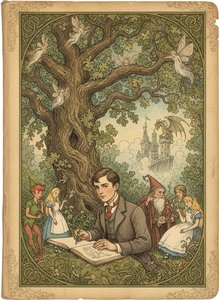 Arthur Rackham: A Master of British Illustration & the Enchanted Realm of Fairy TalesExplore the enchanting world of Arthur Rackham (1867-1939), a leading figure in British Golden Age illustration. Discover his iconic fairy …