
 Preview
 Send
Send Share
Share
 Details
 Guide
Guide

 Download
 Similars
 X-Ray
X-Ray Diaporama
 Stats
StatsIn the box
 Charcoal
- WallArt
- Expressionism
 1908
1908- Modern
 13.0 x 18.0 cm
 Read More
Purchase a high-resolution, enhanced digital image, far superior to the online preview.
Each file is meticulously prepared by our in-house specialists using advanced tools and expert manual retouching. We ensure every image has exceptional clarity, precise color accuracy, and fine detail.
The final file is delivered via email within 72 hours, optimized for immediate use in professional, editorial, and print environments. This is the same quality trusted by top-tier design studios, publishers, and galleries.
Digital Image
Download a high-resolution file for personal display, printing, and creative projects. ( Switch to Print Buy Hand Made Painting)
Included in Every Digital Image Order
Expert Digital Delivery, Guaranteed
When you choose OriginalUniqueArt.com, you're not just getting an image - you're receiving a professionally enhanced digital artwork, crafted with precision and backed by a satisfaction guarantee. Here's everything that comes with your order, automatically:

Fast Email Delivery
Your high-resolution digital image file will be emailed to you within 72 hours of ordering - ready for immediate use.

AI-Enhanced Digital File
Your artwork is professionally optimized using advanced AI tools and manual editing, ensuring maximum detail, clarity, and color accuracy.

Free Lifetime Re-Delivery
Accidentally deleted or lost your file? No worries - we'll resend it to you anytime, free of charge.

No Import Fees - Ever
Enjoy your artwork instantly with zero customs, duties, or delivery fees - digital downloads are always tax-free.

Color Accuracy Guarantee
We ensure your digital image reflects the original colors as closely as possible using professional tools and color management.

100-Day Satisfaction Guarantee
If you're not satisfied with your digital image, we'll revise it or refund 100% within 100 days - no questions asked.

100% Money-Back Guarantee
Not satisfied? Get a full refund within 100 days of receiving your digital file - no questions asked.

Bulk Order Discounts
Buy 3 images, save 10% - Buy 5, save 15% - Buy 10+, save 20%. Great for creative projects, galleries, and agencies.
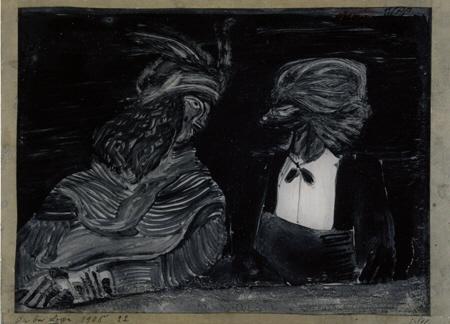
A Fragment of a Surrealist Dreamscape
In the quiet, monochromatic depths of Paul Klee’s 1908 masterpiece, "In the Box," we encounter a world that feels simultaneously intimate and profoundly unsettling. This early work, executed with the raw, expressive power of charcoal on paper, serves as a haunting precursor to the Surrealist movement that would later define much of the twentieth century. At first glance, the viewer is met with two avian figures, rendered with a meticulousness that borders on the obsessive. Yet, these are no ordinary birds; they are anthropomorphic beings, draped in the stiff, formal elegance of waistcoats and bow ties. This jarring juxtaposition of the natural and the civilized immediately disrupts our sense of reality, pulling us into a dreamlike state where the boundaries between species and social roles begin to dissolve.
The composition is masterfully contained, as if the very paper serves as the walls of the enclosure described by its title. By positioning the figures centrally within this tight, dark frame, Klee directs our gaze inward, forcing a confrontation with the subjects' isolation. There is a palpable sense of confinement here—a psychological "box" that suggests introspection, or perhaps even entrapment. The background, a muted and shadowy grey, swallows the edges of the scene, leaving the figures suspended in a void of quiet contemplation. For the collector or designer, this piece offers a profound sense of focus, making it an ideal centerpiece for spaces intended for deep thought or quiet luxury.
The Alchemy of Line and Shadow
Technically, "In the Box" is a triumph of tonal mastery. Eschewing the vibrant palettes Klee would later become famous for, he relies entirely on a grayscale spectrum to convey emotion. Through the skilled application of hatching and cross-hashing, Klee sculpts form out of darkness. These rhythmic, repetitive lines do more than just define the texture of a waistcoat or the curve of a wing; they imbue the artwork with a vibrating energy, a subtle tension that keeps the eye moving across the paper. The technique is raw and tactile, retaining a certain primitive strength that speaks to the artist's early explorations into abstraction.
While the piece leans heavily into the emotional resonance of Expressionism, one can detect the nascent seeds of Cubist fragmentation within the geometric precision of the clothing. This interplay between organic, distorted shapes and rigid, man-made elements creates a visual friction that is both intellectually stimulating and aesthetically captivating. The lighting remains diffused and even, eschewing dramatic highlights to maintain a flat, almost two-dimensional quality that enhances the artwork's mysterious, otherworldly atmosphere. It is a work of profound subtlety, where the absence of color allows the true strength of the line to sing.
Symbolism and Emotional Resonance
Beyond its formal brilliance, "In the Box" invites endless layers of symbolic interpretation. The bird, often a symbol of freedom and flight, is here rendered immobile and dressed in the trappings of human society, suggesting a loss of instinctual liberty. This tension between the wild and the domestic resonates deeply with the modern human condition—the struggle to maintain our essential selves within the structured confines of civilization. The artwork evokes a complex cocktail of emotions: a touch of melancholy, a hint of the absurd, and a lingering sense of mystery.
For those looking to bring a piece of art history into their personal environment, a high-quality reproduction of this Klee treasure offers more than mere decoration. It provides an invitation to wonder. Whether placed in a contemporary gallery setting or a classic study, the monochromatic elegance and psychological depth of "In the Box" act as a window into the subconscious, offering a timeless connection to one of the most innovative minds in the history of modern art.
Questions & Answers
How was "In the box" made, and how big is it?
"In the box" was made in charcoal and measures 13 x 18 cm in its original form.
Where in the home does a reproduction of "In the box" fit well?
The recommended space for "In the box" by Paul Klee is a studio apartment. The suggestion can of course be adapted to your interior.
What is "In the box" made with?
Paul Klee used the charcoal technique for "In the box". The technique defines the material nature of the original work.
Artist Biography
A Life of Line and Lyricism
Born in Münchenbuchsee, Switzerland, on December 18, 1879, Paul Klee entered a world shaped by the rhythms of music. His father, Hans Wilhelm Klee, was a German music teacher, and his mother, Ida Marie, was a Swiss singer. This early immersion in sound provided a foundation for a visual language that often mirrored musical arrangement. While he initially pursued the violin with great talent, eventually deciding that modern music lacked the creative pull he craved, he turned his focus toward the Academy of Fine Arts in Munich. His studies there between 1898 and 1901 were marked by an early mastery of drawing, though he famously struggled with color during those first cold winters.
The transition from a draftsman to an abstract thinker was not immediate. Klee’s early years involved exploring the boundaries of Symbolism and Art Nouveau, often working in black and white or through experimental techniques like needle drawing on blackened glass. A significant shift occurred in 1914 during a visit to Tunisia. The intense light of North Africa allowed him to detach color from physical description, using it instead as an independent force. This period provided the necessary push toward abstraction, moving his work away from mere representation and toward a more personal, symbolic vocabulary.
The Bauhaus Years and Political Shadows
Klee’s career reached a period of intense theoretical and creative activity during his time at the Bauhaus. From 1920 to 1930, he joined the faculty of this influential school of design and architecture, working alongside figures like Wassily Kandinsky. It was here that much of his prolific output occurred, particularly small-scale watercolors and drawings on paper. His teaching allowed him to explore the relationship between color and form with scientific precision, a subject he documented extensively in his notebooks. These writings, which examined the mechanics of design, are now regarded as essential texts for understanding modern composition.
The stability of this era was abruptly interrupted by the rise of National Socialism. In 1933, Klee was dismissed from his position at the Academy of Fine Arts in Düsseldorf because the Nazi regime classified his work as “degenerate.” Forced to return to his native Bern, his later years were marked by a shift in tone. As political turmoil grew and his own health declined, his lines became heavier, turning into black bars, and his forms grew more generalized. The whimsicality of his earlier years gave way to a more somber, melancholic perspective, reflecting the gravity of the era.
A Lasting Visual Language
The breadth of Klee’s output is immense, totaling some 10,000 works that range from delicate sketches to larger, more structured compositions. His ability to blend influences from Cubism, Expressionism, and Surrealism resulted in a style that felt both childlike and deeply intellectual. He utilized a variety of media, including:
- Zinc-plate etchings
- Watercolor on gauze and paper
- Lithographs
- Charcoal and pencil drawings
His work remains a study in balance, where titles often provided the necessary context for his often cryptic imagery. Whether through the use of simple stick figures or complex, colorful grids, he sought to express the inner world of ideas rather than the surface of reality. He died on June 29, 1940, in Muralto, Switzerland, leaving behind a body of work that bridged the gap between the figurative and the abstract.

Paul Klee
1879 - 1940 , Switzerland
Quick Facts
- Artistic Movement Or Style:
- Expressionism
- Cubism
- Surrealism
- Artists Who Influenced This Artist:
- Pablo Picasso
- Georges Braque
- Robert Delaunay
- Vincent van Gogh
- Paul Cézanne
- Full Name: Paul Klee
- Nationality: German and Swiss
- Notable Artworks:
- Hammamet with Its Mosque
- Ships in the Dark
- Walpurgis Night
- The Protector
- Place Of Birth: Münchenbuchsee, Switzerland
- Date Of Birth: 1879
- Date Of Death: 1940