Preview
 Send
Send Share
Share
 Details
 Guide
Guide

 Download
 Similars
 X-Ray
X-Ray Diaporama
 Q&A
Q&A Stats
StatsPolyptych
 1350
1350 167.0 x 285.0 cm
 Gallerie dell'Accademia di Venezia
 Read More
Giclée / Art Print
Museum-quality giclée or canvas print with fast production and flexible finish options. ( Buy Hand Made Painting Switch to Digital Image)




































Pick from our preset sizes that match the artwork's original proportions.

Type the width and the height you need, to fit your frame or your wall. A print can only be cut, never made bigger than the picture, so a size with a different shape loses a part of the image. We send you a digital mockup to approve before we print anything. The picture shown on this page does not show the real cut — only the mockup does.
Worldwide Delivery () in 2 weeks instead of standard 4/5 weeks. (31 October)

Free Worldwide Express Shipping

High-Quality Linen Canvas

Full Shipping Insurance

Customs Tax Refund Guarantee

True Color Matching Guarantee

100-Day Return Policy (Defects Only)

100% Money-Back Guarantee

Bulk Discount Offer
 Glass option is only available in size under 110 CM

Polyptych
Giclée / Art Print
Reproduction Size
-


Total Price
$ 81
Composition and Style
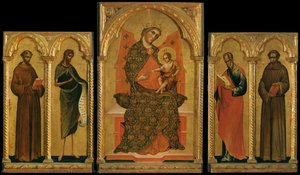
The Polyptych consists of multiple panels, each depicting a scene from religious narratives. The central panel is larger than the others and features intricate details and vibrant colors. The background of each panel is filled with gold leaf, giving the painting an opulent and divine appearance. This use of gold was common in religious art during the Gothic period to symbolize wealth, power, and the sacred nature of the subjects depicted. Light plays a crucial role in the composition of the Polyptych, as it does in many other works of art. As explained on Wikipedia, light fulfills several objectives, both plastic and aesthetic, in painting. The artist's use of light and shadow creates a sense of depth and volume, drawing the viewer's eye to the central panel.Artistic Significance
The Polyptych is an important work in the history of art, showcasing Paolo Veneziano's mastery of Gothic style. The painting's intricate details and use of gold leaf demonstrate the artist's skill and attention to detail. For more information on Paolo Veneziano and his works, visit OriginalUniqueArt.com.- The Polyptych is a prime example of Gothic art from the 14th century.
- The painting features intricate details and vibrant colors, with a gold leaf background.
- Paolo Veneziano's use of light and shadow creates a sense of depth and volume.
Questions & Answers
Where do the visitors of "Polyptych" by Paolo Veneziano come from?
A Stats page exists for "Polyptych". It charts the monthly visits of the artwork and of the artist's other works, with country and language breakdowns.
How do I download the image of "Polyptych" by Paolo Veneziano?
"Polyptych" by Paolo Veneziano can be downloaded from the artwork's Download page, as a high-resolution digital image download.
How light is "Polyptych" overall?
In terms of perceived brightness, "Polyptych" by Paolo Veneziano is balanced.
Artist Biography
The Venetian Pioneer of Byzantine and Gothic Synthesis
Paolo Veneziano (c. 1333 – 1358) stands as a monumental figure in the history of Venetian art, recognized universally as the most important Venetian painter of the fourteenth century. Born into an artistic lineage within the heart of Venice—his father being a renowned artist himself—Veneziano’s brief but brilliant career coincided with a transformative period in European painting. He acted as a vital bridge, spanning the stylistic gap between the rigid, golden grandeur of the Byzantine tradition and the burgeoning, more fluid elegance of the Gothic style. His legacy extends far beyond his short lifetime, establishing him as the true founder of the Venetian school, an artistic movement that would dominate production throughout the century and profoundly influence subsequent masters such as Lorenzo Veneziano.
The essence of Veneziano’s genius lies in his ability to harmonize disparate worlds. While his training was deeply rooted in the Byzantine influences that permeated the Venetian Republic—a style characterized by iconographic stability, preciousness, and a sense of the divine—he possessed an astute awareness of contemporary developments flowing from Rimini and other Italian artistic centers. By incorporating Gothic elements into his compositions, he introduced a new level of sophistication and movement. This dual engagement ensured that his work did not merely echo the glories of the past but actively participated in the evolving, dynamic landscape of the mid-14th century.
A Masterpiece of Devotion and Patronage
The zenith of Veneziano’s artistic achievement is perhaps most vividly captured in his involvement with the Pala Feriale, or weekday altarpiece, commissioned for the prestigious St. Mark’s Basilica in Venice. This monumental project was a collaborative triumph, undertaken alongside his sons, Marco and Luca. The resulting polyptych serves as a breathtaking testament to Venetian patronage and technical prowess. In this work, one can observe the meticulous application of gold leaf and the careful arrangement of sacred figures, creating a celestial vision that reflects both the wealth of the Republic and the deep piety of its citizens.
Through such large-scale commissions, Veneziano demonstrated his ability to manage complex iconographic programs that satisfied both religious requirements and the aesthetic desires of the Venetian state. His technique involved:
- The use of luminous gold grounds to evoke a sense of eternal, divine light.
- Intricate ornamentation that mirrored the luxurious textiles and mosaics found within Venice itself.
- A delicate balance of line and color that allowed for the emergence of more naturalistic, Gothic drapery over the traditional Byzantine forms.
Historical Significance and Lasting Legacy
Though his life was tragically short, ending in 1358, the impact of Paolo Veneziano on the trajectory of Western art is immeasurable. He did not merely paint; he defined a visual language for a maritime empire. By synthesizing the Eastern influence of Byzantium with the Western innovations of the Gothic period, he created a unique "Venetian" style—one that was opulent, international, and deeply evocative. This stylistic synthesis provided the foundation upon which the later, more celebrated Renaissance masters would build.
His importance to art history cannot be overstated, as he transformed Venice from a mere recipient of foreign artistic styles into a primary creator of its own distinct aesthetic identity. The lineage he established through his workshop and his sons ensured that the Venetian school would remain a dominant force in European art for generations, leaving an indelible mark on the history of the Italian Renaissance.

Paolo Veneziano
1333 - 1358 , Italy
Quick Facts
- Full Name: Paolo Veneziano
- Nationality: Italian
- Date Of Birth: 1333
- Date Of Death: 1358
- Place Of Birth: Venice, Italy
- Notable Artworks:
- Pala Feriale
- Panel of a Polyptych
- Artistic Movement Or Style: Byzantine influence & Gothic art
- Artists Who Influenced This Artist: ['Lorenzo Veneziano']
- Artists Or Movements Influenced By This Artist: ['Marco di Paolo Veneziano']