Text size

() ·

A painting made for you, by hand

The Annunciation

Hand Made Oil Reproduction

Hand-painted oil on canvas in your size and frame, made to order by our artists. ( Switch to Print Switch to Digital Image)

Collectible Description

Paolo Uccello was an Italian Renaissance painter and mathematician from Florence who pioneered the use of visual perspective in art, notably in his monumental Battle of San Romano frescos. His distinctive style blended Gothic traditions with innovative mathematical techniques.

Artist Biography

Paolo Uccello (1397-1475): Florentine Renaissance master of perspective & dynamic battle scenes like San Romano. Explore his innovative use of color, light, and mathematical principles.

from ·

Chapter 1

How large should it be?

Slide to change the size; the picture on the left shows the frame at its real width. The proportions of the original are kept.

Standard
custom
CM
INCH

Pick from our preset sizes that match the artwork's original proportions.

width
height

Type the width and the height you need, to fit your frame or your wall. This is hand-painted, so for a size with a different shape the artist can paint a bit more around the picture, or cut a bit — you choose. We send you a digital mockup to approve before the painting starts. The picture shown on this page does not show the real result — only the mockup does.

Chapter 2

How should it arrive?

Choose the edges of the stretched canvas

Choose your frame

Corner sample of the WhiteWrap canvas edge finish, stretched on solid wood bars
White $1
Corner sample of the BlurSideWrap canvas edge finish, stretched on solid wood bars
Blurside $1
Corner sample of the ExtendedWrap canvas edge finish, stretched on solid wood bars
Extended $1
Corner sample of the P118B picture frame: moulded polystyrene, 5 cm wide and 3 cm thick
P118B $10
Corner sample of the P118H picture frame: moulded polystyrene, 5 cm wide and 3 cm thick
P118H $10
Corner sample of the P118W picture frame: moulded polystyrene, 5 cm wide and 3 cm thick
P118W $10
Corner sample of the P438Z picture frame: moulded polystyrene, 5.5 cm wide and 3.5 cm thick
P438Z $10
Corner sample of the P508JH picture frame: moulded polystyrene, 7 cm wide and 3.5 cm thick
P508JH $12
Corner sample of the P508YH picture frame: moulded polystyrene, 7 cm wide and 3.5 cm thick
P508YH $12
Corner sample of the P805H picture frame: moulded polystyrene, 5 cm wide and 3.5 cm thick
P805H $10
Corner sample of the P805Z picture frame: moulded polystyrene, 5 cm wide and 3.5 cm thick
P805Z $10
Corner sample of the P919BZ picture frame: moulded polystyrene, 7 cm wide and 3.5 cm thick
P919BZ $10
Corner sample of the P919G picture frame: moulded polystyrene, 7 cm wide and 3.5 cm thick
P919G $10
Corner sample of the P919XJ picture frame: moulded polystyrene, 7 cm wide and 3.5 cm thick
P919XJ $10
Corner sample of the P959ZH picture frame: moulded polystyrene, 5 cm wide and 3 cm thick
P959ZH $10
Corner sample of the P968JZ picture frame: moulded polystyrene, 6 cm wide and 4 cm thick
P968JZ $12
Corner sample of the W106C picture frame: solid wood, 5 cm wide and 3 cm thick
W106C $8
Corner sample of the W218G picture frame: solid wood, 5 cm wide and 3 cm thick
W218G $10
Corner sample of the W218JH picture frame: solid wood, 5 cm wide and 3 cm thick
W218JH $8
Corner sample of the W218Y picture frame: solid wood, 5 cm wide and 3 cm thick
W218Y $10
Corner sample of the W307PJ picture frame: solid wood, 6 cm wide and 3 cm thick
W307PJ $10
Corner sample of the W316G picture frame: solid wood, 6 cm wide and 3 cm thick
W316G $10
Corner sample of the W316PJ picture frame: solid wood, 6 cm wide and 3 cm thick
W316PJ $8
Corner sample of the W316Y picture frame: solid wood, 6 cm wide and 3 cm thick
W316Y $10
Corner sample of the W398PJ picture frame: solid wood, 5 cm wide and 3 cm thick
W398PJ $8
Corner sample of the W4111J picture frame: solid wood, 6.5 cm wide and 3.5 cm thick
W4111J $10
Corner sample of the W500HY picture frame: solid wood, 7 cm wide and 5 cm thick
W500HY $15
Corner sample of the W500JH picture frame: solid wood, 7 cm wide and 5 cm thick
W500JH $15
Corner sample of the W692G picture frame: solid wood, 8 cm wide and 4 cm thick
W692G $12
Corner sample of the W849H picture frame: solid wood, 5 cm wide and 3 cm thick
W849H $8
Corner sample of the W940BG picture frame: solid wood, 7.5 cm wide and 4.5 cm thick
W940BG $15
Corner sample of the W953PJ picture frame: solid wood, 6 cm wide and 3.5 cm thick
W953PJ $8
Corner sample of the H24-GOLD picture frame: carved wood with gesso, 10 cm wide and 6 cm thick
H24-GOLD $30
Corner sample of the H24-SILVER picture frame: carved wood with gesso, 10 cm wide and 6 cm thick
H24-SILVER $30
Corner sample of the H36-GOLD picture frame: carved wood with gesso, 15 cm wide and 6.5 cm thick
H36-GOLD $45
Corner sample of the H36-SILVER picture frame: carved wood with gesso, 15 cm wide and 6.5 cm thick
H36-SILVER $45
Frame preview
Framed

Moulding: . Overall size with the frame: .

Chapter 3

Who paints it, and should anything change?

Examples of what can be changed: Replace face with customer photo; Add pet (e.g., replace cat with dog); Include hidden message in background; Change background landscape or elements.
After order, OriginalUniqueArt.com team will email client for instructions and provide a mockup preview

Worldwide Delivery () in 3/4 weeks instead of standard 5 weeks. (4 November). No compromise on quality.

Chapter 4

The finishing touches

A nameplate, as in a museum?

Engraved Bronze Plaque Details

This elegant plaque features the artist's name and the title of the artwork, finely engraved for a timeless presentation.

It is made from bronze with a refined, elegant finish. The text is precisely laser-engraved for a sharp and permanent result. Measuring 9x2 cm, the plaque is compact yet easy to read. It's built to be durable and scratch-resistant, offering a professional, museum-quality look. Mounting is simple thanks to the included adhesive backing.

Transparent Acrylic Plaque Details

The plaque includes essential engraved details such as the artist's name, the title of the artwork, the date it was created, the type of media used-like oil on canvas or watercolor-a brief description of the piece, and a QR code that links to the complete artwork information.

It is crafted from clear acrylic, offering a sleek, modern appearance. The text is UV-engraved in black to ensure strong visual contrast. With a size of 10x15 cm, it ensures optimal readability. It comes equipped with two metal hooks for secure wall mounting. The plaque is designed to be weather-resistant, making it suitable for various environments, and it includes interactive features that work seamlessly with smartphone scanning.

Black Acrylic Plaque Details

This elegant plaque includes engraved information such as the artist's name, the title of the artwork, the date it was created, the type of media used (like oil on canvas or watercolor), a short description of the artwork, and a QR code for quick access to more information.

The plaque itself is made from refined black acrylic with a premium finish. The text is laser-engraved in white for high contrast and readability. Its size is 10x15 cm, designed to be easy to read. It comes with two metal hooks for professional mounting. The design is sleek and fits any interior style. It is also weather-resistant and durable, with built-in digital integration for mobile compatibility.

A protective varnish?

When do you need it?

Chapter 5

Your painting, as you ordered it

The Annunciation

Reproduction Medium

Reproduction Size

-

Elite Senior Artist

More detail, finesse, and extra production time

-

Reproduction Frame

-

-

For artworks or reproductions larger than 105 cm (approximately 41 inches) on any side, the frame will be shipped as a kit, disassembled. This method ensures safe delivery and prevents damage during transport.

Professional assembly required - this is not a DIY product.
The kit must be assembled and the canvas stretched by an experienced professional framer, using wood glue (not supplied), a canvas stretching plier and clamps to hold the bars square while the glue dries. Incorrect assembly or uneven canvas tension can permanently damage the artwork and is not covered by our warranty.

  • All solid wood bars are included, precisely cut to size.

  • Assembled with the screws provided, plus wood glue for the corner joints, which is not supplied and must be sourced by your framer.

  • Professional tools are required and not included: a canvas stretching plier (tensioner) and clamps to hold the bars square while the glue dries.

Important:
The corner joints require wood glue, the bars must be held with clamps until the glue is fully dry, and tightening the canvas on the assembled frame requires a canvas stretching plier. None of these are included in the kit. Please arrange an experienced professional framer before ordering this size.

Nameplate

-

-

Protective Varnish

Glossy Varnish (enhances colors, protects against light/moisture)

-

Customize My Artwork

Examples of what can be changed: Replace face with customer photo; Add pet (e.g., replace cat with dog); Include hidden message in background; Change background landscape or elements.

-

Urgent

Worldwide Delivery () in 3/4 weeks instead of standard 5 weeks. (4 November). No compromise on quality.

-

Express Shipping

Worldwide Delivery () in 5 weeks. (11 November).

Included

Total Price

$ 300

Total Price $ 300

Glass option is only available in size under 110 CM

Included with every order

  • Free Worldwide Express Shipping
  • High-Quality Linen Canvas
  • Full Shipping Insurance
  • Customs Tax Refund Guarantee
  • True Color Matching Guarantee
  • 100-Day Return Policy (Defects Only)
  • 100% Money-Back Guarantee
  • Bulk Discount Offer

The Composition and Figures

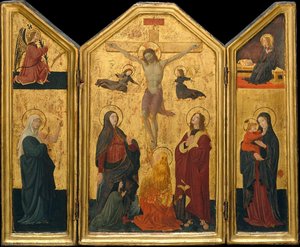
In this tempera and gold panel from approximately 1420, the archangel Gabriel approaches the Virgin Mary within an architectural setting defined by precise geometric lines. The scene is structured around a blue building featuring an arched doorway and columns that recede into the background. On the left side of the panel, several figures are positioned near the edge of the frame, while other figures occupy the space toward the right. Gold accents appear on the clothing of the central figures and throughout the surrounding environment, contrasting with the deep blue tones of the architecture. The figure of Mary is depicted alongside Gabriel, with a book held in the scene. Above the primary interaction, God the Father appears to direct the event. The surfaces within the composition include patterned elements and gilded haloes that catch the light.

Technical Execution and Spatial Construction

The work demonstrates an early application of linear perspective through the use of incised and underdrawn construction lines. These marks reveal a systematic attempt to establish a foreshortened ceiling, pillars, cornices, and a grid-like structure within the portico. Such mathematical precision allows for the creation of an illusion of depth behind the figures. The medium consists of tempera and gold on a wood panel, with some areas featuring oil glazing. Gold and silver leaf, along with punchwork, contribute to a luminous surface. Infrared examination shows that adjustments were made directly onto the panel during the painting process rather than through a mechanical transfer of a finished design. This method highlights the artist's focus on calculating vanishing points and orthogonal lines to organize the spatial relationships between the architectural elements and the subjects.

Historical Context and Subject Matter

Created during the Early Renaissance, this painting depicts the biblical episode from the Gospel of Luke where Gabriel announces to Mary that she will conceive Jesus. The subject matter is grounded in Christian iconography, specifically focusing on the Annunciation. The architectural setting, characterized by its columns and receding planes, reflects the intellectual currents of 15th-century Florence, where the study of geometry and optics was becoming central to artistic practice. The use of gold and tempera follows traditions that emphasize narrative clarity and decorative detail. While the figures are arranged within a structured space, the composition maintains a sense of movement as the angel approaches the Virgin.

Questions & Answers

What does "The Annunciation" by Paolo Uccello depict, and in what mood?

"The Annunciation" by Paolo Uccello depicts religious painting, perspective, battle scene, florentine art, patronage, fresco technique, medieval influence, religious painting, in an elegant mood. Subject and atmosphere together describe the work.

How does "The Annunciation" balance light and dark?

The recorded values for "The Annunciation" by Paolo Uccello are: bright brightness, gentle luminance luminance.

How can "The Annunciation" by Paolo Uccello be used in home decor?

Use (accent) and space (hotel lobby) are the two recommendations recorded for "The Annunciation" by Paolo Uccello.

More about this painting

Preview AR preview Switch to Print Switch to Digital Image Send
Details Guide Add to favorites Download Similars X-Ray Diaporama Q&A Stats

In numbers

  • 1420the year it was painted
  • 29frames to choose from
  • standard sizes, in its own proportions
  • 5weeks to paint and deliver it
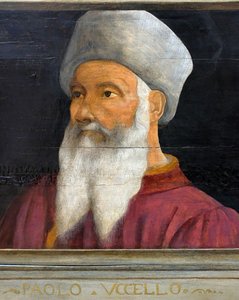
Paolo Uccello

Paolo Uccello

1397 - 1475, Italy

Quick facts about Paolo Uccello

  • Artistic Movement Or Style: Early Renaissance
  • Artists Or Movements Influenced By This Artist: ['Albrecht Dürer']
  • Artists Who Influenced This Artist:
    • Lorenzo Ghiberti
    • Donatello
  • Date Of Birth: 1397
  • Date Of Death: 1475
  • Full Name: Paolo Uccello
  • Nationality: Italian
  • Notable Artworks:
    • Battle of San Romano
    • Birth of the Virgin
    • St George & Dragon
    • The Flood and Ark
  • Place Of Birth: Pratovecchio, Italy

Artist Biography

A Florentine Visionary: The Life and Art of Paolo Uccello

Paolo Uccello, born Paolo di Dono in 1397 amidst the rolling hills near Florence, remains one of the most captivatingly enigmatic figures of the Early Renaissance. His very nickname, “Uccello” – little bird – hints at a whimsical nature and an artistic inclination towards depicting the avian world, yet it belies a mind deeply engaged with the burgeoning intellectual currents of his time. He wasn’t merely a painter; he was a pioneer, a mathematician of the canvas, striving to unlock the secrets of visual space and translate them into breathtaking works of art. His father, Dono di Paolo, practiced the dual profession of barber-surgeon, while his mother, Antonia, hailed from a Florentine noble family – a lineage that perhaps instilled in young Paolo both a practical sensibility and an appreciation for refined aesthetics. From 1412 to 1416, Uccello’s formative years were spent under the tutelage of Lorenzo Ghiberti, whose workshop was a crucible of artistic innovation, focused on the creation of the magnificent bronze doors for Florence's Baptistery. This early exposure steeped him in the prevailing Gothic style, with its emphasis on decorative elegance and narrative clarity, yet also ignited within him a desire to push beyond established boundaries.

The Pursuit of Perspective: A Mathematical Mind at Play

Uccello’s artistic development wasn't simply about mastering technique; it was driven by an insatiable curiosity regarding the underlying principles governing perception. He became consumed with mathematics, particularly geometry and perspective, not as abstract disciplines but as tools to unlock a more truthful representation of reality. While Filippo Brunelleschi is often credited with discovering linear perspective, Uccello was among the first to systematically apply it to painting, meticulously calculating vanishing points and orthogonal lines to create an illusion of depth that had previously been largely absent from art. This wasn’t merely about technical accuracy; for Uccello, perspective became a means of structuring narrative, enhancing drama, and imbuing his compositions with a sense of order and intellectual rigor. His fascination bordered on obsession, as recounted by Giorgio Vasari, who described Uccello staying up late into the night, lost in contemplation of vanishing points and spatial relationships. This dedication, while sometimes perceived as eccentric, ultimately revolutionized painting and paved the way for future generations of artists.

Masterpieces of Illusion: Key Works and Stylistic Traits

Uccello’s oeuvre, though relatively small, is marked by a distinctive style that blends Gothic elegance with Renaissance innovation. The Battle of San Romano, a series of three panels commissioned to commemorate a Florentine victory, stands as perhaps his most celebrated achievement. These paintings are not simply depictions of warfare; they are dynamic compositions filled with swirling figures, fragmented armor, and dramatically foreshortened lances – all rendered in vibrant colors and arranged according to meticulously calculated perspective. The Birth of the Virgin, showcases Uccello’s mastery of linear perspective, creating a convincing illusion of depth within a shallow space, while his St George and the Dragon presents a striking depiction of the legendary saint, characterized by bold colors and stylized forms. Even in works like The Flood and the Ark, part of the San Miniato al Monte frescoes, Uccello’s fascination with architectural detail and complex compositions is readily apparent. His style consistently reveals:
  • A vibrant palette and a bold use of color.
  • An emphasis on linear perspective, often pushed to its limits for dramatic effect.
  • Stylized figures and decorative patterns reminiscent of Gothic art.
  • A profound fascination with geometric forms and spatial relationships.
  • Legacy and Influence: A Lasting Impact on Art History

    Paolo Uccello’s contribution to the Renaissance extends far beyond his individual paintings. His pioneering exploration of perspective fundamentally altered the course of art history, influencing countless artists who followed in his wake. Albrecht Dürer, the renowned German printmaker and painter, was deeply inspired by Uccello's work, dedicating himself to the study of perspective and incorporating its principles into his own artistic practice. While Uccello’s style remained somewhat idiosyncratic throughout his career – a unique blend of Gothic refinement and Renaissance innovation – his groundbreaking approach to space and form secured his place as a pivotal figure in the development of Western art. He died in Florence in 1475, leaving behind a legacy not only of beautiful paintings but also of intellectual curiosity and artistic daring. His work continues to inspire awe and admiration, reminding us that true artistry lies not just in what is seen, but in the understanding of how we see it.

    Quick Facts

    • Dimensions: 65 x 48 cm
    • Movement: Early Renaissance
    • Subject or theme: Religious painting
    • Year: 1420
    • Location: Louvre Museum
    • Title: The Annunciation

    Art Quiz

    There is only one correct answer for each question.

    Question 1:
    Who is the artist of 'The Annunciation'?
    Question 2:
    In which year was this painting created?
    Question 3:
    Which angel is depicted visiting Mary in the painting?
    Question 4:
    What are the predominant colors used in the painting?
    Question 5:
    What type of building serves as a backdrop for the figures?