Preview
 Send
Send Share
Share
 Details
 Guide
Guide

 Download
 Similars
 X-Ray
X-Ray Diaporama
 Stats
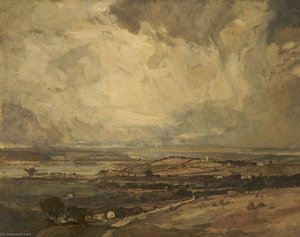
StatsShap Moors
 1919
1919 102.0 x 127.0 cm
 Read More
The artwork displayed on this page is protected by copyright law, which means we cannot legally create or sell an identical reproduction. This protection is enforced under international agreements such as the Berne Convention and by national laws, including those outlined by the U.S. Copyright Law - Title 17.
This method fully complies with copyright regulations because it does not involve copying or duplicating the protected artwork. Instead, it is a creative reinterpretation - a new painting that is influenced by the original but not identical to it.
Giclée / Art Print
Museum-quality giclée or canvas print with fast production and flexible finish options. ( Buy Hand Made Painting Switch to Digital Image)




































Pick from our preset sizes that match the artwork's original proportions.

Type the width and the height you need, to fit your frame or your wall. A print can only be cut, never made bigger than the picture, so a size with a different shape loses a part of the image. We send you a digital mockup to approve before we print anything. The picture shown on this page does not show the real cut — only the mockup does.
Worldwide Delivery () in 2 weeks instead of standard 4/5 weeks. (25 October)

Free Worldwide Express Shipping

High-Quality Linen Canvas

Full Shipping Insurance

Customs Tax Refund Guarantee

True Color Matching Guarantee

100-Day Return Policy (Defects Only)

100% Money-Back Guarantee

Bulk Discount Offer
 Glass option is only available in size under 110 CM

Shap Moors
Giclée / Art Print
Reproduction Size
-


Total Price
$ 81
Artist Biography
The Atmospheric Vision of Oliver Hall
Oliver Hall (1869–1957) stands as a significant figure in British landscape painting, particularly renowned for his evocative depictions of rugged moorlands and Spanish vistas. Born in Portsmouth, Hampshire, Hall’s artistic journey began with formative years spent traveling extensively—a habit that profoundly shaped his visual sensibilities and fueled his lifelong fascination with the natural world. His early training encompassed both formal academic instruction at the Royal College of Art (RCA) and invaluable private tuition from D.A. Williamson of Liverpool, establishing a foundation for his distinctive artistic style. Through these formative experiences, Hall developed an eye for the subtle nuances of light and texture that would become the hallmark of his career.
Hall’s artistic career blossomed during the late Victorian era, coinciding with a burgeoning interest in plein air painting—a technique championed by artists like Frederic Church and Thomas Moran—which prioritized capturing landscapes directly from observation. Influenced by luminist painters such as George Inness and Albert Bierstadt, Hall embraced atmospheric perspective and tonal modulation to convey the grandeur and drama of his subjects. His meticulous attention to detail and masterful brushwork resulted in paintings that possess a remarkable immediacy and emotional resonance, often pulling the viewer into the quiet solitude of the British countryside or the sun-drenched landscapes of the Iberian Peninsula.
Mastery of Medium and Technique
A pivotal moment arrived when Hall joined the Royal Watercolour Society (RWS) in 1894, marking him as one of Britain’s leading artists of his time. This affiliation provided access to influential artistic circles and fostered collaborations with fellow painters who shared similar aesthetic ideals. During this period, Hall's output included a prolific series of etchings—a medium he skillfully mastered—that complemented his oil paintings and further solidified his reputation as a versatile artist. His etchings demonstrated an exceptional understanding of tonal gradation and textural variation, mirroring the expressive qualities found in his landscapes.
The breadth of his technical skill is evident across various subjects and settings:
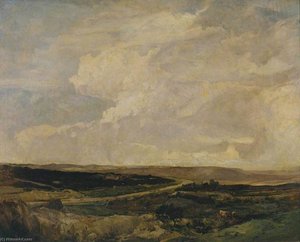
- Romantic Landscapes: In works such as Coates Common, Sussex (1909), Hall utilizes muted tones and atmospheric brushwork to create a hauntingly beautiful scene where a solitary cow amidst bleak hills evokes a sense of profound melancholy.
- Spanish Vistas: His travels inspired romanticized depictions of Spain, such as the Old Mill at Ávila (1931), which showcases a balanced composition and a subtle, sun-drenched melancholy through oil on canvas.
- Architectural Grandeur: His ability to capture historical weight is seen in his studies of landmarks like the Alcántara Bridge in Toledo, where he translates stone and structure into part of the living landscape.
- English Heritage: Works like Waddon Manor, Dorset demonstrate his capacity for capturing the timeless, pastoral beauty of the English estate through a sophisticated use of light.
Legacy and Historical Significance
Throughout his long life, spanning from the height of the Victorian era to the mid-20th century, Oliver Hall remained dedicated to the pursuit of capturing the ephemeral qualities of nature. His work serves as a vital bridge between the formal academic traditions of the 19th century and the more emotive, atmospheric approaches of the early modern period. By blending the precision of his training with a deep, romanticized connection to the landscapes he traversed, Hall created a body of work that transcends mere representation. His paintings remain enduring testaments to the beauty of the natural world, inviting contemporary viewers to experience the quiet majesty of the moorlands and the storied vistas of Spain through his masterful, evocative lens.

Oliver Hall
1869 - 1957
Quick Facts
- Artistic Movement Or Style: Victorian Landscape Painting
- Artists Or Movements Influenced By This Artist: ['Romanticism']
- Artists Who Influenced This Artist: ['Francis Seymour Haden']
- Date Of Birth: 1869
- Date Of Death: 1957
- Full Name: Oliver Hall
- Nationality: British
- Notable Artworks: ['AllPaintingsStore']
- Place Of Birth: England