

 Preview
 Send
Send Share
Share
 Details

 Download
 Similars
 X-Ray
X-Ray Diaporama
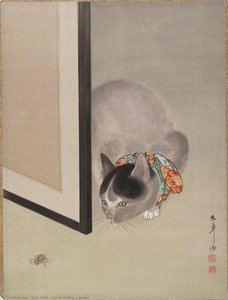
Cat Watching a Spider
 1888
1888 38.0 x 28.0 cm
 Read More
Purchase a high-resolution, enhanced digital image, far superior to the online preview.
Each file is meticulously prepared by our in-house specialists using advanced tools and expert manual retouching. We ensure every image has exceptional clarity, precise color accuracy, and fine detail.
The final file is delivered via email within 72 hours, optimized for immediate use in professional, editorial, and print environments. This is the same quality trusted by top-tier design studios, publishers, and galleries.
Digital Image
Download a high-resolution file for personal display, printing, and creative projects. ( Buy Print Buy Hand Made Painting)
Included in Every Digital Image Order
Expert Digital Delivery, Guaranteed
When you choose OriginalUniqueArt.com, you're not just getting an image - you're receiving a professionally enhanced digital artwork, crafted with precision and backed by a satisfaction guarantee. Here's everything that comes with your order, automatically:

Fast Email Delivery
Your high-resolution digital image file will be emailed to you within 72 hours of ordering - ready for immediate use.

AI-Enhanced Digital File
Your artwork is professionally optimized using advanced AI tools and manual editing, ensuring maximum detail, clarity, and color accuracy.

Free Lifetime Re-Delivery
Accidentally deleted or lost your file? No worries - we'll resend it to you anytime, free of charge.

No Import Fees - Ever
Enjoy your artwork instantly with zero customs, duties, or delivery fees - digital downloads are always tax-free.

Color Accuracy Guarantee
We ensure your digital image reflects the original colors as closely as possible using professional tools and color management.

60-Day Satisfaction Guarantee
If you're not satisfied with your digital image, we'll revise it or refund 100% within 60 days - no questions asked.

100% Money-Back Guarantee
Not satisfied? Get a full refund within 60 days of receiving your digital file - no questions asked.

Bulk Order Discounts
Buy 3 images, save 10% - Buy 5, save 15% - Buy 10+, save 20%. Great for creative projects, galleries, and agencies.
Artist Biography
Oide Tōkō: A Master of Subtle Emotion in the Meiji Era
Born in Tokyo in 1841, Oide Tōkō (also known as Ōide Aya) emerged during a pivotal period in Japanese history – the Meiji Restoration (1868-1912). This era witnessed rapid modernization and Westernization alongside a fervent desire to preserve traditional Japanese aesthetics. Tōkō’s work stands as a compelling testament to this complex interplay, offering intimate glimpses into daily life and profound explorations of human emotion within a distinctly Japanese framework.
Early biographical details about Tōkō are somewhat sparse, though he was recognized as a skilled painter from an early age. His formal training remains largely undocumented, suggesting he may have been part of a guild system or learned through apprenticeship – common practices for artists at the time. The name “Kagyu-zuruya” (蝸牛窟), often associated with his work, translates to "snail shell cave," hinting at a secluded and contemplative artistic practice. His courtesy name, Sōkyō 素巧, meaning “simple skill,” reflects a dedication to understated elegance and naturalism in his compositions.
A Palette of Quiet Observation
Tōkō’s style is characterized by its remarkable subtlety and psychological depth. He primarily worked in ink and color on silk or paper, employing a delicate brushwork that prioritized capturing fleeting moments and nuanced expressions. Unlike the grand narratives often favored during the Meiji period, Tōkō's paintings frequently depict solitary figures engaged in quiet activities – a woman tending to her garden, a child playing with a toy, or a man gazing pensively into the distance. These scenes are not dramatic; rather, they convey a sense of serene contemplation and understated emotion.
His most famous work, “Cat Watching a Spider” (猫と蜘蛛), exemplifies this approach perfectly. The painting isn’t about action or spectacle but about the quiet observation of two creatures sharing a space. The cat's expression is ambiguous – curiosity, boredom, perhaps even a touch of melancholy – inviting viewers to project their own emotions onto the scene. This ability to evoke such complex feelings with minimal visual elements was a hallmark of Tōkō’s artistry.
Influences and Artistic Context
Tōkō's work is deeply rooted in traditional Japanese painting techniques, particularly those associated with the yamato-e style – a school emphasizing naturalism and emotional expression. However, he also absorbed influences from Western art, notably Impressionism’s focus on capturing light and atmosphere. The subtle gradations of color in his paintings, reminiscent of Monet or Renoir, demonstrate this assimilation without sacrificing the core tenets of Japanese aesthetics.
During the Meiji period, there was a conscious effort to promote both Western and Eastern art forms. Tōkō’s work gained recognition as Japan sought to establish its own unique artistic identity. His paintings were exhibited in Japan and internationally, contributing to a growing appreciation for Japanese art abroad.
Legacy and Market Value
Oide Tōkō died in 1905, leaving behind a relatively small but highly valued body of work. His paintings have been offered at auction multiple times, with prices ranging from $1,000 to $5,000, reflecting their increasing recognition as significant examples of Meiji-era Japanese art. His ability to capture the quiet dignity and emotional resonance of everyday life continues to resonate with collectors and viewers today.
His work is a poignant reminder that beauty and profound meaning can be found not in grand gestures but in the subtle details of human experience – a lesson beautifully articulated by Oide Tōkō through his evocative paintings. The Dictionary of Artists in Japan (DAJ) highlights his birthdate as May 24, 1841, and his death date as March 14, 1905, solidifying his place within the historical record of Japanese art.
oide tōkō
1841 - 1905 , Japan
Quick Facts
- Artistic Movement Or Style: Meiji period art
- Date Of Birth: 1841-05-24
- Date Of Death: 1905-03-14
- Full Name: oide tōkō
- Nationality: Japanese
- Notable Artworks: ['Cat Watching a Spider']
- Place Of Birth: Tokyo, Japan

