Preview
 Send
Send Share
Share
 Details
 Guide
Guide

 Download
 Similars
 X-Ray
X-Ray Diaporama
 Stats
StatsDelta Lambda
 Acrylic On Canvas
- WallArt
- Color Field Painting
 1961
1961 260.0 x 449.0 cm
 Cleveland Museum of Art
 Read More
The artwork displayed on this page is protected by copyright law, which means we cannot legally create or sell an identical reproduction. This protection is enforced under international agreements such as the Berne Convention and by national laws, including those outlined by the U.S. Copyright Law - Title 17.
As a respectful and legal alternative, we offer custom, hand-painted artworks inspired by the original. Our skilled and professional artists carefully study the original's style, mood, and artistic essence to create a new, unique piece that evokes the same feeling - while remaining an original creation in its own right.
This method fully complies with copyright regulations because it does not involve copying or duplicating the protected artwork. Instead, it is a creative reinterpretation - a new painting that is influenced by the original but not identical to it.
Hand Made Oil Reproduction
Hand-painted oil on canvas in your size and frame, made to order by our artists. ( Switch to Print Switch to Digital Image)




P118B $10

P118H $10

P118W $10

P438Z $10

P508JH $12

P508YH $12

P805H $10

P805Z $10

P919BZ $10

P919G $10

P919XJ $10

P959ZH $10

P968JZ $12

W106C $8

W218G $10

W218JH $8

W218Y $10

W307PJ $10

W316G $10

W316PJ $8

W316Y $10

W398PJ $8

W4111J $10

W500HY $15

W500JH $15

W692G $12

W849H $8

W940BG $15

W953PJ $8




Pick from our preset sizes that match the artwork's original proportions.

Type the width and the height you need, to fit your frame or your wall. This is hand-painted, so for a size with a different shape the artist can paint a bit more around the picture, or cut a bit — you choose. We send you a digital mockup to approve before the painting starts. The picture shown on this page does not show the real result — only the mockup does.
After order, OriginalUniqueArt.com team will email client for instructions and provide a mockup preview
Worldwide Delivery () in 3/4 weeks instead of standard 5 weeks. (18 October). No compromise on quality.

Free Worldwide Express Shipping

High-Quality Linen Canvas

Full Shipping Insurance

Customs Tax Refund Guarantee

True Color Matching Guarantee

100-Day Return Policy (Defects Only)

100% Money-Back Guarantee

Bulk Discount Offer
 Glass option is only available in size under 110 CM

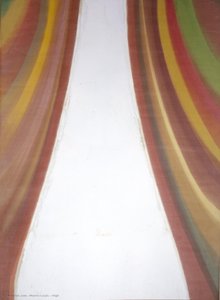
Delta Lambda
Reproduction Medium
Reproduction Size
-


Total Price
$ 300
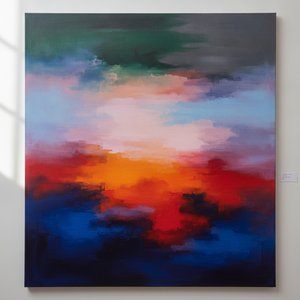
A Dance of Light and Transparency – Exploring ‘Delta Lambda’
Morris Louis's “Delta Lambda,” painted in 1961, isn’t merely a canvas adorned with color; it’s an invitation to lose oneself within a flowing, ethereal landscape. This monumental work, measuring nearly six feet tall and over four and a half feet wide, embodies the core tenets of Color Field painting – a movement that sought to elevate color itself to the status of subject matter, divorced from representational imagery. Louis, a pivotal figure in this aesthetic revolution, masterfully employed a technique he pioneered: staining thin washes of acrylic paint directly onto unprimed canvas, allowing the colors to bleed and mingle organically, creating an illusion of depth and movement that defies traditional perspective.
The painting’s composition is strikingly asymmetrical. Two distinct streams of color – vibrant yellows, greens, blues, and reds – emerge from the lower corners, gracefully ascending towards a central point before subtly dissolving into the surrounding white expanse. This deliberate imbalance isn't haphazard; it generates a dynamic tension, drawing the viewer’s eye along the converging pathways while simultaneously suggesting an infinite space beyond the confines of the canvas. The stark contrast between the saturated colors and the pristine white background amplifies the luminosity of each hue, creating a visual experience that is both intense and serene.
The Alchemy of Color: Technique and Material
Louis’s process was remarkably unconventional for its time. He rejected the traditional layering of paint, opting instead to apply multiple thin washes directly onto the canvas, allowing them to interact and bleed into one another. This technique, coupled with his use of Magna acrylic paint – a revolutionary medium developed specifically for him by Leo Sebak – resulted in a remarkable transparency. The colors don’t simply cover the surface; they seem to float within it, revealing glimpses of the underlying white canvas beneath. Close inspection might reveal subtle variations in the layering process, but the overall effect is one of seamless fluidity and effortless grace.
The artist's deliberate choice to work on unprimed canvas was crucial to achieving this ethereal quality. The paint penetrated the fibers of the fabric, creating a unique textural interplay that further enhanced the sense of depth and movement. It’s a testament to Louis’s intuitive understanding of material properties – he wasn’t simply applying color; he was conducting an alchemical experiment, transforming the very essence of pigment into light and atmosphere.
Symbolism and Emotional Resonance
While “Delta Lambda” resists definitive interpretation, its evocative power lies in its ability to tap into primal emotions. The flowing colors can be seen as representing natural phenomena – water currents, shifting skies, or the dappled light filtering through leaves. However, Louis himself resisted assigning specific meanings to his works, preferring that viewers derive their own interpretations from the experience of looking at them. The asymmetrical composition and the sense of infinite space suggest a journey inward, inviting contemplation and reflection.
Furthermore, the painting’s origins within the context of 1960s America – a period of social upheaval and artistic experimentation – imbue it with an added layer of significance. Louis's work can be viewed as a rejection of traditional representational art, embracing instead the pure sensory experience of color. It reflects a desire to break free from the constraints of the past and explore new possibilities for artistic expression.
A Legacy of Transparency – Reproductions and Beyond
OriginalUniqueArt’s meticulously crafted reproductions capture the essence of “Delta Lambda” with remarkable fidelity, allowing art lovers to experience its beauty and complexity in their own homes. The careful attention to detail ensures that the transparency and luminosity of Louis's original technique are faithfully reproduced, creating a stunning visual statement. Whether displayed as a centerpiece or incorporated into a broader interior design scheme, this iconic work continues to inspire and captivate audiences worldwide.
Questions & Answers
Where should a reproduction of "Delta Lambda" by Morris Louis be hung?
Format (panoramic) and recommended space (living room) are the two placement facts recorded for "Delta Lambda" by Morris Louis.
Can I see an X-ray view of "Delta Lambda" by Morris Louis?
The X-Ray view of "Delta Lambda" by Morris Louis is on the artwork's X-Ray page: an interactive examination of the image through eleven optical layers.
Which print setup is suggested for "Delta Lambda" by Morris Louis?
large size, panoramic orientation: that is the print setup suggested for "Delta Lambda" by Morris Louis.
Artist Biography
Early Life and Education
- Born: Morris Louis Bernstein, November 28, 1912, Baltimore, Maryland
- Parents: Louis Bernstein (furniture salesman) and Cecelia Luckman Bernstein.
- Education: Attended public schools in Baltimore; Maryland Institute of Fine and Applied Arts (now MICA), 1929-1932. Did not complete a degree.
- Early influences included Eugene Speicher and Paul Cézanne.
- Showed an early interest in art, encouraged by his family despite limited opportunities in Baltimore.
Development as an Artist & Key Influences
- 1930s: Worked various odd jobs to support himself while painting (vegetable peeling, laundry work, Gallup Poll research).
- 1934-1936: Participated in the Public Works of Art Project mural project under Sam Swerdloff.
- 1936-1937: Moved to New York City; experimented with techniques at the Siqueiros Workshop.
- Magna Paint Discovery (1948): A pivotal moment – Louis pioneered the use of Magna paint, a newly developed oil-based acrylic paint created for him by Leonard Bocour and Sam Golden. This allowed for greater fluidity and transparency in his work.
- Influence of Helen Frankenthaler: In 1953, Louis and Kenneth Noland visited Frankenthaler's studio and were deeply impressed by her stain paintings (particularly "Mountains and Sea"). This inspired their experimentation with pouring and staining techniques.
The Veil Paintings & Color Field Innovations
- Mature Veil Paintings (1954): Characterized by overlapping, superimposed layers of transparent color poured onto and stained into sized or unsized canvas.
- Technique: Extremely diluted paint was applied to an unprimed, unstretched canvas, allowing it to flow over the inclined surface, creating translucent color veils. This eliminated brushstrokes and emphasized flatness.
- Color Field Painting: Louis became a central figure in Color Field painting, simplifying pictorial space and emphasizing flat planes of intense color. He was part of the Washington Color School movement.
- Series & Styles: Beyond the Veil paintings, he explored series like florals, columns (1960), unfurleds (1960-61) – featuring rivulets of opaque color – and stripe paintings (1961-62).
Major Achievements & Historical Significance
- Pioneering Color Field Painting: Louis is recognized as a key innovator in Color Field painting, alongside artists like Kenneth Noland and Helen Frankenthaler.
- Influence on Abstract Expressionism: His work expanded the boundaries of Abstract Expressionism by focusing on color and flatness rather than gesture or composition.
- Washington Color School: A significant contributor to this influential movement, which emphasized a reductive approach to painting.
- Destruction of Works: Notably, Louis destroyed many of his paintings between 1955 and 1957, reflecting a critical self-assessment of his work.
- Legacy: His emphasis on color, flatness, and the materiality of paint continues to influence contemporary artists.
Later Years & Death
- Louis continued painting prolifically until his death.
- Death: Died September 7, 1962, in Washington, D.C., at the age of 49.
- Memorial Exhibition (1963): A significant exhibition was held at the Solomon R. Guggenheim Museum shortly after his death.
- Retrospective Exhibitions: Major retrospectives followed at the Museum of Fine Arts, Boston (1967), and the National Gallery of Art, Washington, D.C. (1976).

Morris Louis
1912 - 1962 , United States of America
Quick Facts
- Full Name: Morris Louis
- Nationality: American
- Date Of Birth: 1912
- Date Of Death: 1962
- Place Of Birth: Baltimore, United States of America
- Notable Artworks:
- High
- Number 1-36
- Where
- Number 1-68
- Gamma Tau
- Third Element
- Delta Theta
- Artistic Movement Or Style: Color Field painting
- Artists Who Influenced This Artist:
- Helen Frankenthaler
- Jackson Pollock
- Cézanne
- Artists Or Movements Influenced By This Artist:
- Kenneth Noland
- Washington Color School
Related Articles
Acrylic on Paper: A Modern Canvas for Contemporary Expression
Explore the versatility of acrylic painting on paper! Discover expert techniques, artist insights & archival practices for creating stunning contemporary art. Learn more at OriginalUniqueArt.
The Essence of Abstraction: A Definitive Guide to the Power and History of Color Field Painting Masterpieces
Explore the profound emotional depth of Color Field painting. Our expert guide delves into the post-war origins of Abstract Expressionism, analyzing masterpieces by Rothko and Newman. Discover museum-grade, hand-painted oil reproductions that bring art history to your walls.
Navigating Abstract Expression: A Guide to Contemporary Movements for Emotional Resonance in Art Selection
Explore the evolution of Abstract Expressionism & discover contemporary movements for emotional resonance. Expert guidance for discerning art collectors seeking lasting value. OriginalUniqueArt.
Color Field Painting: The Emotional Power of Pure Abstraction and Chromatic Depth
Explore the profound emotional depth of Color Field painting. Discover the history of mid-century abstraction, from Rothko to Newman, and learn how pure color transforms the viewer's experience through our expert art history guide.

Morris Louis: Pioneering Color Field Painting & Abstract Expressionism's Legacy
Explore the groundbreaking abstract expressionism of Morris Louis, a pioneer of Color Field painting. Discover his innovative techniques, influential series & lasting legacy in post-war American art. Learn more at OriginalUniqueArt.