
 Send
Send Share
Share
 Details
 Guide
Guide

 Download
 Similars
 Diaporama
 Stats
StatsConnection
 Textile
- Textile
- Contemporary Realism
 1978
1978- Contemporary
 152.0 x 152.0 cm
 University of Iowa Museum of Art
 Read More
Get a print-ready file that goes far beyond the web preview. Every digital image we sell comes from a high-resolution master in our stock database — usually 5,000 to 15,000 pixels wide — so you can print large, crop tightly, or reproduce fine detail with confidence.
No file leaves our studio untouched. A digital expert checks the colors against the original painting and corrects them if needed, then improves clarity and detail with professional retouching tools — always staying faithful to the artist's brushwork and style. The result is an image that looks like the painting, not like a filtered scan.
You approve before you're done: our expert sends the image by e-mail within 72 hours for your review. Not satisfied? Ask for improvements or corrections, or request a refund if the quality falls short.
This is the quality relied on by publishers, design studios, galleries and print shops.
Digital Image
Download a high-resolution file for personal display, printing, and creative projects. ( Switch to Print Buy Hand Made Painting)
Included in Every Digital Image Order
Expert Digital Delivery, Guaranteed
When you choose OriginalUniqueArt.com, you're not just getting an image - you're receiving a professionally enhanced digital artwork, crafted with precision and backed by a satisfaction guarantee. Here's everything that comes with your order, automatically:

Fast Email Delivery
Your high-resolution digital image file will be emailed to you within 72 hours of ordering - ready for immediate use.

AI-Enhanced Digital File
Your artwork is professionally optimized using advanced AI tools and manual editing, ensuring maximum detail, clarity, and color accuracy.

Free Lifetime Re-Delivery
Accidentally deleted or lost your file? No worries - we'll resend it to you anytime, free of charge.

No Import Fees - Ever
Enjoy your artwork instantly with zero customs, duties, or delivery fees - digital downloads are always tax-free.

Color Accuracy Guarantee
We ensure your digital image reflects the original colors as closely as possible using professional tools and color management.

100-Day Satisfaction Guarantee
If you're not satisfied with your digital image, we'll revise it or refund 100% within 100 days - no questions asked.

100% Money-Back Guarantee
Not satisfied? Get a full refund within 100 days of receiving your digital file - no questions asked.

Bulk Order Discounts
Buy 3 images, save 10% - Buy 5, save 15% - Buy 10+, save 20%. Great for creative projects, galleries, and agencies.
A Tapestry of Identity: The Vibrant Soul of Connection
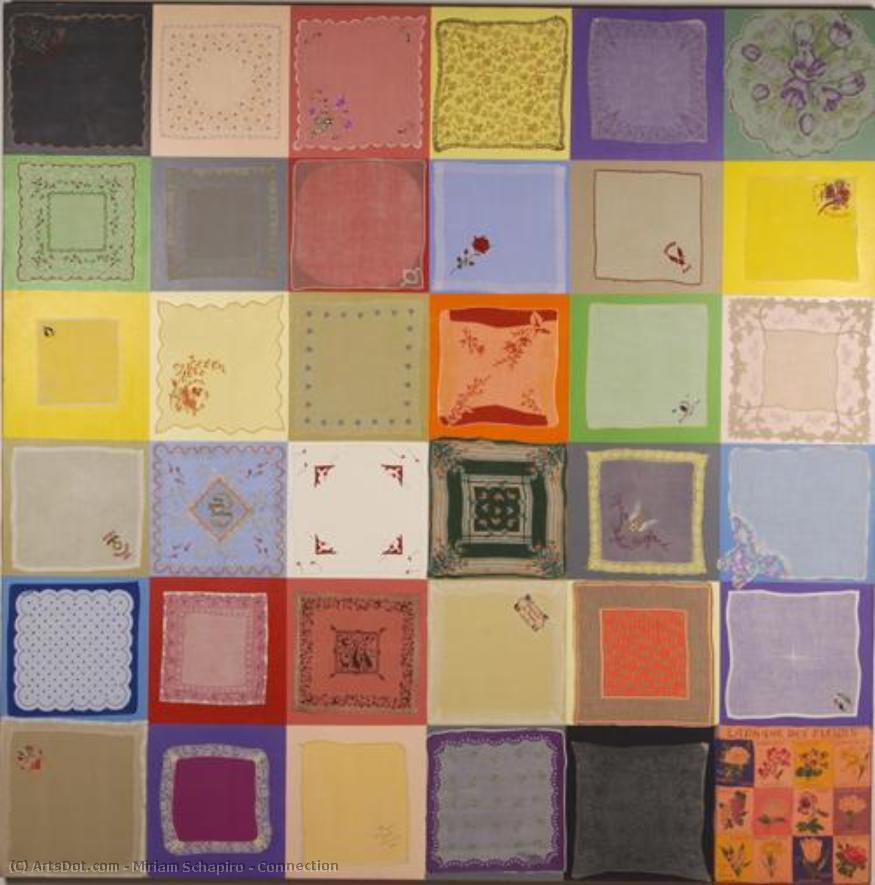
In the vast landscape of twentieth-century art, few works possess the tactile warmth and radical spirit of Miriam Schapiro’s “Connection,” created in 1978. This masterpiece is not merely a visual experience; it is a profound dialogue between the domestic and the divine, the craft and the canvas. At first glance, the viewer is swept up in a kaleidoscopic whirlwind of color—a rhythmic dance of reds, yellows, and deep blues that pulse with life. The artwork presents itself as an expansive, quilt-like arrangement of square patches, each one a miniature universe of pattern and texture. Through this meticulous grid, Schapiro invites us into a world where every fragment, no matter how small or decorative, plays a vital role in the strength of the whole.
The piece stands as a cornerstone of the Pattern and Decoration (P&D) movement, a stylistic rebellion against the austere, often cold minimalism that dominated the post-war era. Schapiro, a pioneer of Feminist Art, utilized this aesthetic to reclaim the beauty of "feminine" motifs—floral patterns, geometric intricacies, and soft textures—and elevate them to the status of high art. By employing acrylic paint on fabric, she blurred the boundaries between traditional fine art and the cherished crafts of quilting and textile work. This choice of medium is deeply symbolic; it breathes a sense of intimacy and domestic history into the composition, suggesting that the stories woven into our daily lives are just as worthy of monumental expression as any historical epic.
The Symbolism of Interconnectedness
Beyond its striking visual surface, “Connection” serves as a powerful metaphor for the human condition. The deliberate arrangement of diverse patches—some featuring delicate floral motifs, others bold geometric shapes—mirrors the complexity of society itself. It is a visual manifesto on the beauty of diversity and the necessity of unity. Each square, with its unique hue and intricate design, represents an individual identity, a specific experience, or a distinct cultural thread. When these disparate elements are brought together in Schapiro’s masterful composition, they coalesce into a unified, harmonious tapestry. The title itself acts as a guiding light, prompting the viewer to contemplate how our individual lives are inextricably linked to the larger community and the shared history of womanhood.
For the discerning collector or interior designer, this artwork offers more than just aesthetic splendor; it provides an emotional anchor for a space. The piece possesses a rare ability to command attention through its complexity while simultaneously offering a sense of comfort through its familiar, textile-inspired textures. It is a work that invites long periods of contemplation, rewarding the eye with new details upon every encounter. Whether placed in a contemporary gallery setting or as a focal point in a sophisticated residential interior, “Connection” brings an atmosphere of intellectual depth and vibrant energy, making it an incomparable choice for those who seek art that celebrates both the strength of the individual and the beauty of our collective bond.
Questions & Answers
How do the colors of "Connection" by Miriam Schapiro relate to its emotion?
The neutrals palette of "Connection" by Miriam Schapiro goes together with its reflective emotional tone. Color is one of the ways a work conveys feeling.
Which artistic current is "Connection" by Miriam Schapiro part of?
"Connection" is a work of Contemporary Realism. The movement indicates the artistic tradition the work is part of.
What historical period is "Connection" by Miriam Schapiro from?
The historical period of "Connection" by Miriam Schapiro is Contemporary. This classification situates the work in art history.
Artist Biography
A Life Woven in Color and Feminism
Miriam Schapiro, born in Toronto, Canada, in 1923, was an artist whose journey mirrored the evolving landscape of twentieth and twenty-first century art. Her life, spanning nine decades until her passing in 2015, wasn’t simply a progression through artistic styles but a deliberate dismantling of boundaries – between high and low art, masculine and feminine expression, and ultimately, between personal experience and universal themes. Schapiro's early years were steeped in creativity; her father, Theodore Shapiro, an artist and industrial designer himself, nurtured her innate artistic inclinations from the tender age of six. This foundational encouragement, coupled with formative instruction at the Museum of Modern Art, set the stage for a lifelong dedication to visual expression. She pursued formal training at Hunter College before continuing her studies at the University of Iowa, where she earned a trifecta of degrees – BA, MA, and MFA – solidifying her commitment to painting, printmaking, and a burgeoning artistic vision. It was in Iowa that she met and married fellow artist Paul Brach, beginning a lifelong partnership both personally and creatively. The influence of Mauricio Lasansky at Iowa proved pivotal, instilling in Schapiro not only technical mastery in diverse printing techniques but also the importance of studying Old Masters to overcome artistic challenges – a practice that would resonate throughout her career.From Abstract Expressionism to the Birth of ‘Femmage’
Schapiro initially gained recognition within the realm of Abstract Expressionism during the 1950s and 60s, developing a distinctive gestural style characterized by delicate layering and subtle erasure – “painting thinly and wiping out,” as she described it. However, these abstract compositions were rarely devoid of underlying references; they often drew inspiration from black and white illustrations of Old Master paintings, revealing her continued dialogue with art history. The true turning point in Schapiro’s artistic trajectory arrived in the 1970s, coinciding with the burgeoning Feminist Art movement. Recognizing a critical void in the art world's representation of women’s experiences, she co-founded the groundbreaking Feminist Art Program at the California Institute of the Arts alongside Judy Chicago. This collaboration proved transformative, providing a platform for exploring female identity and challenging patriarchal structures within the artistic canon. It was during this period that Schapiro coined the term “femmage,” a neologism encapsulating her innovative collages constructed from fabrics, lace, ribbons, and other materials traditionally associated with domesticity and feminine craft. These works weren’t merely aesthetic experiments; they were deliberate acts of reclamation, elevating undervalued "women's work" to the status of fine art and challenging conventional notions of artistic value.Themes of Identity, History, and Decoration
Schapiro’s artistic exploration consistently revolved around themes of female identity, women’s history, and the reclaiming of marginalized artistic traditions. Her canvases became vibrant repositories of symbols associated with womanhood – hearts, floral motifs, geometric patterns, and a deliberate embrace of the color pink. She didn't shy away from incorporating imagery referencing other significant women artists, such as Mary Cassatt and Frida Kahlo, paying homage to their legacies while simultaneously asserting her own unique voice. A particularly striking example of her approach is her monumental depiction of hand fans; transforming what was typically a small, intimate object into large-scale paintings – some reaching six by twelve feet – she imbued the fan with heroic proportions, elevating it as a symbol of feminine power and grace. Beyond feminist concerns, Schapiro’s work also demonstrated a deep engagement with art history. She drew inspiration from the Russian avant-garde movement, recognizing its historical significance as a period where women artists were afforded greater opportunities for recognition and equality. This fascination informed her compositions and broadened her artistic vocabulary. Her embrace of decorative elements was not merely stylistic; it was a conscious rejection of minimalist austerity and a celebration of ornamentation – contributing significantly to the Pattern and Decoration movement, which challenged the prevailing emphasis on reductive forms in contemporary art.Legacy and Lasting Influence
Miriam Schapiro’s pioneering work irrevocably altered the landscape of contemporary art. She paved the way for future generations of feminist artists, redefining the boundaries between fine art and craft and challenging deeply ingrained societal biases. Her innovative techniques, particularly her development of “femmage,” expanded the possibilities of collage and assemblage, inspiring countless artists to explore new materials and approaches. Schapiro’s legacy extends beyond her artistic creations; she was a dedicated educator and advocate for women in the arts, fostering dialogue and creating opportunities for emerging artists. Today, her works are held in prestigious museum collections worldwide, including the Jewish Museum in New York and the National Gallery of Art, ensuring that her vision continues to resonate with audiences for years to come. The Eric Firestone Gallery exclusively represents her estate, safeguarding her artistic heritage and promoting ongoing scholarship on her life and work. Miriam Schapiro was more than an artist; she was a cultural catalyst, a fearless innovator, and a champion of feminine expression whose impact continues to be felt throughout the art world.
Miriam Schapiro
1923 - 2015 , Canada
Quick Facts
- Full Name: Miriam Schapiro
- Nationality: Canadian-American
- Date Of Birth: 1923
- Date Of Death: 2015
- Place Of Birth: Toronto, Canada
- Notable Artworks:
- Beast Land and Plenty
- Untitled (138)
- Untitled (543)
- Artistic Movement Or Style: Feminist Art, Pattern & Dec.
- Artists Who Influenced This Artist:
- Old Masters
- Lasansky
- Russian Avant-Garde
- Artists Or Movements Influenced By This Artist:
- Feminist Artists
- Pattern & Decoration