Send
Send Share
Share
 Details
 Guide
Guide

 Download
 Similars
 Diaporama
 Stats
StatsThe Fall


 Read More
Hand Made Oil Reproduction
Hand-painted oil on canvas in your size and frame, made to order by our artists. ( Switch to Print Switch to Digital Image)




































Pick from our preset sizes that match the artwork's original proportions.

Type the width and the height you need, to fit your frame or your wall. This is hand-painted, so for a size with a different shape the artist can paint a bit more around the picture, or cut a bit — you choose. We send you a digital mockup to approve before the painting starts. The picture shown on this page does not show the real result — only the mockup does.
After order, OriginalUniqueArt.com team will email client for instructions and provide a mockup preview
Worldwide Delivery () in 3/4 weeks instead of standard 5 weeks. (24 October). No compromise on quality.

Free Worldwide Express Shipping

High-Quality Linen Canvas

Full Shipping Insurance

Customs Tax Refund Guarantee

True Color Matching Guarantee

100-Day Return Policy (Defects Only)

100% Money-Back Guarantee

Bulk Discount Offer
 Glass option is only available in size under 110 CM

The Fall
Reproduction Medium
Reproduction Size
-


Total Price
$ 300
The Fall: A Masterpiece of Renaissance Drama
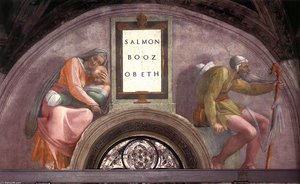
Michelangelo Buonarroti's "The Fall," part of the Sistine Chapel ceiling frescoes, is an iconic depiction of humanity’s expulsion from Paradise as described in the Book of Genesis. Completed between 1508 and 1512, this fresco stands as a testament to Michelangelo's unparalleled skill in depicting human anatomy, emotion, and narrative within the context of High Renaissance art.
Historical Context and Creation
The Sistine Chapel, commissioned by Pope Julius II, served as a vital space for papal ceremonies. Prior to Michelangelo’s work, the chapel was adorned with frescoes by other renowned artists. However, Pope Julius II envisioned a transformative project, tasking Michelangelo with painting the ceiling—a monumental undertaking that consumed four years of the artist's life. "The Fall" is one of nine scenes from Genesis depicted on the ceiling, each contributing to a grand narrative of creation and humanity’s relationship with God.
Artistic Style and Technique
Michelangelo employed the fresco technique—painting directly onto wet plaster—to create “The Fall.” This method allowed for vibrant colors and enduring detail. The composition is characterized by dynamic figures, powerful musculature, and a sense of dramatic movement. Adam and Eve are portrayed with striking realism, their bodies conveying both vulnerability and shame as they react to their transgression. The surrounding landscape, while serene, subtly underscores the gravity of the moment. Notice the snake's subtle presence and the bird perched above—details that add layers of symbolic meaning.
Symbolism and Emotional Impact
“The Fall” is rich in symbolism. The reaching hands of Adam and Eve, almost touching but separated by a chasm, represent the loss of innocence and the severance from divine grace. Their expressions convey a complex mix of emotions—regret, shame, and nascent awareness of their nakedness. The composition’s diagonal lines create a sense of instability and disruption, mirroring the upheaval in humanity's relationship with God. The fresco evokes profound feelings of melancholy, loss, and the enduring consequences of human choices. It is not merely a depiction of an event but a powerful meditation on the nature of good and evil, temptation, and redemption.
A Timeless Masterpiece
"The Fall" remains one of Michelangelo's most celebrated works, captivating viewers with its artistic brilliance and profound emotional resonance. Its enduring legacy lies in its ability to convey universal themes of human fallibility, divine judgment, and the search for meaning—a testament to the power of art to explore the deepest aspects of the human condition.
Questions & Answers
What explains the copyright situation of "The Fall" by Michelangelo Buonarroti?
"The Fall" by Michelangelo Buonarroti is in the public domain - its copyright has expired. Copyright duration runs from the artist's death, which occurred in 1564.
Who created "The Fall" and what style is it in?
"The Fall" was created by Michelangelo Buonarroti in the High Renaissance style. Artist and movement identify the work's tradition.
Where can I buy a hand-painted reproduction of "The Fall" by Michelangelo Buonarroti?
"The Fall" is available as a hand-painted oil reproduction on linen canvas. The order can be placed on its Hand-Painted Reproduction page, with a choice of sizes.
Artist Biography
The Hands of Caprese
In the hills of Caprese, a boy learned the weight of stone and the grit of marble dust. Born in 1475, Michelangelo di Lodovico Buonarroti Simoni spent his early years near Settignano, where his father owned a quarry. The smell of damp earth and the sound of hammers against rock were part of his childhood. He did not start with brushes but with the chisel. His apprenticeship under Domenico Ghirlandaio in Florence brought him into contact with the city's growing interest in the human form, yet it was the Medici gardens that truly shaped his eyes. There, among the ancient Greek and Roman fragments, he studied how light falls across muscle and bone.
His work began to take shape through a deep study of anatomy. He looked at the way a limb carries weight and how skin stretches over a joint. This focus on the physical reality of the body became his primary language. By the time he reached Rome in 1496, he was already carving figures that possessed a heavy, palpable presence. The Pietà, completed in 1499, shows this early ability to make marble appear as soft as flesh, even as it carries the weight of a dead man.
The Weight of the Sistine Ceiling
The task of the Sistine Chapel ceiling was not something he sought. He saw himself as a sculptor, someone who pulls life out of stone rather than spreading pigment on plaster. Yet, for four years, he worked in the high reaches of the chapel, painting over 300 figures from the Book of Genesis. The physical toll was visible in his daily life. He spent hours in difficult positions, his body strained by the reach and the heavy application of fresco technique. In panels like The Creation of Adam, the tension is found in the small gap between two fingers, a moment of near-contact that holds the viewer's attention through pure composition.
As time passed, his style moved away from the balanced ideals of the High Renaissance toward something more restless. His later works, such as The Last Judgment on the altar wall, show a shift toward Mannerism. The figures became more elongated and the compositions more crowded and dramatic. This change reflected a shifting spiritual climate in Rome. He continued to work with an intensity that many found overwhelming, often leaving projects unfinished as his mind moved toward new architectural or sculptural problems.
Architecture and Final Years
In his later decades, Michelangelo turned much of his attention to the structure of buildings. At age 71, he took over the work on St. Peter's Basilica, altering the plans to create a more massive, imposing design. He also designed the Laurentian Library, where his use of architectural elements broke from tradition, creating a sense of movement within the stone itself. His work on the Piazza del Campidoglio in Rome showed how he could organize a public space using symmetry and classical motifs to guide the eye through the square.
He died in Rome in 1564, leaving behind a legacy written in marble, fresco, and stone. His life was defined by several key roles:
- Sculptor: Carving works like David from single blocks of Carrara marble.
- Painter: Executing the vast narrative cycles of the Sistine Chapel.
- Architect: Redesigning the foundations of St. Peter's Basilica and the Laurentian Library.
- Poet: Expressing his inner thoughts through verse.

Michelangelo Buonarroti
1475 - 1564 , Italy
Quick Facts
- Artistic Movement Or Style:
- High Renaissance
- Mannerism
- Artists Or Movements Influenced By This Artist: ['Mannerism']
- Artists Who Influenced This Artist:
- Domenico Ghirlandaio
- Donatello
- Masaccio
- Full Name: Michelangelo di Lodovico Buonarroti Simoni
- Nationality: Italian
- Notable Artworks:
- Pietà
- David
- The Creation of Adam
- The Last Judgment
- Moses
- Place Of Birth: Caprese Michelangelo, Italy
- Date Of Birth: 1475
- Date Of Death: 1564
Related Articles
Michelangelo Buonarroti: A Renaissance Titan – Life, Works & Enduring Legacy
Explore the life, works & enduring legacy of Michelangelo Buonarroti, a Renaissance titan. Discover his iconic sculptures, frescoes, and architectural achievements. Expert art consultation & high-quality reproductions at OriginalUniqueArt.

Michelangelo's Masterpieces: Explore 25 Iconic Artworks for Your Home | OriginalUniqueArt
Journey through Michelangelo's 25 greatest artworks – from David’s strength to the Sistine Chapel’s beauty. Explore Renaissance masterpieces, art history & find museum-quality reproductions for your home at OriginalUniqueArt.com.

John Ottis Adams: Capturing Rural Indiana's Luminist Spirit
Explore the serene landscapes of John Ottis Adams, a key American Impressionist of the Hoosier Group. Discover his Luminist style & forgotten legacy with OriginalUniqueArt.
The Enduring Legacy of Fresco Painting: Techniques, History & Contemporary Relevance
Explore the rich history & enduring artistry of fresco painting – from Giotto to Michelangelo! Discover techniques, conservation efforts, & modern applications. Learn how OriginalUniqueArt brings this timeless art form to your home.

Mastering the Heavens: A Definitive Guide to the Sistine Chapel's Renaissance Masterpieces
Embark on a sophisticated journey through the Sistine Chapel. Discover the profound artistry of Michelangelo’s frescoes, from the iconic ceiling to the altar wall, through an expert exploration of Renaissance mastery and theological depth.