Preview
 Send
Send Share
Share
 Details
 Guide
Guide

 Download
 Similars
 X-Ray
X-Ray Diaporama
 Stats
StatsThe ceiling


 Read More
Hand Made Oil Reproduction
Hand-painted oil on canvas in your size and frame, made to order by our artists. ( Switch to Print Switch to Digital Image)




P118B $10

P118H $10

P118W $10

P438Z $10

P508JH $12

P508YH $12

P805H $10

P805Z $10

P919BZ $10

P919G $10

P919XJ $10

P959ZH $10

P968JZ $12

W106C $8

W218G $10

W218JH $8

W218Y $10

W307PJ $10

W316G $10

W316PJ $8

W316Y $10

W398PJ $8

W4111J $10

W500HY $15

W500JH $15

W692G $12

W849H $8

W940BG $15

W953PJ $8




Pick from our preset sizes that match the artwork's original proportions.

Type the width and the height you need, to fit your frame or your wall. This is hand-painted, so for a size with a different shape the artist can paint a bit more around the picture, or cut a bit — you choose. We send you a digital mockup to approve before the painting starts. The picture shown on this page does not show the real result — only the mockup does.
After order, OriginalUniqueArt.com team will email client for instructions and provide a mockup preview
Worldwide Delivery () in 3/4 weeks instead of standard 5 weeks. (21 October). No compromise on quality.

Free Worldwide Express Shipping

High-Quality Linen Canvas

Full Shipping Insurance

Customs Tax Refund Guarantee

True Color Matching Guarantee

100-Day Return Policy (Defects Only)

100% Money-Back Guarantee

Bulk Discount Offer
 Glass option is only available in size under 110 CM

The ceiling
Reproduction Medium
Reproduction Size
-


Total Price
$ 300
The Ceiling by Michelangelo Buonarroti: A Symphony of Divine Vision
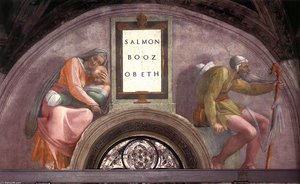
The Ceiling by Michelangelo Buonarroti stands as an unparalleled achievement in Renaissance art—a monumental fresco cycle that transcends mere decoration and embodies the very essence of humanist ideals. Located within the hallowed halls of the Sistine Chapel, Rome, this masterpiece continues to captivate audiences centuries after its completion between 1508 and 1512, cementing Michelangelo’s legacy as one of history's greatest artists. Its grandeur is not merely visual; it speaks to profound theological concepts and represents a pinnacle of artistic innovation.The Artist: Michelangelo Buonarroti – A Titan of Sculpture and Painting
Michelangelo di Lodovico Buonarroti Simoni (1475-1564), universally known as “Il Divino” (“the divine one”), was more than just a painter; he was a sculptor, architect, poet, and humanist philosopher. Born in Caprese Michelangelo, Tuscany, his early life was marked by familial resistance to artistic pursuits—until his father recognized his extraordinary talent for drawing. This formative influence propelled him toward mastering the art of marble carving, studying classical sculptures in the Medici gardens – an experience that instilled within him a lifelong fascination with proportion and beauty. His sculptural prowess culminated in iconic works like David and Pietà, demonstrating unparalleled skill and conveying deep emotional resonance. Michelangelo’s artistic vision extended beyond mere representation; he sought to capture the spirit of humanity itself.The Sistine Chapel: A Sacred Space Transformed
The Sistine Chapel, commissioned by Pope Julius II during a period of papal ambition and artistic patronage, serves as both a religious sanctuary and a testament to humanist aspiration. Built between 1473 and 1481, the chapel’s interior was initially adorned with frescoes by Botticelli, Ghirlandaio, Perugino and Pinturicchio—artists who sought to express Christian themes in elegant and harmonious compositions. However, Pope Julius II recognized Michelangelo's genius and entrusted him with transforming the chapel's ceiling into a visual narrative of Genesis – an ambitious undertaking that demanded unprecedented technical mastery.A Narrative of Creation: The Frescoes’ Composition and Technique
The Ceiling comprises nine scenes from the Book of Genesis, meticulously crafted to illustrate God’s creation story. Michelangelo employed a revolutionary technique known as *buon fresco*, applying pigment directly onto wet plaster—a method that ensured exceptional durability and vibrancy. This painstaking process involved preparing the walls with lime mortar and applying multiple layers of gesso (a mixture of gypsum and glue) to create a smooth surface for painting. The figures are rendered in astonishing detail, capturing human anatomy with breathtaking accuracy and conveying profound emotion through expressive gestures and facial expressions. Notably, the central panel depicting *The Creation of Adam*—featuring God reaching out to bestow life upon Adam—is arguably the most famous image in Western art history, embodying the divine spark of humanity.Symbolism and Emotional Impact: Beyond Representation
More than simply recounting biblical tales, Michelangelo’s Ceiling communicates complex theological ideas about divine providence, human dignity, and the relationship between God and humankind. The nude figures are not merely anatomical studies; they represent idealized forms reflecting classical ideals of beauty and virtue—a deliberate homage to Greco-Roman art and philosophy. The monumental scale of the frescoes overwhelms the viewer, fostering a sense of awe and reverence—reflecting the chapel’s role as a space for papal ceremonies and reinforcing its spiritual significance. Michelangelo's Ceiling continues to inspire artists and scholars alike, serving as an enduring symbol of Renaissance artistic excellence and humanist conviction. Its meticulous detail and vibrant colors are faithfully reproduced by OriginalUniqueArt.com, allowing admirers worldwide to experience the grandeur of this timeless masterpiece.Questions & Answers
How do movement and era meet in "The ceiling" by Michelangelo Buonarroti?
In "The ceiling" by Michelangelo Buonarroti, the High Renaissance movement meets the Renaissance era.
How does "The ceiling" fit into Michelangelo Buonarroti's themes and style?
"The ceiling" belongs to Michelangelo Buonarroti's High Renaissance work, whose recorded themes include classical ideals, religious narrative, papal patronage, human anatomy mastery, monumental scale, symbolic representation, iconic renaissance masterpiece.
Where can I find a guide to "The ceiling"?
A Guide page is available for "The ceiling" by Michelangelo Buonarroti: a printable factsheet about the artwork, designed for students and classroom use.
Artist Biography
The Hands of Caprese
In the hills of Caprese, a boy learned the weight of stone and the grit of marble dust. Born in 1475, Michelangelo di Lodovico Buonarroti Simoni spent his early years near Settignano, where his father owned a quarry. The smell of damp earth and the sound of hammers against rock were part of his childhood. He did not start with brushes but with the chisel. His apprenticeship under Domenico Ghirlandaio in Florence brought him into contact with the city's growing interest in the human form, yet it was the Medici gardens that truly shaped his eyes. There, among the ancient Greek and Roman fragments, he studied how light falls across muscle and bone.
His work began to take shape through a deep study of anatomy. He looked at the way a limb carries weight and how skin stretches over a joint. This focus on the physical reality of the body became his primary language. By the time he reached Rome in 1496, he was already carving figures that possessed a heavy, palpable presence. The Pietà, completed in 1499, shows this early ability to make marble appear as soft as flesh, even as it carries the weight of a dead man.
The Weight of the Sistine Ceiling
The task of the Sistine Chapel ceiling was not something he sought. He saw himself as a sculptor, someone who pulls life out of stone rather than spreading pigment on plaster. Yet, for four years, he worked in the high reaches of the chapel, painting over 300 figures from the Book of Genesis. The physical toll was visible in his daily life. He spent hours in difficult positions, his body strained by the reach and the heavy application of fresco technique. In panels like The Creation of Adam, the tension is found in the small gap between two fingers, a moment of near-contact that holds the viewer's attention through pure composition.
As time passed, his style moved away from the balanced ideals of the High Renaissance toward something more restless. His later works, such as The Last Judgment on the altar wall, show a shift toward Mannerism. The figures became more elongated and the compositions more crowded and dramatic. This change reflected a shifting spiritual climate in Rome. He continued to work with an intensity that many found overwhelming, often leaving projects unfinished as his mind moved toward new architectural or sculptural problems.
Architecture and Final Years
In his later decades, Michelangelo turned much of his attention to the structure of buildings. At age 71, he took over the work on St. Peter's Basilica, altering the plans to create a more massive, imposing design. He also designed the Laurentian Library, where his use of architectural elements broke from tradition, creating a sense of movement within the stone itself. His work on the Piazza del Campidoglio in Rome showed how he could organize a public space using symmetry and classical motifs to guide the eye through the square.
He died in Rome in 1564, leaving behind a legacy written in marble, fresco, and stone. His life was defined by several key roles:
- Sculptor: Carving works like David from single blocks of Carrara marble.
- Painter: Executing the vast narrative cycles of the Sistine Chapel.
- Architect: Redesigning the foundations of St. Peter's Basilica and the Laurentian Library.
- Poet: Expressing his inner thoughts through verse.

Michelangelo Buonarroti
1475 - 1564 , Italy
Quick Facts
- Artistic Movement Or Style:
- High Renaissance
- Mannerism
- Artists Or Movements Influenced By This Artist: ['Mannerism']
- Artists Who Influenced This Artist:
- Domenico Ghirlandaio
- Donatello
- Masaccio
- Full Name: Michelangelo di Lodovico Buonarroti Simoni
- Nationality: Italian
- Notable Artworks:
- Pietà
- David
- The Creation of Adam
- The Last Judgment
- Moses
- Place Of Birth: Caprese Michelangelo, Italy
- Date Of Birth: 1475
- Date Of Death: 1564
Related Articles

OriginalUniqueArt.com F.A.Q.: Elevating Interiors with Bespoke Wall Murals & Masterpiece Frescoes
Discover the pinnacle of bespoke interior transformation with OriginalUniqueArt.com. Our master fresco artists create exquisite, hand-painted wall murals and ceiling masterpieces tailored to your estate. Elevate your architectural space with timeless, museum-quality artistry.