Send
Send Share
Share
 Details
 Guide
Guide

 Download
 Similars
 Diaporama
 Stats
StatsJonah
 Fresco
- Decor
- High Renaissance
 1511
1511- Renaissance
 400.0 x 380.0 cm
 Sistine Chapel
 Read More
Giclée / Art Print
Museum-quality giclée or canvas print with fast production and flexible finish options. ( Buy Hand Made Painting Switch to Digital Image)




































Pick from our preset sizes that match the artwork's original proportions.

Type the width and the height you need, to fit your frame or your wall. A print can only be cut, never made bigger than the picture, so a size with a different shape loses a part of the image. We send you a digital mockup to approve before we print anything. The picture shown on this page does not show the real cut — only the mockup does.
Worldwide Delivery () in 2 weeks instead of standard 4/5 weeks. (28 October)

Free Worldwide Express Shipping

High-Quality Linen Canvas

Full Shipping Insurance

Customs Tax Refund Guarantee

True Color Matching Guarantee

100-Day Return Policy (Defects Only)

100% Money-Back Guarantee

Bulk Discount Offer
 Glass option is only available in size under 110 CM

Jonah
Giclée / Art Print
Reproduction Size
-


Total Price
$ 81
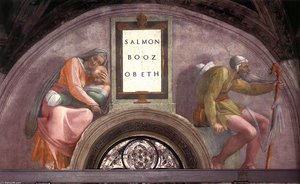
Michelangelo’s “Jonah”: A Vision of Resilience and Divine Intervention
This powerful depiction of the prophet Jonah is a cornerstone of Michelangelo's monumental fresco cycle on the ceiling of the Sistine Chapel, a testament to his unparalleled skill and profound understanding of the human condition. Painted between 1508 and 1512, “Jonah” isn’t merely an illustration of a biblical story; it is a deeply moving exploration of faith, suffering, and redemption.Historical Context & Creation
Commissioned by Pope Julius II, the Sistine Chapel ceiling was an ambitious undertaking that pushed Michelangelo to his artistic limits. Amidst intense physical strain and creative challenges, he conceived of a narrative sequence from the Book of Genesis, populated with figures of immense power and emotional depth. “Jonah” occupies a prominent position within this grand scheme, representing one of the Old Testament prophets who foretold the coming of Christ – a crucial theme for the Chapel’s theological program. Michelangelo's approach diverged from traditional depictions; he wasn’t interested in simply illustrating the story but in conveying its psychological and spiritual weight.Artistic Style & Technique
“Jonah” exemplifies the hallmarks of High Renaissance art. Michelangelo’s mastery of anatomy is breathtakingly evident in the figure's muscular form, rendered with meticulous detail and a profound understanding of human physicality. The fresco technique – applying pigment to wet plaster – demanded speed and precision, qualities that Michelangelo possessed in abundance. His use of *chiaroscuro*, the dramatic contrast between light and shadow, sculpts the forms and imbues the scene with a sense of dynamism and emotional intensity. Note how the light seems to emanate from within Jonah himself, highlighting his contemplative state.Symbolism & Interpretation
The story of Jonah – swallowed by a whale and later repenting at Nineveh – is rich in symbolic meaning. He represents not only individual salvation but also prefigures Christ’s own death and resurrection. The figure's seated pose, with hands resting on his hips, isn’t one of defeat but rather of quiet contemplation and acceptance of God’s will. While the whale itself isn’t directly depicted, its presence is powerfully suggested through symbolic elements. Some scholars interpret the rocky landscape as representing the depths of the sea or even the belly of the beast. The surrounding figures, though less prominent, contribute to the overall sense of drama and divine intervention.Emotional Impact & Enduring Legacy
“Jonah” evokes a profound emotional response in viewers. It’s a scene of solitude and introspection, yet also one filled with hope and resilience. Michelangelo doesn't portray Jonah as a passive victim but as an active participant in his own spiritual journey. The painting’s enduring appeal lies in its universal themes – the struggle between faith and doubt, the search for meaning in suffering, and the promise of redemption.Bringing Renaissance Masterpiece into Your Home
- A Timeless Investment: Own a meticulously hand-painted reproduction of Michelangelo’s “Jonah,” crafted with the same dedication to detail as the original.
- Interior Design Statement: This artwork adds sophistication and historical depth to any space, from grand living rooms to intimate studies.
- A Conversation Starter: “Jonah” is guaranteed to spark engaging discussions about art, history, and spirituality.
Questions & Answers
What technique was used for "Jonah" by Michelangelo Buonarroti?
The medium of "Jonah" by Michelangelo Buonarroti is fresco. Reproductions aim to render the appearance of this technique.
Are the colors of "Jonah" by Michelangelo Buonarroti saturated or muted?
"Jonah" by Michelangelo Buonarroti is recorded with a muted saturation.
What space is suggested for "Jonah" by Michelangelo Buonarroti?
The recommended space for "Jonah" by Michelangelo Buonarroti is a living room. The suggestion can of course be adapted to your interior.
Artist Biography
The Hands of Caprese
In the hills of Caprese, a boy learned the weight of stone and the grit of marble dust. Born in 1475, Michelangelo di Lodovico Buonarroti Simoni spent his early years near Settignano, where his father owned a quarry. The smell of damp earth and the sound of hammers against rock were part of his childhood. He did not start with brushes but with the chisel. His apprenticeship under Domenico Ghirlandaio in Florence brought him into contact with the city's growing interest in the human form, yet it was the Medici gardens that truly shaped his eyes. There, among the ancient Greek and Roman fragments, he studied how light falls across muscle and bone.
His work began to take shape through a deep study of anatomy. He looked at the way a limb carries weight and how skin stretches over a joint. This focus on the physical reality of the body became his primary language. By the time he reached Rome in 1496, he was already carving figures that possessed a heavy, palpable presence. The Pietà, completed in 1499, shows this early ability to make marble appear as soft as flesh, even as it carries the weight of a dead man.
The Weight of the Sistine Ceiling
The task of the Sistine Chapel ceiling was not something he sought. He saw himself as a sculptor, someone who pulls life out of stone rather than spreading pigment on plaster. Yet, for four years, he worked in the high reaches of the chapel, painting over 300 figures from the Book of Genesis. The physical toll was visible in his daily life. He spent hours in difficult positions, his body strained by the reach and the heavy application of fresco technique. In panels like The Creation of Adam, the tension is found in the small gap between two fingers, a moment of near-contact that holds the viewer's attention through pure composition.
As time passed, his style moved away from the balanced ideals of the High Renaissance toward something more restless. His later works, such as The Last Judgment on the altar wall, show a shift toward Mannerism. The figures became more elongated and the compositions more crowded and dramatic. This change reflected a shifting spiritual climate in Rome. He continued to work with an intensity that many found overwhelming, often leaving projects unfinished as his mind moved toward new architectural or sculptural problems.
Architecture and Final Years
In his later decades, Michelangelo turned much of his attention to the structure of buildings. At age 71, he took over the work on St. Peter's Basilica, altering the plans to create a more massive, imposing design. He also designed the Laurentian Library, where his use of architectural elements broke from tradition, creating a sense of movement within the stone itself. His work on the Piazza del Campidoglio in Rome showed how he could organize a public space using symmetry and classical motifs to guide the eye through the square.
He died in Rome in 1564, leaving behind a legacy written in marble, fresco, and stone. His life was defined by several key roles:
- Sculptor: Carving works like David from single blocks of Carrara marble.
- Painter: Executing the vast narrative cycles of the Sistine Chapel.
- Architect: Redesigning the foundations of St. Peter's Basilica and the Laurentian Library.
- Poet: Expressing his inner thoughts through verse.

Michelangelo Buonarroti
1475 - 1564 , Italy
Quick Facts
- Artistic Movement Or Style:
- High Renaissance
- Mannerism
- Artists Or Movements Influenced By This Artist: ['Mannerism']
- Artists Who Influenced This Artist:
- Domenico Ghirlandaio
- Donatello
- Masaccio
- Full Name: Michelangelo di Lodovico Buonarroti Simoni
- Nationality: Italian
- Notable Artworks:
- Pietà
- David
- The Creation of Adam
- The Last Judgment
- Moses
- Place Of Birth: Caprese Michelangelo, Italy
- Date Of Birth: 1475
- Date Of Death: 1564
Related Articles

The Fresco as Family Legacy: Preserving Heritage Through Wall Art
Explore the rich history & enduring legacy of fresco painting. Discover how to preserve family heritage through stunning wall art. Expert insights & restoration guidance.
Michelangelo's Masterpieces: Explore 25 Iconic Artworks for Your Home | OriginalUniqueArt
Journey through Michelangelo's 25 greatest artworks – from David’s strength to the Sistine Chapel’s beauty. Explore Renaissance masterpieces, art history & find museum-quality reproductions for your home at OriginalUniqueArt.com.

Bronze Age to Modern Masters: 10 Sculptures That Redefined Art | OriginalUniqueArt
Journey through art history with 10 legendary bronze sculptures – from Michelangelo's David to Rodin’s Thinker. Explore the stories, techniques & timeless beauty of these masterpieces. Find museum-quality reproductions & elevate your home decor on OriginalUniqueArt.com.
The Enduring Legacy of Fresco Painting: Techniques, History & Contemporary Relevance
Explore the rich history & enduring artistry of fresco painting – from Giotto to Michelangelo! Discover techniques, conservation efforts, & modern applications. Learn how OriginalUniqueArt brings this timeless art form to your home.

Bronze Sculptures That Defined Art History | OriginalUniqueArt
Journey through art history with our Top 10 bronze sculptures! Explore masterpieces by Rodin, Michelangelo & more. Discover stories behind iconic statues and find museum-quality reproductions for your home decor at OriginalUniqueArt.com.