Cupid (Max Klinger)
Max Klinger (1857–1920) made Cupid.

 Preview

 Hand Made Oil Painting
 Send
 Share
 Guide


 Download
 Similars
 X-Ray
 Diaporama
 Q&A

 Stats
Cupid: the essentials
- Title
- Cupid
- Artist
- Max Klinger (1857–1920)
- Artist born in
- Leipzig, Germany
- Subject
- gods
Cupid in high resolution
Max Klinger, Cupid. Public domain.
A digital expert checks the colors against the original painting and retouches the file, faithful to the artist's brushwork.
Buy the high-resolution imageQuestions about Cupid
What subjects appear in "Cupid" by Max Klinger?
The subjects of "Cupid" are gods.
How strong is the contrast in "Cupid" by Max Klinger?
The light-dark contrast of "Cupid" is recorded as statement. Contrast describes how strongly light and dark areas differ.
Where can I find artworks similar to "Cupid" by Max Klinger?
Artworks similar to "Cupid" by Max Klinger are gathered on the artwork's Similars page.
Can I see an X-ray view of "Cupid" by Max Klinger?
The X-Ray view of "Cupid" by Max Klinger is on the artwork's X-Ray page: an interactive examination of the image through eleven optical layers.
Is there a guide for "Cupid" by Max Klinger?
A Guide page is available for "Cupid" by Max Klinger: a printable factsheet about the artwork, designed for students and classroom use.
Can the image of "Cupid" by Max Klinger be freely reproduced?
Regarding copyright, "Cupid" is in the public domain - its copyright has expired.
Can I use augmented reality to see "Cupid" by Max Klinger in my room?
"Cupid" by Max Klinger can be previewed on your own wall with the artwork's AR Preview page, using augmented reality on a compatible device.
How intense are the colors in "Cupid" by Max Klinger?
The color intensity of "Cupid" is monochromatic. Intensity describes how strong the colors appear.
What colors dominate "Cupid" by Max Klinger?
The color identity of "Cupid" by Max Klinger: a neutrals palette, dominated by white (#f0f0f0).
About the artist, Max Klinger

1857–1920, Germany
Max Klinger
The Shadowed World of Max Klinger: A Pioneer of Symbolism Max Klinger, born in Leipzig in 1857, emerged as a pivotal figure bridging the gap between Realism and the burgeoning world of Symbolism. His artistic journey wasn’t one of immediate recognition but rather a gradual unfolding of a unique vision—a descent into the psychological depths that would profoundly influence modern art. Klinger's early training at the Academy of Fine Arts in Karlsruhe, under Karl Gussow, provided him with a solid foundation in traditional techniques, yet it was his fascination with the etchings of artists like Menzel and Goya that truly ignited his imagination. These masters demonstrated the power of printmaking to convey not merely visual representation but also narrative complexity and emotional intensity—qualities Klinger would masterfully employ throughout his career.
Also by Max Klinger
 The death peeing
 The Isle of the Dead
 Presa
 Y sin embargo!
Essays around Cupid
 Masterpieces of Desire: Exploring the Eternal Allure and Iconography of Cupid in Fine ArtDiscover the enchanting world of Cupid in fine art. From Neoclassical grace to Baroque drama, explore mythological masterpieces that define…
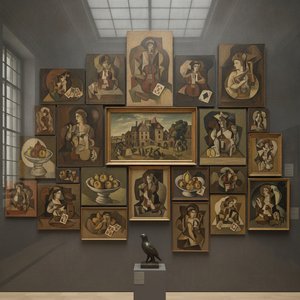 Mastering Cubism: The Top 25 Georges Braque ArtworksJourney through the revolutionary world of Georges Braque. Explore 25 iconic Cubist masterpieces, from geometric abstractions to timeless s…
 Master of Color: The 25 Greatest Paintings by TitianImmerse yourself in the vibrant world of Titian. Explore 25 legendary Renaissance masterpieces, from dramatic portraits to soulful landscap…