Send
Send Share
Share
 Details

 Download
 Similars
 Diaporama
 Stats
StatsMadeleine Lafon


 Read More
Hand Made Oil Reproduction
Hand-painted oil on canvas in your size and frame, made to order by our artists. ( Switch to Print Switch to Digital Image)




































Pick from our preset sizes that match the artwork's original proportions.

You may enter your own dimensions to fit a specific frame or space. If your selected size does not match the original image's proportions, we will either crop the artwork or extend the painting with additional hand-painted elements. A digital mockup will be sent for your approval before production begins.
Please note that the on-screen preview does not reflect the actual cropping or extension. Only the mockup will accurately show the final composition.
While custom sizes are available, we recommend selecting a dimension from the predefined list to preserve the original proportions.
After order, OriginalUniqueArt.com team will email client for instructions and provide a mockup preview
Worldwide Delivery () in 3/4 weeks instead of standard 5 weeks. (17 September). No compromise on quality.

Free Worldwide Express Shipping

High-Quality Linen Canvas

Full Shipping Insurance

Customs Tax Refund Guarantee

True Color Matching Guarantee

100-Day Return Policy (Defects Only)

100% Money-Back Guarantee

Bulk Discount Offer
 Glass option is only available in size under 110 CM

Madeleine Lafon
Reproduction Medium
Reproduction Size
-


Total Price
$ 300
A Symphony in Sandstone: The Ethereal Grace of Madeleine Lafon
In the grand tapestry of the Bohemian Baroque, few works capture the delicate intersection of strength and fragility as profoundly as Matthias Bernard Braun’s Madeleine Lafon. Created in 1725, this masterpiece transcends its medium of sandstone to present a moment of suspended animation, where the heavy weight of stone is transformed into the weightless poise of a ballerina. To behold this sculpture is to witness a masterclass in tension; Braun utilizes a masterful diagonal composition that draws the viewer’s gaze upward, tracing the dancer's form from her grounded stance toward the expressive vitality of her torso. It is a work that does not merely sit in space but breathes within it, embodying the very essence of movement held in a state of eternal, serene grace.
The technical brilliance of Braun lies in his ability to marry the rugged durability of sandstone with the fluid, organic textures of the human form. Drawing deeply from the Venetian sculptural tradition, Braun imbues the piece with an anatomical precision that honors the discipline of ballet while allowing for a poetic interpretation of drapery and musculature. Every curve of the dancer’s limbs and every fold of her attire serves to amplify the sense of motion. For the discerning collector or interior designer, this work offers a sophisticated focal point—a piece that commands attention through its intricate textures and the way it plays with light and shadow, much like the dramatic chiaroscuro found in the great Baroque canvases.
Historical Resonance and Emotional Depth
The historical soul of Madeleine Lafon is rooted in an era of profound spiritual and artistic fervor. As a titan of the late Baroque period in Bohemia, Braun was heavily influenced by the theatricality of Gian Lorenzo Bernini and the monumental power of Michelangelo. This lineage is evident in the sculpture's emotional resonance; it possesses a psychological depth that invites contemplation. The ballerina is not merely a subject of physical beauty but a symbol of disciplined artistry and the triumph of grace over gravity. Her poised mid-performance stance evokes a sense of breathless anticipation, capturing the fleeting nature of beauty and the enduring power of art.
Integrating a reproduction of such a significant work into a curated space brings with it an atmosphere of classical elegance and intellectual richness. Whether placed in a sunlit gallery or a moody, contemporary study, the sculpture’s monochromatic tones and organic shapes provide a timeless aesthetic appeal. It serves as a bridge between the opulent history of Central Europe and the modern pursuit of refined, soulful decoration. To own a piece inspired by Braun is to possess a fragment of the Baroque spirit—a reminder that even within the most solid materials, there exists the potential for infinite lightness and enduring beauty.
Artist Biography
The Bohemian Baroque Titan: The Life and Legacy of Matthias Bernard Braun
In the heart of Central Europe, where the dramatic landscapes of Bohemia meet the spiritual fervor of the Counter-Reformation, the name Matthias Bernard Braun resonates with the weight of stone and the fluidity of motion. Born in 1684 in the small Tyrolean village of Sautens, near Innsbruck, Braun was a sculptor whose hands possessed the rare ability to breathe life into cold minerals. His early years were shaped by the rugged, pious atmosphere of the Stams monastery region, where he began his apprenticeship under the esteemed Andreas Tamash. This formative period in Tyrol provided him with a foundational mastery of stone carving, yet it was only through his subsequent wanderings that his true artistic soul began to emerge from the mountain mists.
The trajectory of Braun’s life changed irrevocably when he embarked on a transformative journey through the great cradles of Italian art. At a young age, he traversed the vibrant landscapes of Venice, Bologna, and Rome, immersing himself in the pulsating energy of the High Baroque. Here, the shadows of Michelangelo Buonarroti and the theatrical, swirling dynamism of Gian Lorenzo Bernini became his silent mentors. He did not merely observe these masters; he absorbed their essence—the way light dances across a furrowed brow, the way drapery seems to catch an invisible wind, and the profound emotional tension held within a single, poised gesture. This Venetian-inflected sensibility, characterized by a certain rhythmic grace and intense psychological depth, would become the hallmark of his later masterpieces.
A Symphony in Stone: The Prague Years and the Kuks Masterpiece
While his roots were Austrian, Braun’s destiny was inextricably linked to the cobblestones of Prague. Arriving in the Bohemian capital around 1708, he found a city ripe with architectural ambition and religious devotion. His ascent was accelerated by the patronage of the influential Count František Antonín Špork, a nobleman whose vision for monumental art provided Braun with the canvas necessary to execute his most ambitious dreams. It was during this era that Braun established himself as a central figure in the Prague Sculptors' Guild, transforming the city’s skyline and its most sacred landmarks with works of unparalleled expressive power.
Perhaps no location serves as a more profound testament to his genius than Kuks. Under the commission of Count Špork, Braun orchestrated a sculptural program that remains one of the pinnacles of Baroque achievement. In the natural setting of Bethlehem, he sculpted the Virtues and Vices, a series of figures that transcend mere decoration to become profound allegories of human morality. These works are not static; they are caught in a state of perpetual becoming, their limbs twisting with an organic vitality that seems to defy the very medium of sandstone. His ability to weave complex theological narratives into the physical movement of stone allowed him to bridge the gap between the earthly and the divine.
Beyond the hospital at Kuks, Braun’s influence draped itself across the most iconic artery of Prague: the Charles Bridge. His contributions to this historic span, including the hauntingly beautiful Dream of St. Luitgarde and the commanding presence of St. Ives, brought a new level of dramatic intensity to the riverfront. To walk past these statues is to witness a masterclass in the use of light and shadow—a technique where deep undercuts create dark recesses that contrast sharply with polished surfaces, forcing the viewer’s eye to follow the undulating rhythm of the composition.
Historical Significance and Artistic Endurance
The legacy of Matthias Bernard Braun is not merely found in the museums that house his smaller works, but in the very atmosphere of Central European Baroque architecture. He was a bridge between the traditions of the Alps and the sophisticated theatricality of Italy, synthesizing these influences into a uniquely Bohemian style. His work represents the zenith of the late Baroque period, a time when art sought to overwhelm the senses and stir the soul through sheer technical virtuosity and emotional honesty.
Even as the tides of art history shifted toward Neoclassicism, Braun’s ability to capture the "drama of movement in space" ensured his permanence in the canon of great sculptors. His life remains a testament to the power of artistic migration—how a young apprentice from a Tyrolean village could, through study and patronage, reshape the cultural identity of an entire region. Today, we look upon his rugged, expressive stone figures not just as relics of the 18th century, but as enduring symbols of human passion captured in eternal, unyielding form.

matthias bernard braun
1684 - 1738 , Austria
Quick Facts
- Artistic Movement Or Style: Baroque
- Artists Or Movements Influenced By This Artist: ['Venetian sculptural school']
- Artists Who Influenced This Artist:
- Michelangelo Buonarroti
- Gian Lorenzo Bernini
- Date Of Birth: February 24, 1684
- Date Of Death: February 15, 1738
- Full Name: Matthias Bernard Braun
- Nationality: Austrian
- Notable Artworks:
- St Jude Thaddeus
- Bethlehem
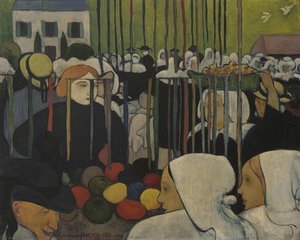
- Market in Pont-Aven
- Place Of Birth: Sautens, Tyrol
Related Articles

Bronze Age to Modern Masters: 10 Sculptures That Redefined Art | OriginalUniqueArt
Journey through art history with 10 legendary bronze sculptures – from Michelangelo's David to Rodin’s Thinker. Explore the stories, techniques & timeless beauty of these masterpieces. Find museum-quality reproductions & elevate your home decor on OriginalUniqueArt.com.

Bronze Sculptures That Defined Art History | OriginalUniqueArt
Journey through art history with our Top 10 bronze sculptures! Explore masterpieces by Rodin, Michelangelo & more. Discover stories behind iconic statues and find museum-quality reproductions for your home decor at OriginalUniqueArt.com.

Theatricality & Triumph: Baroque Drama in Painting & Sculpture
Explore the dramatic world of Baroque art! Discover its history, defining characteristics, & lasting influence on painting & sculpture. Expert insights into Caravaggio, Zurbarán, and Bernini – plus high-quality reproductions at OriginalUniqueArt.

The Enduring Form: Exploring Themes & Techniques in Sculpture Across Historical Periods
Explore the rich history of sculpture from ancient masterpieces to contemporary innovations. Discover key techniques, influential artists & investment potential for discerning art collectors.

The Enduring Form: Sculpture Across History, Technique & Emotional Resonance
Explore the rich history of sculpture with OriginalUniqueArt. Discover key techniques, influential artists & investment potential for discerning collectors. Expert insights into valuing and collecting timeless masterpieces.